Showing posts with label Art. Show all posts

Sunday, November 29, 2009

Koons' lost puppy in Feinin' garden


lost puppy by Feinin 2009
Sculpture, Polyethylene, contains oxygen, oils
Deflates over time

This is the last of Jeff Koon's sculpture. I wanted to give it the same value as one would of his work. Its quite playful as she sits in the garden. I also wanted to give thought to a number of questions addressed.

1. The concept behind the work has no value
2. The materials used has a value
3. The craft involved orchestrating the piece has value
4. The public's reaction towards the finish product has value

Art, is it a hustle?
1. No, but art is generally despised

When I look at great art, I am never thinking, "Oh I could have done that myself."
1.Great Art withstands a millennium

.........................................................................................................................................................................

IN DEFENSE OF CONCEPTS
by Ben Davis published by permission

Is it becoming cool to hate conceptual art? Recently in the Guardian, Adrian Searle wrote about being asked to take part in a debate at Oxford University. The proposition under consideration was "This House believes that conceptual art is no art at all." Speaking for conceptual art, Searle describes being stunned by "the general cultural ignorance" on the other side, "the unexamined prejudices, the kneejerk anti-intellectualism and cultural suspicion of contemporary art." What exactly Searle’s foes thought the word "conceptual" meant is not totally clear -- it was certainly not limited to the esthetic puzzles of Joseph Kosuth. The term, seemingly, has spread to cover anything that involves an idea at all, and it is often used as an epithet, as if the person speaking really wanted to say "trick art."

The Guardian article struck a chord with me, because of a sense I have had lately, a sense of coagulating ignorance surrounding the art world. Maybe I can chalk this up to Twitter, where one can survey the vast, mixed-up spectrum of opinion on art, all in one place. Or maybe it was the trailer for the recent comedy (Untitled), which looks amusing but also seems to be satirizing the pretentions of the art world of 20 years ago (The preview contains a spoof of Robert Gober and, yes, Robert Rauschenberg.)

What is certain is that my uneasiness received a potent kick from a New York Times op-ed last month by Denis Dutton, a critic who has been everywhere this year, from the Colbert Report to NPR. Appearing under the oh-so-witty title "Has Contemporary Art Jumped the Shark Tank?," Dutton’s Times piece was an assault on all things "conceptual," a term he uses in the same loose way as the Oxfordian anti-conceptualists. The California-born, New Zealand-based Dutton is an old-hand at anti-intellectualism -- in the ‘90s, he was known for his "Bad Writing Contest," holding up academic prose to ridicule -- but he is an informed person. Which makes his essay all the more striking for its "general cultural ignorance, unexamined prejudices, kneejerk anti-intellectualism and cultural suspicion of contemporary art," to use Searle’s checklist.

Since Dutton seems to be a figure who has been selected to explain contemporary art to the public, it’s worth taking note in detail of the basic errors that he manages to cram into this brief essay:

* Dutton’s archetypal examples of the ills of contemporary art are Damien Hirst and Jeff Koons. He uses these two convenient villains to illustrate his thesis: "appreciation of contemporary conceptual art. . . depends not on immediately recognizable skill, but on how the work is situated in today’s intellectual zeitgeist." Consequently, Dutton implies, art has become a game for insiders with no connection to popular values of art.

What is comic about this is that Hirst and Koons are probably the two most popularly identifiable contemporary artists. Neither can be summed up as opaquely "conceptual" in the way that Dutton wants to argue. You may or may not like Hirst’s The Physical Impossibility of Death in the Mind of Someone Living or Koons’ Flower Puppy, but they are both artworks that have an inbuilt "wow" factor. Arguably, a more informed criticism of these two artists would be that they cave in to the need for flashy, immediately legible spectacle. Dutton concludes his essay staring into a jewelry store window, speculating that there is just something about gems that is naturally fascinating. Which is why, of course, Hirst coated his For the Love of God with diamonds.

* Dutton’s primary concern is to argue that "human beings have a permanent, innate taste for virtuoso displays in the arts," and that "conceptual art" is bad because it neglects this natural affinity (in fact, the article is framed around the conceit that "works of conceptual art have an inherent investment risk," with Dutton seeming to indicate that the art market would do better to reorient around, I kid you not, "Acheulian hand axes.") He completely collapses the notion of "virtuoso display" with handicraft, as if a well-crafted philosophical essay weren’t a "virtuoso display" of its own sort. This, in turn, leads him into two cringingly obvious errors.

The first is evidenced in his claim that, as opposed to the insider gamesmanship of contemporary art, "we are still able, as with the great bronzes or temples of Greece or ancient China, to respond directly to craftsmanship." I guess Dutton thinks that the experience of appreciating sculpture is summed up by surveying it and saying, "Nice bronzework!" or "Wow, they really knew how to put together a temple!" In fact, appreciating art of any kind implies a command of the narratives around it; ancient Greek and Chinese art require a great accumulation of cultural knowledge to "get" them. All art is conceptual if by that you mean that actually having a rewarding encounter with it implies something beyond just the brute facts before your eyes.

Dutton gives a dire warning about contemporary art: "Future generations, no longer engaged by our art ‘concepts’ and unable to divine any special skill or emotional expression in the work, may lose interest in it as a medium for financial speculation and relegate it to the realm of historical curiosity." But my sense is that the average non-specialist visitor walking through the Met’s Greek and Roman Galleries appreciates the works there as precisely that: "historical curiosities." They spend about 10 seconds on masterpieces that have had whole books written about them, take a picture, move on.

* A second error, more crucial to understanding specifically contemporary art, comes in Dutton’s bold call that we should stop kidding ourselves that craft is "a value left over from our grandparents’ culture." I certainly don’t believe that craft is a dead issue -- far from it, I love the limpid paintings of my friend René Smith, who I think is a very good painter -- but Dutton seems to believe that nothing significant has changed that might affect our way of appreciating craft, not just from our grandparent’s time, but literally since the Stone Age! Arguably, the modern definition of the "artist" comes alive at exactly at the point where "art" is elevated above mere craftsmanship -- the birth of the artist-as-intellectual is the thrust of Vasari’s The Lives of the Artists.

But you can go further. Presumably, the value of craft in contemporary art will have something to do with how craft is viewed in contemporary society. If one is engaged in craft labor, one is also better placed to appreciate the craft labor of others. Today’s culture, however, is characterized by the massive alienation of people from the actual processes that produce almost all the goods that make up their everyday life-world, from food to clothing to entertainment. So of course this implies entirely new modes of esthetic appreciation, and gives new shades of meaning to craft when it is employed. People still make themselves things -- cooking themselves meals, puttering around in the basement, and so on -- but it is just a small part of daily experience. Correspondingly, "craft art" is just one color in a very broad rainbow of esthetic possibilities.

All of this is really basic, first-week-of-art-appreciation kind of stuff. So, why does Denis Dutton get a platform in the New York Times? Because he is able to give a sophisticated-sounding argument (Acheulian hand axes!) to something a large number of people feel, justifiably or not. A little while ago, I was sitting on David Cohen’s "Review Panel," talking about five diverse pieces of contemporary art. When the question period began, a hand shot up and a woman demanded of the panelists, as if aggrieved, "Don’t you think that the artist has an ethical responsibility to make their own work? How would you feel as a writer if someone took your words and published them as their own?"

"Well," I replied, "pouring your guts out onto the canvas is one kind of artistic expression. But even within the conventions of things that we normally think of as ‘artistic,’ it’s not the only one: Architects don’t make their own buildings, but we still recognize their labor as creative; choreographers don’t always dance their own work; and so on." Or something like that. I was proud of the answer as a kind of basic defense of a broad-minded approach to art. Immediately, 20 hands shot up, apparently to challenge me. Sensing that we were hurtling towards a quagmire, our moderator quickly steered us back to the artists at hand.

But maybe we should have finished the conversation, if such a conversation still needs to be had. The funny thing is, of course, that if you look around the professional art scene, you would never really know that there was any need to make the case for "conceptual" art, which is by now an established part of the artistic vocabulary that people treat rather casually. But insularity is itself a problem. It might be worthwhile to establish a criticism that revived the sense of how challenging and thought-provoking idea-based work can be, rather than being blasé about it. "Creative minds say arts fight not only for funds, but relevancy" ran the headline of a recent article in the Times of Trenton, reporting on a convention dedicated to "The Arts and the Economic Crisis," and noting that the major challenge arts advocates see in these troubled times is that the broad public might not care about what’s going on in the arts at all.

Ultimately, I don’t believe that this present debate about "conceptual art" versus "traditional craft" is really about those terms at all. The debate is a distorted reflection of something else, with the word "conceptual" standing as a kind of code word. Searle, for example, notes that one of his foes in the Oxford debate, the artist Mark Leckey, "said he was on the philistine side of the debate because he hated everything the YBAs stand for. He wasn't against conceptual art but what he regarded as the pop version of it." Dutton tellingly fixates on the high prices that Hirst commands at auction, arguing that a romantic love of craft would represent a rebellion against shallow economic calculation (as if Peter Doig wasn’t also an auction-house darling).

What people actually mean by "conceptual art" here is art that is not valued on the basis of its real, intrinsic merits, but because of the ideas around it. "Conceptual" is conflated with an "anything goes" mentality, the sense that esthetic values have been compromised by shallow commercial permissiveness. Because "conceptual art" is idea-driven, it is dismissed as a whole as being based on cliquishness and hype. A whole manner of art-making is being conflated with the scene around it, with the specific ends to which some successful artists put it.

No one, least of all me, is going to dispute the fact that there are a lot of smug, half-assed conceptual gestures out there, produced for an in-crowd audience. But there are also good, committed conceptual artists. I’ve always appreciated the Zen-like gravitas of On Kawara, despite having little luck explaining him concisely during my days as a docent for children at the Walker Art Center. (On the other hand, you know what artist kids do love, spontaneously? Rauschenberg. He connects with their love of making a mess.) In this, conceptual art is no different from "traditional" art: There is plenty of interesting painting and sculpture today; there is also plenty of boring, derivative painting and sculpture.

What’s notable about the present attack on "conceptual" art by Dutton and many, many others is that it is a symmetrical, distorted reflection of the very critique of "traditional" art that led artists to adopt diverse "conceptual" strategies in the first place. A great many of these (e.g. process art, abject art, performance art) attracted the zeal of their purveyors in the ‘60s, ‘70s and ‘80s because they seemed to promise some kind of critique of the art market. Traditional art forms like painting and sculpture were -- and still are, in some circles -- considered to be corrupt, because the objects they produce lend themselves to being sold, owned and traded. Barbara Rose expressed this silly conception in a particularly hyperbolic passage from the Partisan Review: "For some time now I have felt that the radicalism of Minimal and Conceptual art is fundamentally political, that its implicit aim is to discredit thoroughly the forms and institutions of dominant bourgeois culture."

The fact that such strategies devolved inexorably into their own sort of market-friendly style just proves a point. On both sides, "traditional" and "conceptual," the perceived ill of the other is actually just the displaced face of the market itself, with its tendency to transmogrify and vulgarize everything. Which should provide a lesson for critics about the kind of promises they make for art: There are no formal or esthetic solutions to the political and economic dilemmas that art faces -- only political and economic solutions. Consequently, the only critical temperament that makes any real sense is an eclectic one that doesn’t build up one or the other side into the answer for problems that they both share.

BEN DAVIS is associate editor of Artnet Magazine

Wednesday, November 18, 2009

Feinin - Cindy Sherman in her later career


Cindy Sherman - Americana

I believe that if you are exceptional, and you have done something that has never been attempted that makes you famous.....Then its all becomes about you. Whether Mr. Hirst is termed as "daemon of genius or destruction? He has denigrated living things for the sake of vanity, and has mocked in his words..."God" . Never you mind...his life continues on a path of destruction, "The Golden Calf" will de-plode in its formaldehyde...


A study of illusion and reality, parody, humour and humanity

In my earlier self-portrait of Damien Hirst; I found myself surrounded by a triumph of good apposed to what I thought was profane. In the feinin, I felt like a circus clown, laughing at my own mortality, yet chocking with grief at the gall of being a piece of jewelry. It was as if I was facing God in the mirror, testing his will and his tolerance for stupidity. Charlatan, mindbogglingly, entertainer, coax, afraid, hat trick, sadness....

What's up? I am above you all, laughing, giggling at it all, my supreme fame and abundance, Cheero. Smile, sublime, fatherhood, counter-plane, bomb exploding off my chest, testing God's creatures, playing a little game with him, his brilliant, cutting edge son. - Feinin

His works may degrade...My writing will never die.

Monday, November 09, 2009

Ahdela Toad - Meh know she well


She beg meh to do she so I do she


Ah tell she dis morning is he, so he say to do he

Lapeyrouse Wall - Peta Donk


Feinin wall - Dem forget I have dem. But meh eh shame me forget dem already...

peter-Doig

Peter Doig - Lapeyrouse Wall

Saturday, November 07, 2009

Proyecto Capital - Alice Yard Trinidad

The Proyecto Capital installation opens to the public at Alice Yard …… Audience members can participate by taking the found coins away. All are invited – Alice Yard

Proyecto-Capital

An artist caught collecting a cent from a drain, Trinidad, West Indies in a project called, “Proyecto Capital” is a collaboration of three artists, Alejandro Mina, Mar Molano and Michelle Isava

Source: Proyecto Capital

Este proyecto parte de la observaciòn. En los recorridos hechos caminando por la ciudad de Puerto España es posible encontrar una gran cantidad de monedas en el suelo, aparentemente insignificantes para la mirada local, pero para la mirada forànea resulta llamativo en comparacion con la ciudad de Bogota y otras ciudades. La idea es recolectar las monedas de la calle y registrar el proceso para luego hacer una instalaciòn que pretende despertar reflexiones frente a este gesto de arrojar y recoger para luego reinsertarlas en la sociedad cambiando el valor capital por el valor simbòlico.

Michelle Isava writes:

“We have collected 500 5-cent coins, 987 25-cent coins, 498 10-cent coins, 7 50-cent coins (although they are no longer in use)…. This installation seeks to give value to what is not valued here in Trinidad. To foreign eyes, coins on the streets are an absurd enigma that represents the extravagance and wealth of Trinidad and Tobago.”

Soon after their The Proyecto Capital slide presentation at Alice Yard on Friday 6th November 2009, Alice Yard announced that guests were free to participate by taking away the found money all gathered in pile located in the centre of the gallery floor. A man then walked to the installation, stooped down and preceded to collect the coins with a hand brush and dust scoop all the money in his bag. The Colombian artists began to panicked as they saw all their efforts being taken away. Only a Cent was left behind as a reminder to never give away your money so freely for the work you have done to earn it. He then offered the money to the audience by allowing them to take a hand full from his bag. Some did, others did declined and ten he left Alice Yard with total sum of money estimated to be $300.00.

m-a

Miss Cassava, yeh eh see meh coming?

Me ain’t know why dem artise does do per-formance in middle of de road counting coins dem does find in nasty canal, deep pothole and drain. I does hope dem does wash dem finger and toe nail after. I big art installation and me scan d money already. Dem talk, dem show pict-ture, den dem clap. Talk over is show now to see. I see dis Cassava bleed inside she, when dem say TAKE DE MONEY IS FREE, is blight who say it and I obey he and full meh bag quick wit dust pan and brush. No pict-ture please.

Den all fight break out wit
Alice Yard man who steups. Dem all looking like ass when realize is early. I say I offer dem de money and some take hand full and is right because de rest LEGALLY is mine. I take meh time, watch de woman bicycle at Brooklyn bar den is straight to Cassava Cassava and I ask she to put meh bag content in ah black plastic and plop it dead centre on she child bed like is show in de Alice Yard box. When Cassava reach she home, she bawl out, ” Oh Mami,” but is when she see de note and all de coins, is steups and laugh at de same time. If she open she el Espanol mout, is prison I sending she. Is lessen I teach dem whatless fools to give way prize so quick.

Thursday, May 14, 2009

Buxom love goddess Hohle Fels found estimated to be 35,000 years old

Dolly Parton's maquette unearthed, Greatgrand to Venus of Willendorf

A bone sculpture of a female goddess less then two inches in length and having the likeness of an Indian deity. No, no its not a plucked chicken

A figurine, unearthed from a cave, called Hohle Fels in Schelklingen, Germany in 2008 was unveiled publicly. It may be the oldest sculptural carving created by human hands. Anthropologists believe the doll to be at least 35,000 years old. The ivory Venus figurine may shed light over male desire for sex and reproduction. It could have been carved by a youth as a gift to an admirer, made over many hours of idle time. No internet, not porn, no Playboy magazine, just a dark damp cave, and a shell scraping at a husk. I'll like to met her someday, we could be friends, Those breasts, Boy oh Boy, that flat rump, wow, those razer sharp lips, ahem..

Wednesday, May 06, 2009

Terrible relics from the 16th century on Auction

Never in your wildest dreams would you think that any God would allow these movements to exist. Only the lowest of man would devise such a heavenly pain device to enter his mind. His blood, his generations shall bear his deeds


Dachau concentration camp, Munich, 1933


It may be the Bridle of Shame, the Wheel, the Judas Cradle or any given relished name by the agents to punish a victim and shred them apart, The Guernsey's Auction House in New York is auctioning off their 16th century Torture relic collection which they privately own. The proceeds are to go to Amnesty International and other organizations committed to prevent the use of torture Worldwide in these modern times.

This comes just after the recent debate over United States instigating levels of torture in its interrogating prisons. This may be a guilt trip to purge generations of blood and death stained into these devices, and in their possession. The Guernsey's Auction is the most extensive collection of historical torture devices, and over 252 items including artifacts, rare books and documents are to be sold to a buyer without a fetish for pain or having something that causes much of it. Eccentric collectors may relish over getting the original Rack to place side by side to their copy. Careful, objects carry a history.

Before Marcel Duchamp and his conceptual readymade "Fountain", 1917, these objects serve a function, with a less desire to be tested over its meaning or in its participation


Spike chair designed to torture to death by weight of the victim. These relics are considered works of Art.

Saturday, May 02, 2009

Isabella Rossellini act of wonderful indecency - Green Porno


Its called Breading, Madonna

Isabella Rossilini has produced a series of educational short clips illustrating the mating habits of God's Creatures, Great and Small by playing both sexes in mammals, reptiles, arachnids and cold-blooded aquatic vertebrates as she explains how they procreate as her in the spotlight. This is the offspring of National Geographic and Sesame Street parents. The costumes are large paper sculptures and Isabella Rossilini portrays her character with a sense of humour, coyness and with a tingle of naughtiness and humanity. Then I die because we all have too, she laments with her Limpet shell hat made from pleated sheets of construction paper. This is after she proclaims, I the closest male to her body will become female, we are sequential hermaphrodites. Green Porno is really about the cycle of life produced beautifully and choreographed with a tactile quality.

The current series is part 2 produced by the Sundance Web channel as a form of public sex education which can't be objected to. Rossellini should look into the mating habits of Humans to pinpoint the idiographic behavior when they are in heat. Yet, her spider episode brings some truth to how some men view big powerful women.

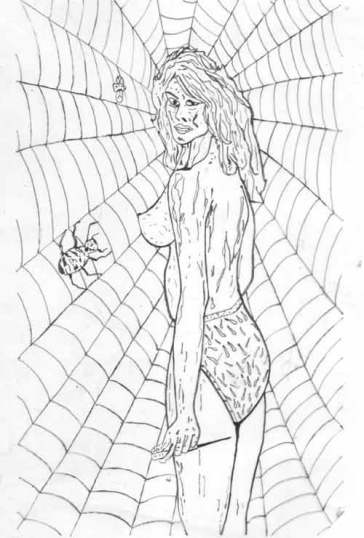
man-eater

A drawings copied from a wall painting 2001, Trinidad. Madame man eater and her web

.............................................................................................................

The actress, model and famous daughter of Ingred Bergman, Isabella Rossilini has come up with the most beautiful and intelligent documentary series since the likes of Carl Sagan and Jacques Cousteau. She uses soft sculptures of all types, and discusses some extremely adult subject matter with great humor and sensibility. Not since "Sister Mary explains it all," have I seen such delightful short bits of information delivered with so much freshness and creativity. You can catch the shows on the
Sundance Channel. - Adele


The mating habits of a Whale and links to other creatures below

Limpet
Barnacle
Starfish
Anglerfish
Why vagina
Spider
Fly
Earthworm
Snail
Bee
Praying Mantis
Dragonfly
firefly

Tuesday, March 24, 2009

kanye West outdoes Jeff Koons

Why collect contemporary art when I can manufacture it myself


Scanning imaging clay model technology projects a composite mold of kanye West

The American rapper kanye West has focused his attention on producing a fabrication of himself using a photographic device that can mold the entire body by the process of scanning. The computer generated image can simulate the likeness of the subject as it passes over the contour of the model. The results is art in itself, more poetic then Jeff Koons' Micheal Jackson statue. These photographic compositions are likely to set the boundaries of the art of the self with the art of technology.


kanye West holograms himself in clay is far better than Damien Hirst's medical cabinet

West should toy further with the idea of erotic imagery with whoever or whoever he desires, or that of self masturbation. Madonna would be deeply pissed. Nevertheless, it has been done before in its primitive colour photographic genre by his predecessor Jeff Koon having sex with his wife, Ilona Staller, but West wins over with the photographic concept that places himself in the position of mortality and leads him straight into the Museum of Modern Art. What possibilities for the future.....

Wednesday, March 18, 2009

Murmurs of Earth - The Blueprint of Mankind

The mystery remains, the cosmos is a gateway if we allow ourselves to think the possible, I say this for future generations solely in awe of life...


The Voyager space craft's Golden Record

This diagram is the given instructions to operate a disk called the Voyager Golden Record which was launched with the Voyager spacecraft in 1977. It contains visuals and sounds to portray the types of life and culture on Earth. Such a device would probably be laugh at or destroyed if it was found in hands of other life more or less intelligent then ourselves. As with the cave painting discoveries in France, the pictogram is an example that art or the act of drawing geometric symbols is the key to all life, etched here on this golden disk. The statement below was part of the intergalactic journey of
the American Voyager spacecraft.

If one such civilization intercepts Voyager and can understand these recorded content, here is our message: This is a present from a small distant world, a token of our sounds, our science, our images, our music, our thoughts and feelings. We are attempting to survive time so we me live into yours. We hope someday to solve the problems we face to join a community of galactic civilization. The record represents our hope and our determination, and our good will in a vast and awesome universe. - Jimmy Carter, June, 1976


A plaque placed on board Pioneer 10 in 1972 and Pioneer 11 spacecraft in 1973. "Hey white woman stand up straight"

It would have been more practical as a self generated device encased in a indestructible sphere. As you shook it to see what it was, the motion would generate power and trigger on a holographic image. The audio should be samples be our heart beat, nevertheless the following montage is an example of what we look like to the outside world. Who knows, the aliens we are in search of may derive from ourself millions of light years ahead. The universal elements of life; Magnetics, electricity, fibonacci spiral, light, magenta, cyan and yellow.

In a dream, I remember seeing the vision of the statue of David as an epoch to the end of the World. Somehow the Sun had died and this was a reminder that only art survives the test of time.


A montage of the pinnacle individuals that left their mark in history on this planet, earth. We will be remembered in a vast universe that we accounted for something, fractions of light if so be......We have already passed

The compilation in the following order; largest bomb ever tested, the Tsar, the bombshell, Josephine Baker, Metropolis, LL Cool J's fly girls, Nadia Comaneci, Diego Maradona, Muhammad Ali, break dancing, Rudolf Nureyev, Pablo Picasso, first television felix the cat, Jesse Owens, Aboriginals dancing, Arnold Schwarzenegger, Marlon Brando, Bruce lee, Albert Einstein, character, Who shot J.R. Ewing, Tank man, Bugsbunny, Martin Luther King, Coco Chanel, Marilyn Monroe, Y2 rocket, the beloved Laika, Apollo 11, Michelangelo David and finally, an aboriginal from Australia. The sound track taken from the radio sounds detected during the Voyager bypass of Jupiter's magnetic field.

Saturday, March 14, 2009

King of conceptual art - Francisco Cabral 1980s

For instance, if you want to take this tri... triptych right


Francisco Cabral's chair at the National Museum of Trinidad and Tobago. The work incorporates a panoramic view of what is believed to be a fort

This captured television clip of Francisco Cabral gives a glimpse over the meaning and conceptual backing of his sculptural work. Cabral is considered to be one of the most revered artist from the 1980s. He is noted for his construction of steel high chairs, and his work is part of the permanent collection of the National Museum of Trinidad and Tobago. His chairs speaks of leisure, privilege and restrain on these sunny Caribbean islands.

In the interview, he describes one of his works, Coffin kite as to neutralize the polarizing factions to what constitutes Indian, African art and more relevant, Trinidad art. In Coffin kite, a skeleton is placed in a coffin using machine cogs to form its structure, he also conglomerates the social classes by using cultural elements in it, but separates his own ethnicity by giving a generalization to whose sociological grouping this particular work should be placed. He says its African because it carries that aesthetic value in it.

If you read more into this, he is really leading the Christians to the lion's den stressing that machines can never replace the image of man himself. " We have go off on a technology race, and has neglected man who is a completely human being. He is total, he has so much more to explore within himself as an individual that being neglected all because technology is used as a measure of man' development which it totally incorrect, it is external, it really has nothing to do with man.". No other artist since then has had that this level of conceptual incite.


A short clip of Francisco Cabral on Banyan television

Thursday, February 05, 2009

Above Group - Branding a talks series


L.A.M.E - Chris Leacock - Bold and Beautiful beauty competition screened at Abovegroup, Trinidad West Indies

At the Abovegroup Branding agency at the former CCA7 building, a launch of a series of visual presentations hosted by artists commenced with the photographer, Alex Smailes and painter, Che Lovelace. As to kick off the series, Mr. Smailes showed his portraits of a competition that involved cone speakers which appeared to be a deejay sound off in the fields near Piarco with the large speakers mounted on vintage cars. The recordings, Smailes joked were old 78 R.P.M. Indian love songs from the 1950s. Each Datsun 260c or Hillman Avenger Saloon for an example were fitted with an amplifier / record player / 8track tape deck and operated by slick oily hair comb back deejay. Che Lovelace presentation surrounded a lengthy description of his paintings and process soon to be a published as an Artist book later this month.


What is a "Mic Man? Alex Smailes explains his new work about to be published by Intersection magazine.

Gareth Jenkins explained that these monthly events at Abovegroup can follow the following disciplines: Graphic Design / Photography / Advertising / Branding / Writing / Poetry / Illustration / Architecture / Interior Design / Furniture Design / Landscape Architecture / Urban Planning / Typography / Identity / Chocolate Blending / Spirit Blending / Publishing / Fashion Design / Retail Design / Jewellery / Sculpture / Music / Film / Animation / Fine Arts / just about anything else.

Friday, December 12, 2008

My leisurely Sunday stroll - Art at the Oval


A public Art project supported by private sponsors under guidance of the Trinidad Art Society located at the Queen's Park Oval, Port of Spain.

The Queen's Park Oval wall has a face lift after it was painted white for the World Cup Cricket venue in 2006. The entire wall has been placed with large posters showcasing the who's who in local contemporary art. This is to spruce up the capital and give the public a look at art where they may have never seen it before. The vinyl posters are to be up until Carnival 2009.


Men at work, the Queen's Park Oval, Tragarete Road, Port of Spain.

What needs to be done to make this project benefiting.

1. The
Trinidad Art Society should include walking tours of the space open to the public by someone who is knowledgeable on the subject.
2. Target the community, schools, elder homes, disable people etc.
2. Invite artists to talk about their work.
3. Make it aware that high quality reproductions of the work are available.
4. Rotate this exhibition in other places including on the island of Tobago.


The Queen's Park Oval mural spared by the onslaught of carnival mas, 2009

Thursday, November 20, 2008

Postmodernity of the future - R. Mutt II


Fleurs dans un vase, 2008

Sunday, October 19, 2008

Art Crawl - Port of Spain


Adele Todd with Shastri Maharaj at Y gallery, Port of Spain

My friends and I took the opportunity to go see Shastri Maharaj’s show at Y Gallery, Jasmine Thomas-Girvan’s jewellery show at SoftBox and Che Lovelace’s show at the Trinidad Art Society space. We were also able to pop by More Vino to see the work of Shalini Singh. We never got to In2Art to see Jackie Hinkson’s group show, but we shall rectify that very soon, when during the coming week we go off to see the jewellery exhibition of Janice Derick. The Christmas season is nearing, and artists’ shows are coming fast and furious. That is a good thing, as there are so many things that people have to pay for if they want to be entertained, and an art show is one that is free of charge.

This Art Crawl, which basically is telling a group of friends about a number of shows that are on, plotting where they are situated, having everyone park at the furthest one and then car pooling to the others. Is a good deal. We get to spend the entire day focused on the work, and if the artist is there, as was Shastri and Jasmine, then that makes it even better.


Shastri Maharaj's work representing aspects of the people of Trinidad and Tobago

The atmosphere at Y Gallery was practically festive as Shastri walked in. The space is naturally very bright, and for his body of work, thirty-six pieces, there was an opening up of new approaches. He continues to have the women on the plains, and the homage to Indian miniature, in such work as Lingam. But he also has a series of sensitively painted individuals with folksy titles like, “Uncle Ralph” and “The Housekeeper.”

Jasmine Thomas-Girvan’s show, Gems, is a visual delight of discovery, as she choreographs the space as well as entertains the eye with s prodigious one hundred pieces of work! The level of detail never grows stale, as every single piece is filled with enough whimsy, skill, charm, colour and shape to keep you lingering on and on. She also has a running film of her work, in case you may wonder how the piece looks from another angle or in another context. She has included bits of writing with some works that also inspire.

Shalini Singh’s show at More Vino, are long rectangular paintings that recall the work of Carlisle Chang in the early seventies. His look at Mas. This may be because of her colour choices. These panels are very affordable and decorative.


Che Lovelace at Gallery 101, Trinidad

By contrast Che Lovelace’s show at The Trinidad Art Society, fourty-four pieces of varying sizes, are carnival conscious. That is the theme he plays with, and like Singh, something in the handling suggests paintings in Trinidad and Tobago from the late 1950’s early 1960’s. The painting style is chock full of a past history, and in some ways despite the festive theme, there is an underlying sadness there. Mr. Lovelace uses a number of painting styles, dry brush, dripping,light application and dense colour tones.


Stuart Hahn with Adele Todd at Jasmine Thomas-Girvan's jewelery exhibition, softbox, Trinidad

All of the shows, save Ms. Thomas-Girvan's Gems', could have been better served by a bit of editing, as in every instance the space used was packed with work. It was difficult to enjoy one piece when another stood so closely by, competing for attention. This is always an issue for me. How a show is hung is as important as what is shown.We enjoyed going out together and having a chance to see several shows at once. We are looking forward to the shows to come, to do it all over again.

Monday, September 08, 2008

A thing is more important than me - Damien Hirst


No more butterflies no more spin painting

The British artist Damien Hirst has put two hundred works of art on auction at Sotheby's. The artist explains his process of art practice is more like as being an architect, and artists don't necessarily have to do the physical work. The business he oversees has a staff of 180 people and operates from nine studios. He also reflected what a museum is, a dusty gallery that hangs dead artist's work and that his work at Sotheby's is more like a retrospective.

The auction, critics believe, is gamble for the artist and for the art market. if buyers fail to bid at all, the fallout will have a domino effect of the true value of contemporary art. This may be a study which may yield a more realistic value of his work, and cause a tumble that you really don't have to pay for something you really don't want. Come judgment day.

During the BBC interview, Hirst simplified his work as butterflies, spin and spot paintings and said he is working on producing one spot painting. The l
ogistics is of a two metres by four metres painting which will contain over a million dots. The work he says will take twenty years or for the rest of his life to complete. His description of the mythical object, the golden Calf produced after his diamond skull, Damien Hirst palms it off as a traditional image from a long time ago. If this clearance sale backfires, Hirst should step away from his art and rethink whether trying to constantly bet himself causes more harm than good. Its not about the money. See the Damian Hirst - Mythology to God


The artist Damien Hirst is selling his work at the famous auction house Sotherby's. This latest 'antic' of his has played right into the hands of those who love to give him free press. The question that I am posing in this article is, what exactly is Mr. Hirst saying about art right now, and what are the implications of his actions?

I have stated in the past that an artist is an entertainer. Mr. Hirst knows this as a certainty. He has been able to draw attention to what he creates and he has more importantly encourage sale for what he makes. He continued in my opinion, the dialogue begun by the very prolific Jeff Koons, who as far as I am aware was the first to float an object in a tank of water as Art.

Not every work created by Mr. Hirst in his career has been remarkable, yet, he has managed to propel himself off of the controversy of his taxidermist centred works in tanks.

These works are indeed beautifully constructed and leave a haunting message, and they have gone on to influence fashion to graphic design, one of the many tests of the power of an artists' skill. It cannot be argued that Hirst has brought some needed fire into the arena of Art today. Love him or hate him, most people cannot dismiss him. Yet, this latest manouvre of his, to sell his work at auction has left me feeling a bit cold. To me the work looks less like the sweat and rigour of a master, and more like the traversed movie set of a Tim Burton.

I do not say this easily. Listening to Mr. Hirst explain his golden calf piece, in the biggest gilded tank built for it, was painful to listen to. He sounded like a gauche billionnaire boasting about something that no one would want to create in the first place. Of itself,the calf is a reflection of mythology and religion, now seen in the context of the present. It is actually quite dramatic to look at. But Hirst's explanation of it dumbs it down to a Liberace-like spectacle and not the remarkable object that it portends to be.

Is it possible that he is suffering from too much publicity perhaps? An artist able to make millions of pounds for his work is a wonderful thing. An artist who can command public attention on the scale that he does is also a boon to the artworld. The auction houses are known for selling the works of dead artists for fantastic prices. Hirst is getting attention for doing so for a living one. He is testing the boundaries of the art market and putting himself out in a risky way. All of this can backfire, and that is his challenge to himself. He is at the top of his game with very little else to prove. Is it possible that he is now becoming redundant? Is it also possible that he is too successful and we are now watching the decline of a once great artist?

Perhaps, but he certainly took us on an exciting ride. - Adele

Sunday, August 31, 2008

Peter Doig, and the Man with the umbrella


A poster highlighting the Trinidad and Tobago's film festive 2008 by using the work by the Scottish painter, Peter Doig. Doig's rendition is of an eccentric man who wandered the streets of Port of Spain. His composition is quoted from his original painting, Lapeyrouse Wall

Why is it that it takes the casual observation of an
international artist to see what we take for granted every day? In the work of Peter Doig, Man with umbrella, he captures the steady gate and avid quirkiness of one of our many local characters of the savanna. You may still be able to see this gentleman with his umbrella on any given day if you look with care, minding his own business and looking very relaxed with himself. He wears shades and is very clean. I used to look at him often and one day when I was going to school I approached him to let him know that I found his style very unique and interesting. At that time, I would see him in different shirts with images on them made from bits of fabric. Sometimes he included text too.

The man was walking
Performance Art. On my approach to him, he listened to what I had to say and then went into a slow but steady bizarre statement about himself and God. I thanked him for his time and went on my way. We have several loners who may be homeless, may be mentally challenged or may simply be eccentric in our midst in Trinidad and Tobago. I am happy to see Mr. Doig giving this particular character his dignity in paint for posterity, for when the high rises replace the gingerbread houses completely, there shall be a lovely frozen memory of simpler times. - Adele

See all listings under Peter Doig

...................................................................................................................
In its third year, the Trinidad and Tobago Film festive is screening a body of work by Trinidadians and Tobagonians including a host of international filmmakers who have their roots from the Caribbean. The two week festival will give the public a taste of independent film and what it takes to be filmmaker through a series of workshops detailing the process of the craft. The festive begins on the 17th September, 2008

The following list are the films to be screened via the Trinidad and Tobago Film Festival

Disclaimer:

Views expressed on thebookmann are not affiliated with any Art Organizations and an “Art Review” may be open to interpretation as it is an observation at face value.

Amendments to such articles if misleading or with grammatical errors shall be corrected accordingly.

All photographs, Feinin studies, accompanying quotes, articles and visual headers appearing on site are the exclusive property of Richard Bolai © 2004 - 2010 All Rights Reserved.

Any fare use is restricted without written permission