Showing posts with label Exhibitions. Show all posts

Monday, May 25, 2009

Preparing for CEPEP - UWI graduating Art class of 2009

Brothers and sisters, I learnt a great lesson here. Never believe in something that does not believe in itself. Never try to help when help was never asked of, never tell the truth when truth does not want to be heard and never consort with those less of you. Only believed in the beauty which Art can bring
.....................................................................................................................................................................

Art of the times, Obama, Kanye West, Sex, Death and the casualties of being too casual

Steve Ouditt, chair of the department well wishing his graduating students to a public who he stressed may not fully understand the artwork produced for their UWI DCFA credited degree

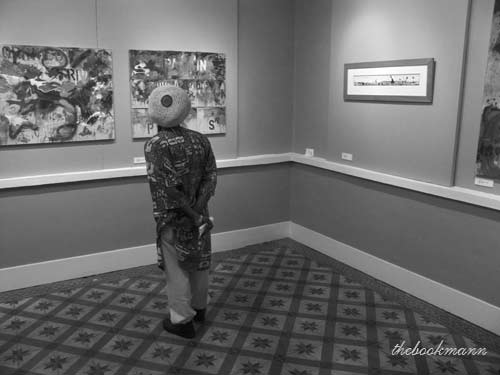
Any student who graduated from the the Visual Arts Unit of The University of the West Indies (UWI) Department of Creative and Festival Arts (DCFA), 2009 should ask themselves a key question. Can what I’ve learnt over these four years make me feel confident enough that where I am about to venture into…………, that my qualifications in this field will pave the way to a prosperous and fulfilling career. If anyone paid close attention to the speeches at the open day exhibition, there would be a certain doubt placed on the graduates as to say their art and concepts may be too high to grasp or esoteric in its field. One grasp is that this show reflected work no less than first or second year standards. Works located on the periphery of the main space should not have been accepted.


Seven look puzzled at UWI graduates concepts on Art practice.

Yet, the spoken consensuses was the general weakness from the variety of installations, paintings, sculptures, industrial design pieces which were placed in spaces that were too small. Students opted on the readiness of technology to make a collage of photocopies or that of found objects, video projections as if the four year old brief was executed as a final over the past weekend.

This is not to say that a genesis an of idea can’t happen. An immediacy can give you a rush. But here needs to be practice in the same relationship you would like seen with a tailored garment, a nicely designed pair of shoes or an ergonomically functional mobile phone. Four years of learning a craft. Perfecting it and understanding it. Art is supposed to give hope in a world bombarded with consumerism and throwaways. How many students who showcased publicly their best efforts are eager to re-assemble, functionally use or reinstall their artworks in their living rooms and live with them honestly? Dear graduating class of 2009, your journey has just begun.

Khmama Cox’s cd cover cases which merged as Barack Obama and made up of people of colour who have left their mark in history. This is similar to the photographic work by chuck close. It would have better produced in colour, yet it would have been more difficult to construct the variable tones. See Lisa Brice and Adele Todd’s exhibition, Paradise


A video by Natasha Mahabir debating the etymological use of the word CUNT, one of the stronger works from the show – I rather much prefer, ” He lick down meh nanny – Soca lyric”

Issues and reasons, hypothetically:
Lack of classroom space, lack of equipment, lack of workshops to build work properly. And a credited degree viewed as an easy one to pass. Remember this is Art, I could pelt things together and write something on it knowing that I don’t even understand. – No rocket science in dat.


Friday, May 15, 2009

Nicholas Emery - Stroke of married genius


Nicholas Emery at Soft Box Studios, Trinidad

An unknown painter, Nicholas Emery has released what appears to be Art. This is said with the fondest of intent as his compositions reflect the urban landscapes purported to be of Trinidad and Tobago. Abstractions and figuratively they, meld as buildings, streets and construction beams are painted with a warm temperature that differs of the Caribbean, as a place much hotter and dryer, desert like in its ambiance.


Work such as the Passage way is painted with a vortex of concentric boxes, with buildings confined by outlines using a pallet of pinks, yellows and oranges with streaks of white to tone down the deeper hues. New York and Midnight acrylic canvases are very beautiful by the manner he places on the simple outlines to enclose the gangly structures. The skyscrapers are stacked with notes scaling across warm rich colours set to a backdrop of cobalt and navy blue. Midnight is a winding motif expressing a pitch black night scene under a full moon with a branch swaying in the foreground, beautifully composed and painted. This man is a colourist, its what he sees with his childlike demeanor.

artisst-22

Nicholas Emery at a show that earlier was packed to capacity

Other paintings are a matrix of a urbanised planning, with buildings stacked against each other like a hodgepodge of dwellings deflecting sunlight off the Laventille hill. Yet, Mr. Emery is not as successful at estimating when to stop painting, as tempting as it seems, an overworked canvas can loose it subtlety and become too heavy in its muddiness. One or two suffered in that fate. Forgoing the minor detail, this show is well worth a look.

Nicholas Emery has been painting for over fifteen years and was born in Trinidad of American parents, his exhibition Urban Introspective runs till May, 30th, Soft Box Studios,Trinidad, West Indies

Sunday, October 19, 2008

Art Crawl - Port of Spain


Adele Todd with Shastri Maharaj at Y gallery, Port of Spain

My friends and I took the opportunity to go see Shastri Maharaj’s show at Y Gallery, Jasmine Thomas-Girvan’s jewellery show at SoftBox and Che Lovelace’s show at the Trinidad Art Society space. We were also able to pop by More Vino to see the work of Shalini Singh. We never got to In2Art to see Jackie Hinkson’s group show, but we shall rectify that very soon, when during the coming week we go off to see the jewellery exhibition of Janice Derick. The Christmas season is nearing, and artists’ shows are coming fast and furious. That is a good thing, as there are so many things that people have to pay for if they want to be entertained, and an art show is one that is free of charge.

This Art Crawl, which basically is telling a group of friends about a number of shows that are on, plotting where they are situated, having everyone park at the furthest one and then car pooling to the others. Is a good deal. We get to spend the entire day focused on the work, and if the artist is there, as was Shastri and Jasmine, then that makes it even better.


Shastri Maharaj's work representing aspects of the people of Trinidad and Tobago

The atmosphere at Y Gallery was practically festive as Shastri walked in. The space is naturally very bright, and for his body of work, thirty-six pieces, there was an opening up of new approaches. He continues to have the women on the plains, and the homage to Indian miniature, in such work as Lingam. But he also has a series of sensitively painted individuals with folksy titles like, “Uncle Ralph” and “The Housekeeper.”

Jasmine Thomas-Girvan’s show, Gems, is a visual delight of discovery, as she choreographs the space as well as entertains the eye with s prodigious one hundred pieces of work! The level of detail never grows stale, as every single piece is filled with enough whimsy, skill, charm, colour and shape to keep you lingering on and on. She also has a running film of her work, in case you may wonder how the piece looks from another angle or in another context. She has included bits of writing with some works that also inspire.

Shalini Singh’s show at More Vino, are long rectangular paintings that recall the work of Carlisle Chang in the early seventies. His look at Mas. This may be because of her colour choices. These panels are very affordable and decorative.


Che Lovelace at Gallery 101, Trinidad

By contrast Che Lovelace’s show at The Trinidad Art Society, fourty-four pieces of varying sizes, are carnival conscious. That is the theme he plays with, and like Singh, something in the handling suggests paintings in Trinidad and Tobago from the late 1950’s early 1960’s. The painting style is chock full of a past history, and in some ways despite the festive theme, there is an underlying sadness there. Mr. Lovelace uses a number of painting styles, dry brush, dripping,light application and dense colour tones.


Stuart Hahn with Adele Todd at Jasmine Thomas-Girvan's jewelery exhibition, softbox, Trinidad

All of the shows, save Ms. Thomas-Girvan's Gems', could have been better served by a bit of editing, as in every instance the space used was packed with work. It was difficult to enjoy one piece when another stood so closely by, competing for attention. This is always an issue for me. How a show is hung is as important as what is shown.We enjoyed going out together and having a chance to see several shows at once. We are looking forward to the shows to come, to do it all over again.

Sunday, July 20, 2008

The state of Patrimony


Patrimony at the SPACE, Trinidad, West Indies

At the SPACE gallery, Trinidad, artist Adele Todd shows her dimensional embroidery sculpture called Patrimony. The installation is expressive of the political state of Trinidad and Tobago and was described as a derrick and fragmented embodiment which the country is leading towards. Read the artist statement


Patrimony has been extended from July 28th till August 1st, 2008.

Wednesday, April 30, 2008

Ideas - Exchanges- Experiences - UWI Art

UWI students get it right


Drawing by Nicolai Noel shown at the National Museum of Trinidad and Tobago

I ventured in to The National Museum on Friday to see the latest University of the West Indies student show. I was very pleased with the results. The only little issue I have is in the annex space. The work in that space looked like the poor step-child next to the wonderfully finished displays in the main gallery. At last the students are coming into a maturity in regard to process and presentation. There are definately reasons to go take a look. Pottery with a sensitivity by Adam Williams, gorgeous experimental bags made in mesh by Linda Goodridge, A super modern, whole grown art piece by Kim See Tai, a really tongue in cheek, cheeky, clever installation sculpture by Eden Bissoon and a lovely fractured canvas of riotous colour by Seema N. Pustam are all worth the trip. After many posts about my concerns about what is being prduced at UWI, this show is on the right track. - Adele

Wednesday, March 21, 2007

Radical Art - But Not Jeans

When it comes to charity why do people give seconds?

Last November, Radical Designs sent out an invitation to local artists to participate in an Art project using a pair of their jeans. The idea was to produce a piece of Art which would be later exhibited at their store and then the pieces where to be auctioned off for a chartable cause. The exhibition was scheduled for February 2007, but nothing was hear. Carnival came and went, until tonight, and to a packed house at the Annex of the National Museum in Port of Spain, Trinidad where sixteen artists including a work by Dianne Hunt of Radical Designs are on show.

Here was the opportunity for artists to alter a pair of jeans into a couture work which could be worn as a work of art, but many of the artists kept within the literal boundaries by using quilts, beads, laced or incorporated doodles and three dimensional objects into a pair of Jeans. The exhibition looked like a farce as its justification for the such poor work is a reminder that the freedom to have an artistic expression may not always equate in its excellence. The curatorial decisions should have been more stringent.

The list of participants included professionals in the field of dance, architecture, artists, curators and industrial and graphic designers. It is also unclear how many works were auctioned off that evening. The question is whether any of these torn and tatted jeans were appropriate to a wary art buying public who are doubtful to what contemporary art actually means.


A practical approach to the art exercise converting the jeans into wearable art

Radical Designs Jeans Art at the National Museum of Trinidad and Tobago - The Radical Designs Jeans Art Project ends 6th April 2007

Sunday, January 21, 2007

Exposición de Botero en el Puerto de España


The Annex at the National Museum of Trinidad and Tobago is pristine with its bone white walls and a floor which has a reflective glassy polished finish. This is in preparation for an exposition of the Colombian artist, Fernando Botero exhibition posters mounted at Museums throughout Latin America, North America, Europe and Asia. The
reproductions are enough to give the public a tickle of his humor, parody and scope.

Fernando Botero's signature is his large human sculptures and self portrait paintings which are scaled to a size more plumper that expected, yet they have the facets of sensuous nature. Bolero takes a whimsical look by lampooning the World’s greatest art masterpieces in its exaggerated flair and period. The curator has placed one of his posters at the head of the gallery and this is The Heart of Christ as the artist himself. The poster hangs at the head of the gallery as is a reminder of his Catholicism which Catholics in Trinidad and Tobago also partake by hanging the portrait Christ in their front gallery.


The Heart of Christ


In conjunction with this exposition, there is the 12th anniversary retrospective of the Association of Caribbean States, the sponsors of the show. A series of photographs provide a peek into the history of the organization and through this exhibition, the Association of Caribbean States and the Government of Colombia are attempting to unite the peoples of the region by using a cultural exchange that gives art the power to speak. In Columbia, Fernando Botero is considered an icon and is respected and guarded as a treasure of which his works shall outlast any political post.


Visitors to
Fernando Botero museum posters at the National Museum of Trinidad and Tobago

Friday, November 03, 2006

In Search Of ........Galvanize

Finding truth no matter the lie.....


A painting by a street artist on a coconut vendor's cooler around the Queen's Park Savannah, Trinidad, West Indies, 2006

Words rightly put by a street artist, where did we go wrong and why was the art project Galvanize visibly absent, and why did it faltered to ignite any public interest but to soured many of the Artists who took part.

Here are a few clues:

1. If you were told there was more to see but the space was inaccessible to the public. What would you say?

2. If you are told that a video installation is up in a restaurant in Port of Spain and you took the time to go here and nothing is up, and no one in the place knew anything about it. What would you think?


A stencil by Sabrina Charran on a subject too common


3. If you were told that site specific art would be placed in abandoned areas. Where should you look?

4. If you walked across a busy roadway and the gates to a proposed exhibition were closed with no posted apologies. How would you feel?

5. If you had the support of the Art community, an Art organization, television and print media, but still was incapacitated to arouse any public interest. What do you think the agenda of the project was in the first place?


A copy of Nicolai Noel's work stenciled against a wall fifty feet from the street in a abandon lot in Port of Spain filled with garbage. - Was the public expected to walk through the fith to see the small insignificant stencil ?

The project was a big undertaking by the parties involved, and I am unsure whether the objectives were met. Nontheless, the concept in theory was worth attempting. I must state that thebookmann and Adele approached Mr. Lewis regarding the plans for Galvanize as we found that what they intended was extremely close to what thebookmann has been doing for over a year without funding. We suggested video projections of elements from the blog, to be transmitted throughout Port-of-Spain and environs. Unfortunately our suggestion came a little too late, and we were not included. It is essential to make this clear as I continue because contrary to how this maybe perceived, a project like Galvanize is looked upon with optimism, hope and excitement. Such activities are sadly lacking generally in the art landscape of Trinidad and Tobago. In fact Galvanize did not reach (outside of Port-of-Spain or even to Tobago. (Something to seriously look at.)


Tessa Alexander's billboard was locked up in a studio where it should have been opened to the public. Why was this allowed to happen?

My concern was the difficulty I had in getting to see some of the work. for example, Tessa Alexander, Nicolai Noel and Marlon Griffith. These things can happen when an idea has not been completely ironed out. on the other hand, Jaime leeloy produced a thorough project that managed well despite some minor concerns. she was able to use an air conditioned space that she cordened off with a black cloth. She also wisely included a very thorough blog of her working process as a follow up to her work. Leaving nothing to chance. So what was the objective of Galvanize? And was it met? i believe the project helped to prove once and for all the obvious divide between Art and the public at large. it is a very real concern, and needs to be more fully addressed.


Galvanize: A six week programme held as a ‘reaction’ to
CARIFESTA promises a body of work from a group of artists that can be seen all over Port-of-Spain and environs. Oddly, the people who know about Galvanize have the same complaints about Carifesta. They don’t know where everything is located, and they don’t feel inclined to go looking either. - Adele see where it began and the Galvanize launch post. Left: Jaime leeloy's video about the role in which young women are portrayed in her society.

Tuesday, October 10, 2006

The Drawing Room


Helen Kelshall walks through with her clients and discusses in detail, each of the Artist's concepts or history. The most recognised painting in history painted by a Filipino expatriate who is captivated by the Renaissance

The “Drawing Room” is a gallery that places art where it can be best appreciated, and this is in a drawing room. The director, Helen Kelshall says the purpose of the space is to give amateur artists some exposure and the room is full with easels and mounts in support of her venture. But the income comes from her framing shop which in turn supports her passion for Art.


The prospects of seeing the work in right setting may be a good incentive to buy, ie; your living room. The Drawing Room gallery in Diego Martin, Trinidad
................................................................................................................
Terms and meaning - Drawing room means a living room

Thursday, October 05, 2006

Drawings - Finished and Unfinished

But is Carnival, it just have to stand up for two days, trow it after


The Bottom Line Drawing has taken a back seat to landscapes and the like, so I was looking forward to seeing the show, The Bottom Line. An exhibition of drawings by thirteen artists from Jackie Hinkson and Eddy Bowen to Dean Arlin and Akazuru. Walking into the Cotton Tree Foundation I was very willing to reserve my judgement in favour of exploring the works on show, but yet again, I was disappointed by the curation. I asked aloud, what is the purpose of a show of drawings? Framed works were interspersed between rough sketches. Some works were very skilled against others that were mere doodles! I have to confess that I wanted to throw up my hands is disgust because I could just hear people saying to me, why do you always have nothing good to say! Little do they know that I want to be able to have something good to say. I really do. But the problems are always so obvious, so glaring, that I cannot believe that I am the only person seeing them.


I am extremely happy to see so many shows on at the same time. I am very happy to see very different shows, focusing on very different things. I am not happy to see the opportunity to show the best wittled down by sloppy decision making and not asking the right questions of the showing. I am also beginning to wonder about artists themselves, how can you allow your work to be represented so badly.
LeRoy Clarke has some gorgeous drawings, Jackie Hinkson’s drawings are larger than life joys to behold, so imagine my shock to see small sketches by Pat Bishop framed in soiled frames! A person who prides herself on presentation, and then there was Akazuru's installation placed in the centre of the space. Does this mean that drawing can be viewed this way? What is going on?

Can someone place explain this to the public at large! A show like this needed to explore or expose a variety of standards of what drawing is and means to us at this time. Perhaps showing sketchbooks, works in progress and finished studies. At this time, the show looks like a hodge-podge of things with no cohesive centre. - Adele -Temperature – cool Work - cool
Top image : Kimme, Bottom: LeRoy Clarke at the Cotton Tree Foundation, Port of Spain, Trinidad.

Monday, October 02, 2006

A Suitable Distance – Impressions by five artists

Too many pieces to small a space


Of all of the shows on at this time, none interested me more than this one. A Suitable Distance features the work of Roberta Stoddart, Rex Dixon, Kofi Kayiga, Peter Doig and Chris Ofili. The latter two are arguably the most important British contemporary artists of their generation, and it is quite reasonable to say that the show is worth seeing purely for that fact. Anyone who knows something about art at least knows about Mr. Ofili’s piece, Madonna defaced by an irate New Yorker. It is Mr. Ofili’s first showing of work in Trinidad and Tobago. Let me say what disappointed me, and get that out of the way right away. It should be clear by now what it is, the curation. Too many pieces crowding the small spaces. This show deserved to breath. For such large pieces and several smaller ones, the show should have struck out for difference from all other art spaces in Trinidad and really sent a message and stood out boldly for where art should be going. How hard would it have been to gut the building of the everyday working environment in favour of one work per room?


This has never been done as far as I am aware, and the works of Stoddart, Doig and Ofili needed just such attention. Here is an opportunity for the art weary public to really see how art can be, and instead the decision was to pack it in, not to choreograph, and for that, I felt cheated.

Yet, I am thrilled to see the work of such luminary artists in a very new gallery space, what a coup for Soft Box and Andy Jacob who conceived of the show. Here is an opportunity to draw a line going upward stating what art should be, if we really want it to. Five foreign artists explore what working in this place means to them. I must say that this show left me thinking about colonialism and post colonialism, the expat culture and where local art stands at this time. I found that very good for me, as these issues are very real and worthy of discussion. I hope that those who were at the show also took away a sense of provocation about art, and not just the privilege of saying that they saw some work by some internationally known artists and that was all. Temperature – air conditioning cold Work – warm. - Adele


Top: Chris Ofili Cente: Roberta Stoddart (Detail) Bottom: Rex Dixon at "A Suitable Distance" exhibition in Trinidad, West Indies

Wednesday, September 27, 2006

How The Queen Sees Her Empire part 1

Painting an idyllic psychedelic dream


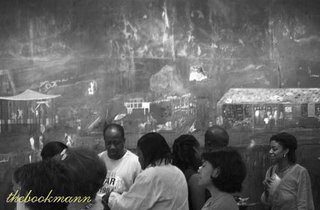
It did not matter if you liked them or not, Here was an opportunity to see in detail the level of art that museums such as the Museum of Modern Art or the Tate exhibit, and the influences which Trinidad and Tobago had transcended itself though two British Contemporary painters. This was an art opening where curiosity packed the house, and in particular to see the paintings by Peter Doig and Chris Ofili in a show entitled, a suitable distance, the impressions of Trinidad by five international artists.


In Trinidad and Tobago, people protect themselves from the scorching heat by using an large umbrella, Doig paints this object with a kaleidoscope of colour. The parasol is an accessory which he incorporates in his work.

Music of the future
is a fairly large oil, (143x95'' 2005) and it is a
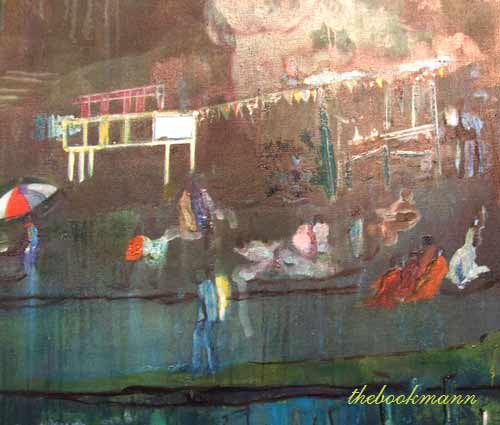
narrative of Trinidad by Peter Doig. It is surreal and whimsical at best and the subject appears to be a typical Sunday cookup set somewhere down the island, yet it is a place unclear to define.

Divided into three horizontal and equal divisions, the centre of painting is mired with dwellings on stilts with a large structure comprising of coloured stones as part of the outer décor. The rusting roof gives it a mosaic look with some sort of social gathering in inside. There are streamer that draped across two structures amidst an atmosphere of fanning smoke to keep a barbeque going, otherwise as the focal point of the cookup.


The artist applies globs of paint to give a particular accent to an individual

Music of the future
has a whimsical impression of Edouard Manet’s loose painterly quality. Doig simplifies this further. The painting is somewhat panoramic with odds and ends and people seem to walk precariously at the water’s edge, while others are reclining on beach towels. This is what Trinidadians call limers. There is also a bandstand that seems out of place and a white public bench that is so large and it gives the work a flat and childlike appeal. In addition, the artist applies globs of paint to give a particular accent, this may be the colour of an individual's shirt. He also applies a wash of greens and blues to the lower half of the canvas as to mirror the refection of water, tranquil as it seems. A boat is anchored at the lowered right, and dabs of black and long white strokes indicate bathers in the sea. A worthy note is that Mr. Doig is able to control the areas where the wash should stop running, and this may be done by tilting the large canvas.

Music of the future has a rich intensity in colour, and the work is most likely to be termed exotic on an international level. It may be confusing to most people as there is no reference point of a place that is so idyllic like a sort of psychedelic dream. Doig's painting could be construed as a just a crude pictorial scene, losing the subtleness of how the artist envisioned Trinidad. Music of the future = Limers down the islands.
.................................................................................................................

It is be noted that Mr. Doig clarified that the concept of this painting comes from postcards from Indian merged with the elements from the Queen's Park Savannah in Trinidad.

Monday, April 03, 2006

Finding A Home - Steelpan or Steelpan Painting?


The Steelpan, conceived by Joseph Charles at the Steelpan Museum, Trinidad and Tobago

What constitutes a gallery or museum space? Is it the white walls? The empty converted space? Or the love of one's work? All of this is prevalent in the choices made by folk artist Joseph Charles who decided to do just that. Mr. Joseph has found a house with white walls and has called the space The Pan Museum. His work was first featured at the National Museum a few years ago with a colour catalogue. Not satisfied with the response to his work, Mr. Joseph decided to do something more. It was here that the museum came into being. Starting anything as serious as a gallery requires a great deal of planning, and Mr. Joesph has attempted to show a chronology of Pan history, using his work as the narrative. He also includes audio of famous and familiar calypso's to go along with the images, as well as artifacts on many of the folk stories about Pan and Pan life.


A popular Mosque at "East Dry River,"Port of Spain, Trinidad

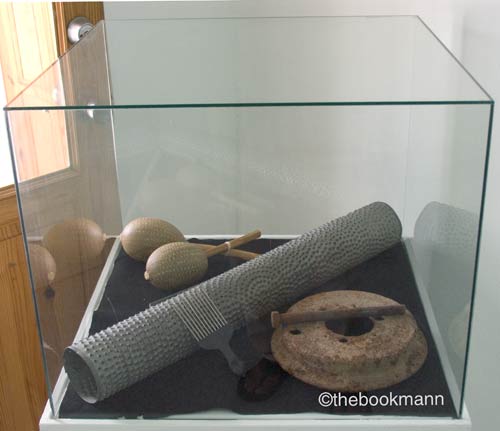
This is a tourist’s glance of Trinidad and Tobago's culture though the classical landmarks interpreted by Joseph Charles, and his vignettes of the "Pan" experience are divided into six rooms where one or two paintings are displayed. To enhance the ambiance of each room, a few artifacts are placed such as a metal scratcher, green bottle and spoon.


(Salvatori) once the tallest building in Trinidad and Tobago with a vintage steeldrum and Fancy sailor costume at its side.

The gentleman walking us through the exhibition was quick to tell us that during Carnival, when they had the bulk of people coming to the museum, many foreign tourists and embassy people knew the stories he was trying to tell. He was quite surprised by how much non-Trinbagonians knew about the steelpan history. It made him aware that he would have to handle his own knowledge in a different way. All of this is very helpful t a new space like that. It means that after the initial idea, the museum must grow and change. But moreso, do so with much more relevant information and reference materials. After all, the story of pan is spreading daily and what people want to come to see is something much more than they already know. A growing museum is essential for pan historians and enthusiasts alike.


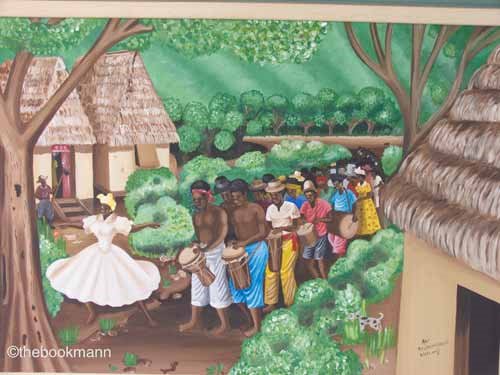
A kitsch postcard view of a small Caribbean island where a street parade introduces a musical instrument to the World called the steel drum.


Percussion instruments as part of the artifacts

For those of you who would like to go to the Pan Museum, there is a flat price of TT$60 per person. This may be a bit pricey, considering that the National Museum is free to the public. However we believe that this price can be negotiated down, particularly for schools and for the elderly. So make the trip to Mucurapo, St.James where the Pan Museum is on lease for two to three months. - Adele
See another rendering of the vision of the Steelpan as a wallpainting from an Artist weed high and out of World

Disclaimer:

Views expressed on thebookmann are not affiliated with any Art Organizations and an “Art Review” may be open to interpretation as it is an observation at face value.

Amendments to such articles if misleading or with grammatical errors shall be corrected accordingly.

All photographs, Feinin studies, accompanying quotes, articles and visual headers appearing on site are the exclusive property of Richard Bolai © 2004 - 2010 All Rights Reserved.

Any fare use is restricted without written permission