Thursday, August 31, 2006

Trinidad and Tobago through the lens of a War-Correspondent


One of the challenges of picture books is the familiarity one has with the images. How can the photographer take us away from the familiar and show us something new? That is one of the major challenges of such a book. People unfamiliar with Trinidad and Tobago would enjoy a reflection of the countries, but for those of us who know the place, it is a bit harder to see the body of work in this book as special or different. That said, it is still wonderful to see a year in the two island state represented here, and occasionally one can come across an interesting eye, as the people of the SWWTU Hall would attest. I think that one of the challenges of this book is the odd use of themes throughout. By categorising the work into sections, the last section seems like a catch-all and that throws you a bit. Also the layout does not always enhance the photography as the section on flora and fauna shows. Images are placed in such a way that the work has an almost clinical study quality that can be seen in any botanical or biology book. See his exhibition of SWWTU, Back In Times


Where Mr. Smailes' skills peak through are in works such as the hands of toil. But again this book could have been better served by a clear decision being made as to what each work in every section was trying to convey,and thus known, sizes, shapes and placements adjusted to suit. The dust jacket prepares you for something very dynamic and exciting inside and then the choices let you down. However the book does succeed in doing what it is made to do, and that is, please the tourist. - Adele

................................................................................................................

How is Trinidad and Tobago interpreted through the eyes of an outsider? What reflects our true essence? A glossy coffee table photographic book is here to answer these questions. The British photographer, Alex Smailes has canvassed across the country to document landmarks, cultural observances and facets of our culture which we take for granted and a portfolio of the photographer's work is represented in Land, People, Carnival, Aquatic and Wildlife.


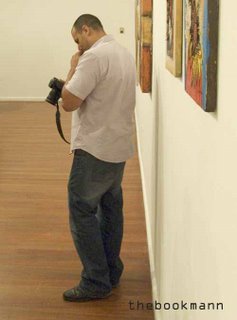
The photographer Alex Smailes at CCA7, Trinidad

Sunday, August 27, 2006

A Lover's Quarrel


A stone used as a writing implement


A former employee or lover has imparted his grievance by using a stone to scrawl a massage for anyone to read.
He did not bring flowers, nor did he say how deeply sorry he was, but was man enough to chisel his true feelings. Scrawled at the lower part of the wall, he begs for forgiveness. Oh God take meh back nah, Ah go behave


The wall with the inscription, Barataria, Trinidad, West Indies.

Wednesday, August 23, 2006

The Trinidad Aesthetic


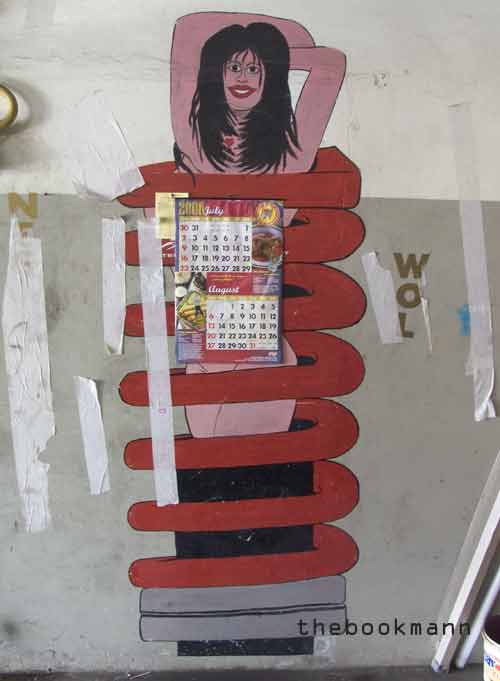
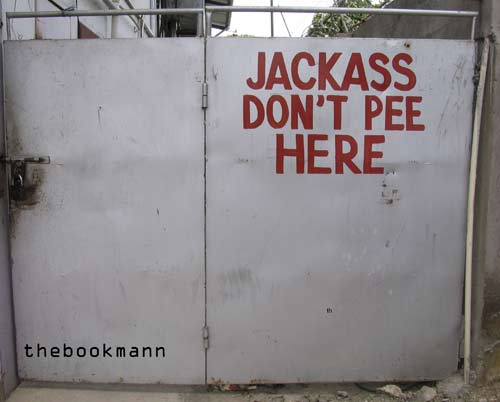
Touring Trinidad and Tobago, the bookman and I come across work that we consider closer to the man on the street than the work of the artists who show for exhibitions. The artist who displays for exhibition is working at what they believe is the taste of the public, and the work of the street is the real desire of the public. This has been hard to reconcile, particularly in the case of graphic design. But that is another post. The artist on the street is a commercial artist. Work is done by commission or by compulsion. However it is always done with sincerity. It sometimes reflects the taste of the person commissioning the work, or at other times it represents the community. This is why we gravitate towards rum shops and bars, street signage and graffiti. It is in these places that the work of the street thrives.


In the last year we have begun to see what started as random imagery expand into a visual narrative of our country and its people. The divide between the artists who exhibit and those who do not is vast, and in many ways the artist on the street is much more a real artist than the artists getting sound bites in the newspapers. We can say this because the work on the street is without artifice. As commissioned work reflecting taste, the works are an extension of the architecture that is as much a hodge podge of styles as the works we see. That doesn’t mean that the work is pretty or even engaging. Sometimes the things we come across are hard to reconcile. We wonder what is the purpose of large bas relief’s on house exteriors or air brush paintings on cars. We conclude that they are extensions of personalities that transcend taste and create styles of their own. These works compete with all other media and succeed because they represent their spaces without apology.


When you look at a wonky sign or an aggressive piece of graffiti, you are feeling something much more intimate than the work in an art gallery. First of all the things in the gallery have all been vetted before. Almost none of the things have gone beyond expectation. Not in style, technique or composition. Every year you can see the same landscape, seascape, Magnificent Seven, Belle dancers, standpipe bathers and kerchief wearing women. On the street you see none of that. There is no asking, apology or even politeness. There is only arough suggestion that something was asked for and received. You see sexual politics, illiteracy, desperation, identity issues, fantasy and wishful thinking. The work on the street speaks to an attempt of those who put their ideas out on display, to reconcile theirspaces. Theirs is a searching, finding, grasping desire to make something from nothing using what they have. It is not asked, do you have talent. Someone has said, ‘I can draw.” Or, ‘He does draw real good boy.” Another issue is that for many, art has to be polite, we want it to be ‘nice’ and we want it to be pretty. That is the whole unheard argument with contemporary work that is seen more so abroad than locally of our working artists.


When the work is seen here, it is basically seen by the same 70 to 100 people. So am I saying that good work is gritty and hard? Not necessarily. But I am saying that while contemporary artists are showing to a select group, there is a lot more going on the islands than just that, and the public is seeing it all the time and asking for it. It isn’t necessarily ‘good’ or ‘proper’ art. It isn’t necessarily art that contemporary artists understand, some may even make fun of it and say that it isn’t art by a long shot. Yet these things matter because they represent us and they are engaging, and they do cause a second and third look. They are actually a glimpse into how to make work seen in galleries stronger.
- Adele

thebookmann: Showcasing the richest of Trinidad and Tobago

Tuesday, August 22, 2006

Whimsical Intuitive Art - Trinidad and Tobago

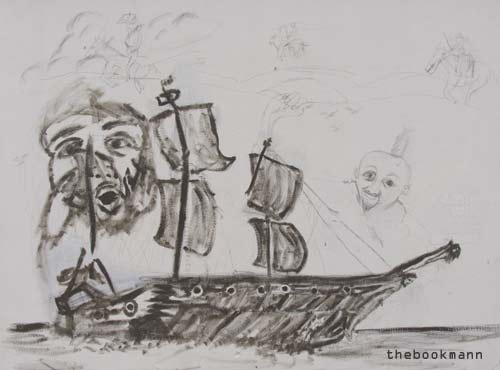
A series of paintings from a street artist who lets his imagination wonder in the world at the time of Christopher Columbus , Port of Spain, Trinidad

If Art could speak from the walls across Port of Spain, they would whisper; This is damm good Art. So the bookman has posted a few examples of work that expresses the true essence of an Artist. No matter their circumstances, their passion stands out by a whimsical approach to defuse the jargon towards contemporary meaning, and by showing a purer approach towards visual and social interpretation rendered in full public view. This is wall work in progress with a message of hope and resolution: Mohawks and like "Botticelli's birth of Venus," a figure of a face blowing into the Galley's mast. See his earlier drawings

A stencil of infant and young boy crying by the street artist Louse, left in abandon places throughout Port of Spain

The people who create street art are usually outsiders in society. Unlike the major cities of the world, these unsung dabblers in creating will never get any recognition for what they do. Some artists may observe the work, people on the streets may know who they are, but many of them are mentally ill, homeless or both. They draw and paint for the joy and desire of it. the Bookman and I find their work worthy of documentation and their names worthy of knowing. This time we have come across delicate stencils of babies. Recently adult murders are taking a back seat to child murder and abuse and these sensitive spray painted cut-outs are powerful in that context. - Adele

Embah’s intuitive paintings and sculptures are uniquely his own, and his work gives a glimpse of the Trinidad and Tobago with his sharp and whimsical commentary. The painting of this obelisk affirms his artistic doctrine; Knowledge is proud that he knows so much, Wisdom is humble that he know no more

Monday, August 21, 2006

Move over "Pierre et Gilles," Slugo Take Over

You have a sedative or suffer from heart palpitations? You need to take a pill because these sculptures are beautiful - Uncel Lall


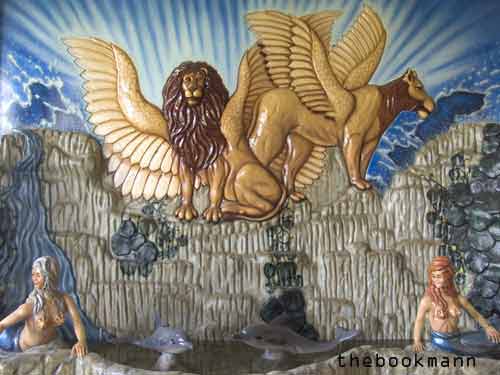
A house is a man’s castle and at Uncle Lall's humble video store in Chaguanas, Trinidad, West Indies, Art is his castle with a work under construction by a sculptor from Princess Town nicknamed, Slugo.

Slugo has conceptualized a mystical composition in
Lall's living room using both entire walls for the relief. At the crest, a winged lion and lioness are set against the aura of an azure sky with water cascading down the face of the cliff into a pond where two sculptural mermaids and dolphins frolic. The project so far has taken four months.

More importantly, is this work is being built around his unfinished home. The décor includes unicorns galloping over a barren landscape which has a Bonanza appeal and looks as if it was taken from Pierre et Gilles. In any aspect, it is kitsch and probably no other work like it exists. Slugo’s reliefs are also part of series of drinking Bars called Obsession.

.................................................................................................................


Who would expect that in Trinidad and Tobago, somewhere in Borough of Chaguanas there would be a house being built around works of sculpture? The Taj Mahalesque relief interiors are extremely large bas relief’s in some places, in others the relief becomes three dimensional. The colour and theme takes on a sort ofJeff Koon's sensibility and humour, except there is nothing funny here to the owner. He is building a fantasy, a world of Bollywood opulence, and like a reality show, we can't look away. - Adele

Friday, August 18, 2006

Moving on up on the East Side - Che


This is Che Lovelace's new poster for his weekly deejay gig at Zen Club in Port of Spain. Before, his earlier posters appeared to be a loose understudy, but there it shows much promise. The work is a figurative montage set at the rooftop of the club and is expressive of a social commentary to which Trinidadians of a certain class attain too. Zen is formally the Deluxe theater.

See all listings under Che Lovelace

Monday, August 14, 2006

Tate Modern exhibits "Surface Art"

"Eddie to the Art curator: “I just want to buy Art, I want to be surrounded with lovely things” - Absolutely fabulous


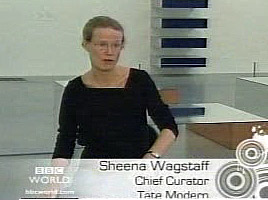
The work of Nigel Cooke - A large painting of a banana smoking a fag highlighting the best of British Art televised worldwide on the BBC. Sheena Wagstaff's slip of the tongue but I like him: "First of all he is a fantastic painter but secondly these very bizarre scenes are a kind of imbued with this very dark and almost gothic idea behind them and they are incredibility compelling."

Art is subjective?

Art is like religion when people begin to talk about taste, and so said I must launch right into a tirade about BBC Worlds’ long anticipated show called Destination Art. I have been waiting to see who will be featured on the programme, and this week the feature was home, ie: London. I was pleased to see Yinka Shonibare. I find his work biting, amusing and refreshing, sometimes all at the same time. It was also wonderful to hear the artist in his own words, which were very thoughtful and wise. I settled back to enjoy this precious half hour as oddly, art is not actually something that makes television watchable for most, and that is why I say with a heavy heart that Nigel Cooke’s work fell awfully flat being watched through a book that he provided as well as one or two medium shots of his actual pieces in the Tate Modern gallery space. This was particularly alarming because after a shaky first half, Mr. Cooke rallied with what he had to say to young and upcoming artists like myself, how to ‘make it’ in the world of art. But by far the biggest surprise was the curator of the Tate Modern herself. I must assume that not everyone is television savvy, or maybe the Americans do mediaso well that they leave everyone else to shame. I found her statements about the work we were looking at, not particularly strong. It led me to assume that her eye must be indeed sharper and keener than her tongue. No offence, television does stop some people in their perfectly rehearsed tracks when the thought of millions of people weighing your words become apparent. - Adele


Yinka Shonibare's copulating Mannequins - Conventional Dutch fabric of Indonesian patterns exported to Africa make up these headless mannequins dresses in eighteen century attire. (A black woman fucked over by a black man and subsequently sodomised by a white man)

Wagstaff's imperialist guilt: “....it also deals with a post-imperialist topic which is done elegantly, and where the work is seen within the context not just with his generation but the subsequence generations"

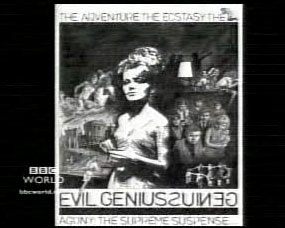
The BBC is attempting to get “with the AmPublish Posterican program” by producing programmes that are quick visuals interspersed with sound bits to keep their viewers interested. There are graphics, images morphing and music sampling in keep with the content of what is being shown. “Destination Art” is a series of short interviews with Artists and curators to predominantly publicize themselves.


Transcribed in Italics Tate Modern's chief curator Sheena Wagstaff speaks about the Artists

With this week’s broadcast of “Destination Art,” Yinka Shonibare and Nigel Cooke are interviewed and the Tate Modern’s chief curator Sheena Wagstaff projected clues to the gallery’s requisitions policy and she also reinforced to a worldwide audience what a farce British contemporary Art really is from her politically crafted interjection in order to give relevancy in contemporary Art.


From bad to worse. Why say anything: ".....her work similarly are representative of a very new kind of approach to Art making, drawing itself as an entity as a finished product is something ??? that characterizes a lot of contemporary arts now a days."

Monday, August 07, 2006

Copycat PH Confessions


Pulling Bull like on HBO and advertising a Stage beer for revenue

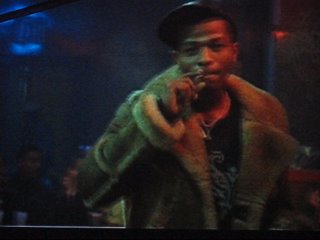
Trinidadians have no qualms about copying other television shows. For instance, Taxi Cab Confessions. There is a hidden camera in this PH car which is recording the conversation between these three men. The subject is on Tabanca and Horning and it leads to their own confession of heartbreak of who horning who. So check you local TV listings
for an adaption of HBO's Taxi Cab Confessions aptly called Copycat PH Confessions. Also pay attention because there are a few quirky instances which make you suspect that this is all a set up. Listen to an excerpt of the conversation 555kb wav format.
........................................................................................................................................................................

Terms and meaning

PH is the abbreviation for Private Hire, also termed Pulling Bull
Horning is having sex with a person other than your current partner
Tabanca is love sickness

Friday, August 04, 2006

Bullers at THE STUDIOFILMCLUB


Paris is Burning at the Studiofilmclub

What if visions of material wealth constantly bombarded you through billboards, window displays, on television and in glossy magazines? Or, that you lived in social conditions and were told that you’ll never amount to anybody, and that you will be ostracized for who you were? In destitution, as with the film Paris is Burning, you'll find a way out with self confidence and an extravaganza that screamed vogue.

At the Fernandes, Centre, Laventille, Port of Spain, Studiofilmclub is a place to socialize and discuss a film’s synopsis with one of the creators, Peter Doig. At times when there are popular screenings, there isn’t even enough room to find a seat. Yet, at the screening, Paris is Burning, 1990 directed by Jenny Livingston what was thought to be a crowd pleaser fell short to only a few patrons, pondering whether the film’s content of Homosexuality ie; Bullers, Pantyman, Battyman Drag queens and Transvestites reinforced its homophobia, even to the sophisticated, arty boosh studiofilmclub’s goers.

Paris is Burning a documentary on the Gay culture in New York city and is performed aa s costume Balls where their marginal lives of hustling and prostitution, Bullers, Battymen Drag queens and Transvestites from the Hispanic and black community portray in costumes what they would like to be in an exaggerated way directly taken from the pages of Vogue magazine. These young men strut the catwalk to be judged by their peers. Vogueing is competing with each other through dance, says Willi Ninja one of the major influences of the movement and immortalized by Madonna in her video, Vogue. See the post by photographer Gerard Gaskin who has documented these types of Balls in New York.

...........................................................................................................................................................................

THE STUDIOFILMCLUB


Cinema for most people is a form of escapism and it is a place where you can lose yourself in the plot. For two years, two artists have devoted their Thursday nights to share what they truly love, and that is film. At the controls are Peter Doig and Che Lovelace piloting a projector that for every week since its inauguration, audiences have been sedated by a record of one hundred film screenings. The Studio Film Club shows independent and foreign films that are obscure. But foreign films to the Trinidadian audience is nothing new, since 1999, the European Union has promoted their films through a free public screenings at former deluxe theatre. The film festival had a score of memorable films such as the German film, Winterschlfer, (Winter Sleep), directed by Tom Tykwer, and the French animation, Kirikou and the Sorceress which resonated warmly with local movie goers and publicized the fact that films of a different caliber has its place .


Peter Doig's weekly movie poster


For those who can make the trek to Building 7, Fernandes complex in Laventille, there are a few adjustments to consider. This is House, but feels like Pit. A prolonged screening can be discomforting due to the heat of the place and rigidity of the seats. The Studio Film Club deals with these pitfalls the best they can, electric fans are in place, and there is a refreshment bar to cool people down. Yet people come prepared, bringing their pillows which adds their devotion these screenings.


There are hits and misses and Mr. Doig says that the misses can leave you listless and dry. Ultimately, the angle is to be diverse . The future of the Studio Film Club is directed towards mobility. Mr. Lovelace stresses that their is a need to show films in rural places throughout Trinidad and Tobago. For communities that have never been exposed to foreign cinema, a simply projector in community hall wall may transpose the a flicker on a dirty marked wall.

Thursday, August 03, 2006

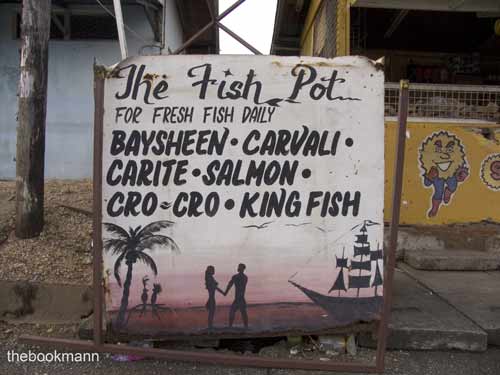
Painting Paradise

Oh gooo you an't see dat bottom


Pan music, a docking clipper and coconut tree brings a touch of class to these two Tobago lovers. So a fish vendor sign says on the Eastern Main Road, Trinidad, West Indies

Tabanca means a kind of love sickness, and this street painting is expressing the early stages of a Tobago love before the lovers had their falling out. The fish cart sign shows a silhouette of a couple embracing each other at the moment the sun dipped below the horizon. And although the woman has a large sagging bottom, this is a Caribbean trait which men like to hold on to. Tick and saucy and any ting to sweeten meh fish pot.

Tuesday, August 01, 2006

Ladies Ladies Ladies

Oh wow, this man has some much style

Ladies, ladies, ladies, a Pan man

Winston, a local model smirking and trotting his style on a day which Trinidad and Tobago celebrates the end of slavery.
On this local television talk show, the subject of the evening is emancipation along with fashion and many Trinidadians and Tobagonian wear some sort of African garb to recognize the emancipation of slavery. Whether they truly understand what these clothes may mean, there are three women to explain it with the help of a lady's man.


So ladies, ladies, ladies, call your seamstress and buy out those bolts of burgundy fabric to make your twenty bridesmaids dresses and watch this saga boy plucked from his daily vocation of selling nuts on Prince street as he trots the catwalk where the world of low fashion delights these women dressed as if they are part of occult.

Disclaimer:

Views expressed on thebookmann are not affiliated with any Art Organizations and an “Art Review” may be open to interpretation as it is an observation at face value.

Amendments to such articles if misleading or with grammatical errors shall be corrected accordingly.

All photographs, Feinin studies, accompanying quotes, articles and visual headers appearing on site are the exclusive property of Richard Bolai © 2004 - 2010 All Rights Reserved.

Any fare use is restricted without written permission