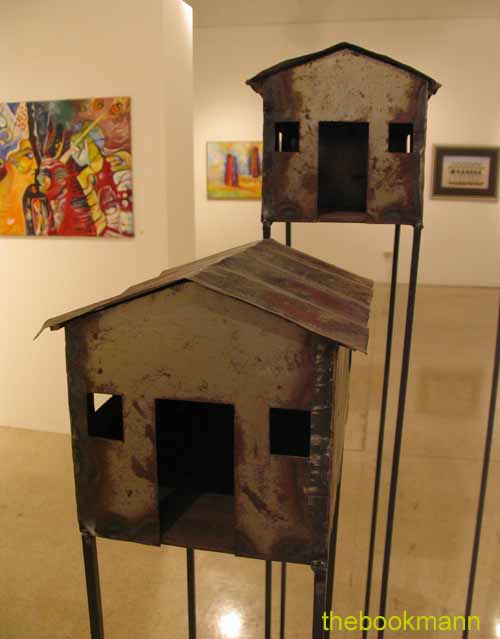
Inward Journey at National Museum, Trinidad and Tobago, West Indies
The National Museum in Port of Spain has produced a retrospective of the works of the artist Shastri Maharaj who has been practicing since the early 1970’s. Mr.Maharaj is arguably one of the few Indo-Trinbagonians working locally today in Trinidad and Tobago to that acclaimed. His art runs the gamut from Post Expressionism to Abstraction. I first came across Mr. Maharajs’ work in the mid 1980’s. I was very excited about his technical skill and moreso by his compositional creativity. At the time he was discussing things that were very current in his own life, things that were both intimate to him and humorous. I recall one piece where he painted a house with a veranda, and on the veranda was a frigerator.The house was his grandmothers’ and he had some funny antidotes about it. I recalled that I found his energy infectious and I thought that this artist is the locale quivalent of the luminaries that were being touted in America, Julien Schnabel, Sandro Chia and Francesco Clemente. His ideas seemed refreshing and even daring for our society.
I never promised you a Rose Garden
Over the years Mr.Maharaj’s concepts have not continued in the direction he began and I must say that I have occasionally been disappointed about that. He has meandered in the direction of Indocultural symbology, using a lot of imagery from a traditional Indian aesthetic. He has focused on the many layers of traditional Indian crafts in his work, and although this has been relatively new for an Indian artist working in Trinidad, (The late Dr.James Isaiah Boodhoo had the same introspection about being Indian and Indian life in terms of exploration) however in Mr. Maharaj’s case, I have found his work limiting interms of technique and content. Gone is the searching nature of colour. Gone is the almost manic desire to explore complexities of life. In its place are ideas outside of himself that seem too politically correct while adhering to what one expects of Indian concepts in our society today. I lament the retirement of the work he had first began with.
Ring De Bell
However this show put on by the museum has more serious concerns. A retrospective suggests a body of work that shows growth as well as process. In this attempt that is seen in the small annex space of the museum, there are no added pieces of literature on the artist other than some sketchbooks. I would have liked to have seen some writing on the artists process and a better variety of work. 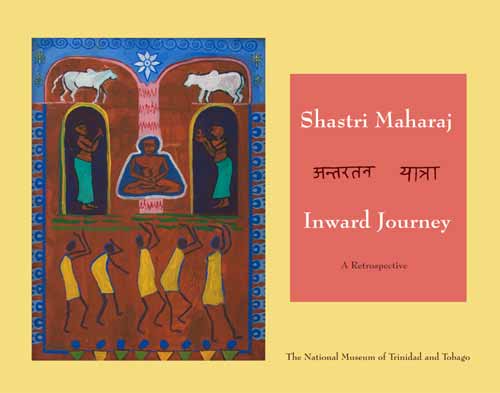
Deity on the cover of the The National Museum's Catalogue
As someone at the opening suggested, acquisitions from people who had purchased his work over the years should have been added the exhibition. Another curious thing is the price list accompanying the works on show? This makes the whole point of a retrospective seem like something else altogether. The pieces are not in any order of date and some of the works on closer inspection have come to the museum without any restoration or upkeep. One early piece in particular has dry rotted at its base. I was quite shocked to see it in such condition. This brings me to a statement that I must make about what is happening with Art in Trinidad and Tobago at this time that really concerns me. On the one hand I find that of late there have been many shows that attempt a sort of retrospective of known artists. I say attempt because these shows have all fallen flat in terms of preparation and presentation because of the sloppiness of the curation. I wonder how these shows happen? Do the people involved and this includes the artist, sit and discuss what they want to achieve from the showing? Do they actually go through the works and discuss content and context? Do they discuss lighting and framing? Do they discuss borrowing works and restoring? How is the whole thing really planned? 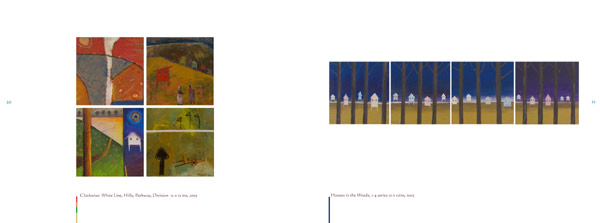
Spread of Mr.Maharaj's Catalogue The National Museum of Trinidad and Tobago
I am very concerned about this trend. It is claimed that art is important to our society. Yet the shows are presented with very little regard for quality. Why is this? It is not as though doing them badly is any less time consuming and challenging than doing them well! Is it possible that those involved just do not understand what it really takes to put on a professional showing? What is most unfortunate of all is that what I am stating here is likely to be interpreted as bashing instead of what is intended which is a look at producing better, stronger shows that will benefit all involved at the end of the day. Nonetheless it has to be said because these shows shall continue and will forever seem less than they can be. .- Adele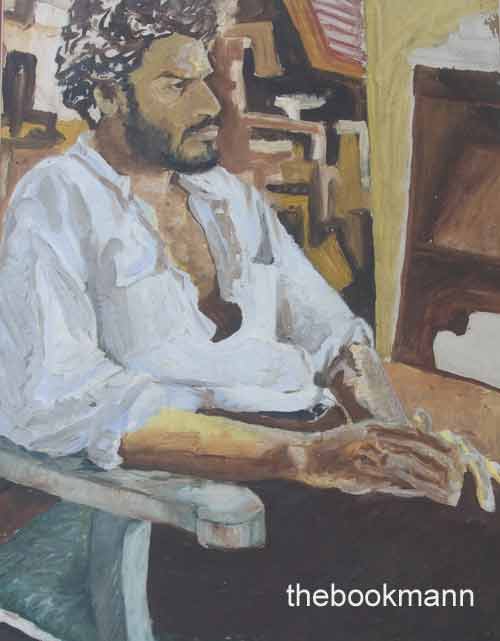
Shastri Maharaj
Sunday, May 28, 2006
An Inward Journey - Shastri Maharaj

Saturday, May 27, 2006
A Criteria for Caribbean Artists and Photographers
Fourth world photography
The National Library's exhibition foyer. Shows are generally displayed on plinths or tables.
Coordinated by Patricia Mohammed and Rex Dixon, the Caribbean in the age of modernity is a photographic exhibition organized by the Conference of Caribbean Studies Association. Thirteen Caribbean artists participated in this show at the National Library of Trinidad and Tobago as they dabble into the world of photography, questioning the very standards of Caribbean photography itself.
Although amateurishly displayed, this exhibition included professional and non-professional alike. Abigail Hadeed for an example stuck with her journalistic view of the Caribbean diaspora. From Jamaica, Annie Paul documented a Dancehall event and Patricia Mohammed took snap shots of wall paintings in Haiti, but her reproductions were poor in terms of its caliber. Errol Brewster from Guyana produced a grainy collage from 35 mm negative and was one of the more successful prints. So the question is, are these the standards set by artists and academics from the Caribbean? 
Steve Ouditt's orthodox stills of Hindu sites in Trinidad and Tobago. The Caribbean in the age of modernity, runs till June 8th.
Tuesday, May 23, 2006
Where beauty lies - Site specific Art
The devil's pack - Even the dead need burglar proofing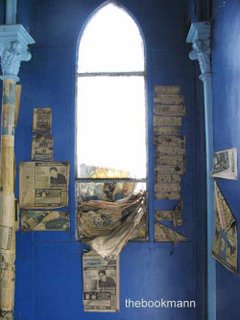
Newspapers used to block in the sunlight, a comic strip to the right of the window frame.
Like many mausoleums in Laperose cemetery, vagrants have vandalized any crypt they can break into. What they leave behind is turmoil by the families who are helpless to restore these mausoleums to the state they once were. The burglar proofing seems not to work for the devil's idle hand, Trinidad, West Indies.
An ornate fortified mausoleum with arched burglar proofing and protected by a decorative wrought iron fence
But one inhabitant has decided to make this mausoleum his home, unfurnished. It looks like a work of Art by default with stacks of spherical crumbled newsprint placed neatly against the forward buttress, and cobalt interior adds charm to the place aesthetically. As contemporary art continues to focus on the mundane and of death, here is opportunity to see a work in progress, once you have courage to enter the gates of Laperose.
................................................................................................................
Terms and meanings
Devil's idle hand - To be preoccupied with a activity which is destructive by any means
Sunday, May 21, 2006
The Brown Christ
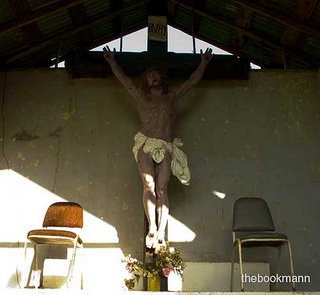
A shrine on the burial grounds of Our Lady of Lourdes, (1916) R.C. Church, Maraval, Trinidad West Indies, 2004. The chairs are for taking in the view of Parimin while being high on weed or drunk with Bush Rum.
On a steep road that end on a graveled hill that meanders around a graveyard, and then leads up a dirt track that climbs up a mountain, you come to a freshly painted shed. In it is a shrine of a life sized statue of the Jesus Christ crucified on a cross. To members of Our Lady of Lourdes, say that the shrine is known as, The Cross. 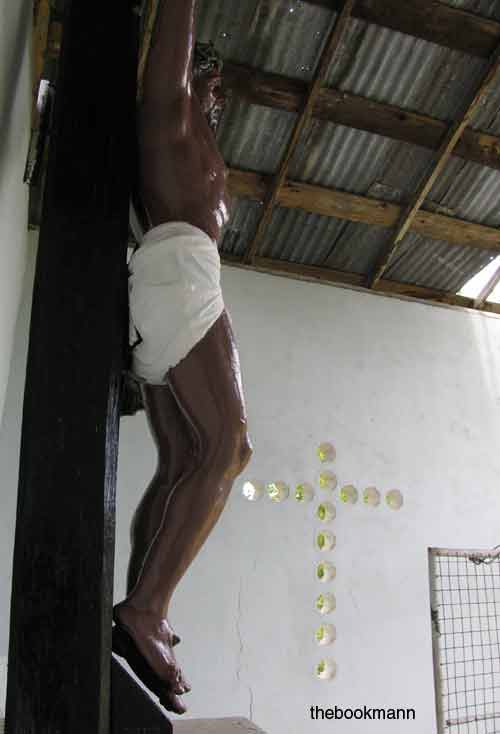
Christ repainted in brown and white house paint giving the statue a ceramic sheen. Below, two boys climbing up the hill with a tank of cooking gas.
Saturday, May 20, 2006
Show of Hands not Cricket - Wendy Nanan
 Walking into the CCA7 InterAmericas Space, one is first made aware of three draped lengths of saffron coloured fabric with coloured drawings attached to them. There are lengths of raw cotton on the walls, drawings of hands stopped by thin bamboo that are placed on either ends of the fabric lengths like borders. But the really interesting and unexpected work is on the floor. She has a series of oversized hands, all have something in the palm or held in the fingers. It is clear that the work is about meditation. The overall impression of the pieces for me was one of ambivalence. I acknowledged that the show was about meditation. I felt that I knew what she was suggesting in the hands. My concern was about the technical skill. I found myself wrangling with this, and that is what I believe the works legacy questions.
This is a difficult statement because Wendy Nanan to me is a prolific artist, one who has gone far from the beaten track with and for her work. To ask whether her technical skill should be in question is almost like asking if her most definitive work, her cricket series is technically proficient. But here lies the rub. The cricket work is strengthened by its abstraction. Those works are beautiful because she captures the essence of the game. Why is technical skill at issue with this body of work? Is it because it asks so much of the viewer?
 Ms.Nanan's technical proficiency is exposed by her choice of materials and the intent of the works. There are many artists, locally, regionally and internationally working in na�ve styles, finding their own symbology, so who is to say that this is not Ms.Nanan's visual language? Barbadian artist Annalee Davis has her own quirky style of drawing that is at the base of her narrative. Trinidadian artist Suzie Dayal draws in a similar personal way. Their work goes against the expected �styles� and idea of traditional, classical art. This is neither new or unusual to see. So the question may be believability and intent. What makes work believable and intentional? Should Nanan�s work be perceived by these criteria, and is this fair?
My first awareness of Wendy Nanans� work came in the early 1980�s when the  I related to Wendy Nanan�s work right away. I wanted to see more of it after that first exposure. I was not disappointed. She started a series of black and white prints on cricket. But she also explored using plastic crocus bags as sculpture at the Trinidad Art Society and a series at Horizon�s Gallery on Jhanti�s, using the
Two years ago CCA7 presented a series of work on yoga by Suzie Dayal, Johnny Stollmeyer and other artists. To say that many artists are focusing on similar themes cannot be ignored. Trinidad and Tobago has lost its innocence and for many of us the grind of daily life demands some slowing down in our private life, if only for a moment. That show also exposed questionable technical skill, over theme. One of the most difficult things artists have in Trinidad is choosing what to put into a show and what the intention of these works will be. It is difficult to know what sort of impression certain works leave on the viewer, this is never known until the work is in the space. It also does not help that there is little to no art writing to support or question the artists� intent.
There are a few Indian artists
exploring their heritage in their art. The late James Isaaih Boodhoo, Shastri Maraj, The Singh Brothers, Suzie Dayal and Shalini Seereeram. For many the focus is not necessarily traditional drawing skills. Dr.Boodhoo�s focus was colour, Mr.Maraj�s latest body of work is primitive with stick figure imagery, and Ms.Seereeram�s drawings are ripe with decoration and art nouveau, art deco taste. The desire to create work clearly greater than the need to fit into some technically proficient sensibility. The question of intent is the subjective one, however it is a large part of what makes work, work. It is argued by many today that art has become too gimmicky. Artists have to find a hook very much as musicians do. That may be the case. But I would like to take this suggestion further. As we all know art has to compete with all media, and so it owes itself stability. Whether that means that technical skills have to be challenges, or themes, or intent, then so be it. Art has value in society and like everything else, it has to be held to what it claims and sets out to be about. Adele 2005
Thursday, May 18, 2006
Jamaica's take on a AIDS campaign


Man with shades: “What happen yo youth.”
Youth: “Yo I need a condom, I have a little situation”
Man with shades: “Sorry I can’t help you dat”

Man with shades: "Di girl dem have “Mike” run round like a little chicken."
Man in red jersey: "Ah least him ask for a condom, him smart, thinking smart”
Man with shades: “See this condom t’ing takeaway from the feeling mind you, besides its top class girls me rolling with.”
Man in red jersey: “Tell me something all dem girls you with you know who dem use to deal before you… or what, yuh don’t think you can catch this AIDS t’ing”
Man in red jersey: “Playing with your life… rudeboy”

Youth: “I got one at the shop you know, I could use it for a second rounds.”
..........................................................................................................................................................................
Tuesday, May 16, 2006
Money Money Money
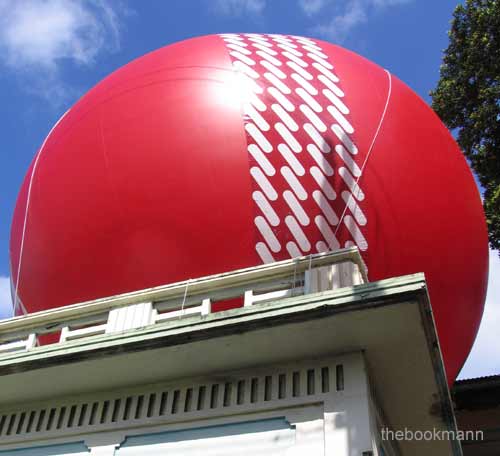
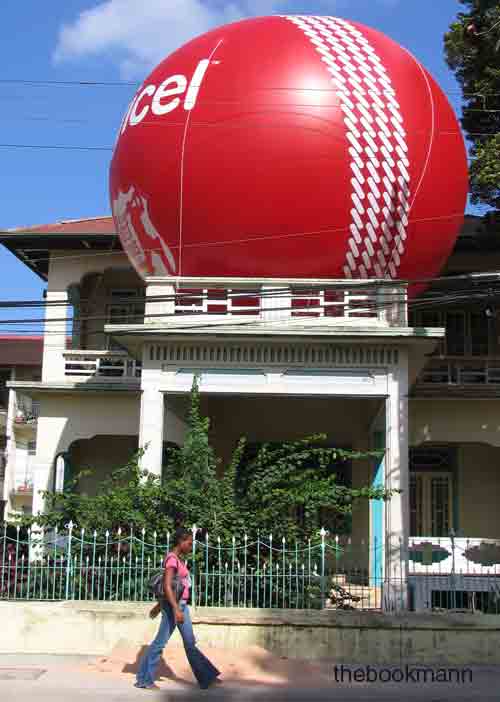
A large beach ball for Maracas on a veranda facing the Queen's Park Savannah, Trinidad
Around the Queen’s Park Savannah, there are many historic landmarks. There is the Memorial Park to honour those service men and women who sacrificed their lives in both World Wars and also the popular Magnificent Seven, the Prime Minister's Office, the President’s House, Botanical Gardens and the Boissiere or Gingerbread house. Then, there is the inflatable red cork ball anchored at Cipirani boulevard. A wonder in itself, and an eyesore to the thousands of commuters who pass by.

A West Indian fan blowing a shell in support of West Indies Cricket. (This wall ad at the Queen's Part Oval has be destroyed)
Monday, May 15, 2006
Oh Canada Our Inuit And Native land!
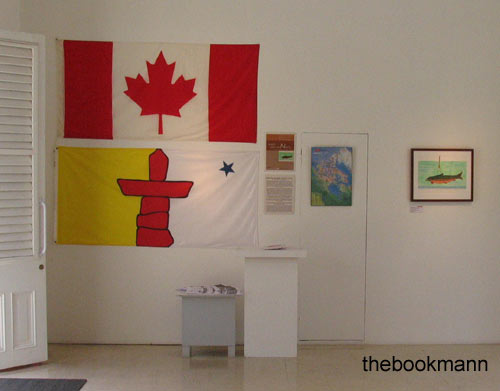
The Flag of the Aboriginal peoples of Canada who are finding ways to expose their grievances and neglected Rights by using art as a platform.
In Trinidad and Tobago, this is a rare exhibition presented by the National Museum and the Canadian High Commission. It is art from the Inuit peoples. Qamanittuag Drawings by 14 artists from the Baker lake, Nunavut, a region which is 250km south of the Artic Circle. Entitled, Voices from the North, this collection of that spans over 37 years and is part of the Macdonald Stewart Art Centre collection in Guelph, Ontario.
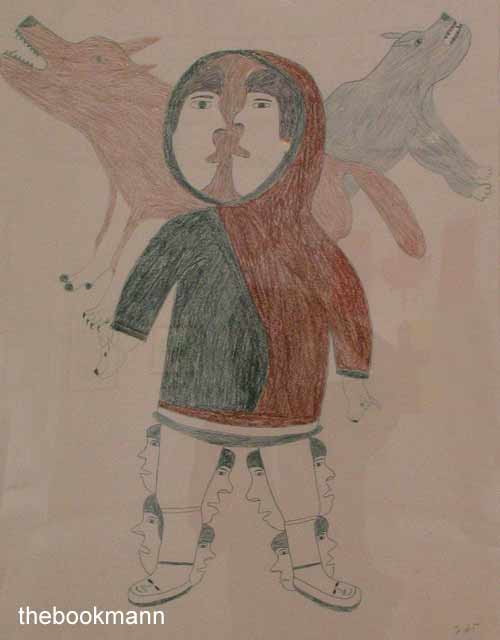
Qamanittuag translated from Inuit implies, where the river widens, and it is a place with extreme inhospitable conditions. At the Annex, Trinidadians may have a glimpse of how these people live their daily lives. The drawings are of animals, aquatic life and reflect the Shamanic beliefs between man, animal and the spirit world.


Friday, May 12, 2006
Pretty Pretty Frieda
Pull back pull back cut to a wide cameraman!
The dancer in this video clip spiraled out to the right of the frame as the director of this local television station tried to cope by pulling the camera back but not as far to show the actual size of the studio space which Pretty Frieda had to contend with. Yet, her performance was delightful in its pose and gesture in the traditions in Indian dance.
Wednesday, May 10, 2006
Shalini's Stir Of Art
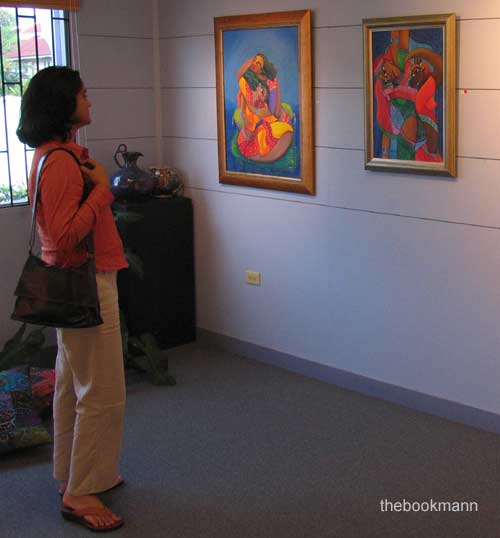
Shalini Seereeram's acrylic paintings expresses the richness of an Indian heritage with a sensual sexuality purely her own, 9th till 20th May 2006.
Shalini's Rite of Passage exhibition at Horizons Art Gallery, Port of Spain encompasses many art genres from painters such as Marc Chagall, Henri Matisse and Pablo Picasso. She also embraces the traditions of Hinduism, Islamic filigree, Mehndi and miniatures from the Moghul school.
A self portrait of a West Indian East Indian painted as an altar piece simulating gold leaf motifs with the use of metallic inks
Seereeram merges these styles together without losing her own unique character. Her figurative portraits intermingled with primary and secondary colours and her use of metallic pigments simulate a gold leaf. This gives the feel of stain glass. These paintings are simplified by the curved line and by the painter's stokes to give a fullness to the human form without fumbling with its proportions. A Sari is drawn as if as it was body painted. There is also the national flower of India held by Shiva as the deity holding the lotus in front of a radian disk. Seereeram gives homage to her Indian heritage.
Rite of Passage is mystic and decorative and there are levels of eroticism present. Women embrace each in any erotic ways. This is cleverly mask for the voyeur or taming the concerns of a sexual identity in public view in its stigma or discomfort.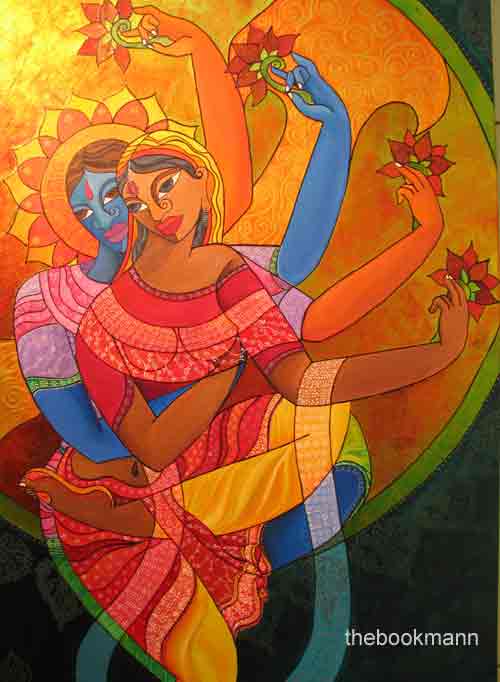
Eroticism cleverly masked and India cleverly illustrated
.........................................................................................................................................................................
There is more to the work of Shalini Seereeram than meets the eye. She began her career by working on window pane with her signature bursts of vibrant colour and unusual use of metallic nail polishes. She has since produced a distinctive style as an illustrator whose arabesque shapes detail a rich, flat spectrum that draws interest every time the work is looked at.This show is called “Rite of Passage” and it is clear that Miss Seereeram is looking beyond the surface of works past. She is still using her rich tones and textures,but for this show that is all mainly a single woman in a frame, she has restricted herself to contemplating the meaning behind the solitary nature of the figure.The work is steeped in many levels of traditional drawing. The affected tilt downward of the heads of the women recall Renaissance images of the Madonna and child.
The colours she uses and the details mirror the miniature painting schools of India, causing a second observation of her women who do not look directly at the viewer, but look demurely away, reminiscent of yet another traditional view of women, this time, of Indian women. 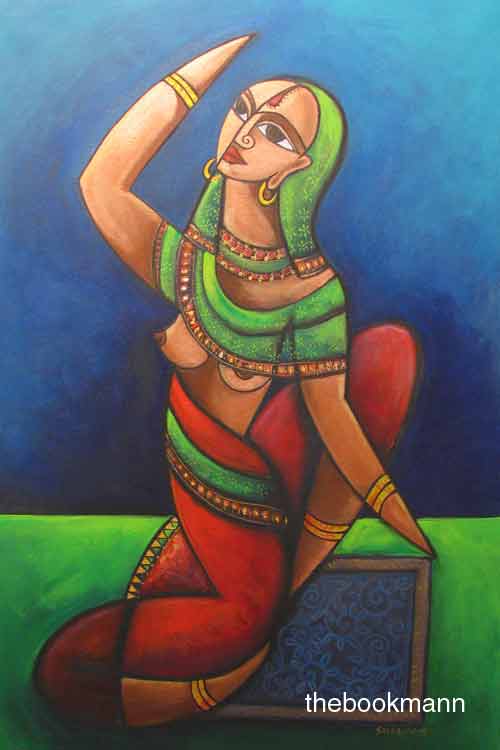
Miss Seereeram may be grappling with how to go beyond the pretty and the appealing for something with greater depth and meaning to her, and she is doing so subconsciously by following the lines that she loves to make in the follow through jesture of ending them as sharp points. By doing so she is making the statement that her women may be descendant from many traditional historical perspectives, but they transcend that and are firmly rooted in the present.She shows this with her daring image of two women embracing in a clearly Lesbian clutch. For a show of this nature it is a gutsy move to make, as such themes are seldom if ever attempted openly for public consumption.
Thus it is refreshing to see Miss Seereeram taking such steps to look at the many aspects of modern female life. It is not easy to be working as successfully as she has and kicking out of the box of her own comfort. She still has much that she is looking at in terms of her technique and style, and as she continues to show her work it shall be interesting to see her continued growth process. - Adele 
Tuesday, May 09, 2006
The Changing Of The Guard - Dwight Eversley Yorke

Dwight Yorke on spotlight at the TSTT building, Port of Spain, Trinidad
The football player Dwight Eversley Yorke had his humble beginnings by selling crab in Tobago, but had the determination to better himself and kicking ball served his passion. Today, he is the captain of the Soca Warriors team as they prepare for World Cup matches in June, 2006. This is a series of billboards spotlighting local personalities and sportsmen from Trinidad and Tobago as they endorse B mobile. See the Brian Lara billboard.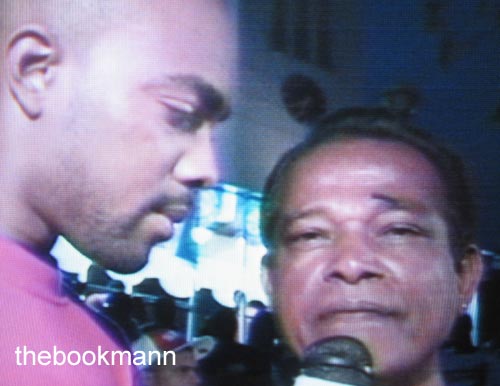
Other World Cup highlights in San Fernando, Yuh going Germany not Canada
After being lead blindfolded into a large industrial bin filled with competition letters for a World Cup Football trip in Germany, a heavy set woman trotted ankle deep into a sea of envelopes. She then knelt down and dug out the lucky winner. It was a decrepit crumbled envelope.
Soon after the winner was announced, a man with a bruise over his left eyebrow as if he was in a Rum shop brawl was interviewed by Synergy TV. His unenthusiastic disposition and poor diction made many viewers wonder why he ever bothered to participate in the competition in the first placed?
Monday, May 08, 2006
"Look Punk Buy My Shoe ....Doggg"
Don't mash meh shoe
Snoop Dogg's Doggy Biscuitz
A billboard of the American Hip-Pop personality, Snoop Dogg, and the endorser of the shoe, Doggy Biscuitz at St. Anthony’s College grounds in Trinidad West Indies. The singer is cloaked as a figure head and dressed in a blue Mao jacket. His arms are extended as a Deity advertising a range of sporting gear towards young impressionable school boys. Owning a pair of Snoop's sneakers can cost over $900 dollars or at what ever means it takes to signify a rank and respect among your peers. Accidentally stepping or causing scuff marks on a new pair is a another matter resolved in the school yard. 
A billboard located at the Beetham, Trinidad and Tobago
Hip Hop Nelly living the lifestyle of the American pimp and promoting his drink Pimpjuice on a billboard located at Beetham, Trinidad where residents endanger their lives by crossing the highway into the Beetham landfill to salvage what they can.
Sunday, May 07, 2006
Friday, May 05, 2006
Breakfast At Piggy
Two...slight 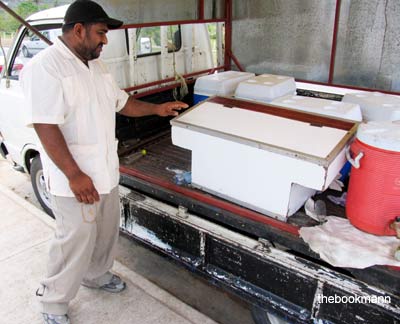
Piggy and his doubles located on the Western main road, Trinidad
Doubles is a staple diet in Trinidad and Tobago and you can find these food vendors set up on the roadside throughout the country. According to Piggy, the owner of this doubles spot on the Western Main Road, preparing for two hundred customers is no easy task. You are at it for five hours or until it all runs out. The preparation of doubles is done by contract which begins around 2am to be ready and freshly made by 6am.
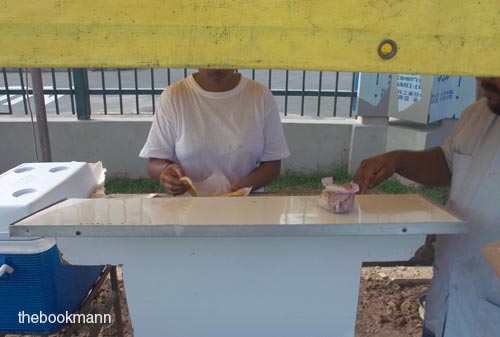
Doubles (meaning two bharras) is similar to Roti, the Bharra is filled with channa and topped with a variety of chutneys. Serving doubles is an art in itself as it requires two people who can work quickly together. One is in charge of taking orders while the other prepares the order. Generally this food should be eaten immediately. Popular locations are the Barataria roundabout and n front of the Brooklyn Bar, Port of Spain where George and George's Ex compete for customers.
.........................................................................................................................................................................
Slight meaning the degree of pepper to go along it your doubles.
Thursday, May 04, 2006
Pimp Juice - Trinidad Style
Ah bulling the lower one tonight
Which bull do you like best? A provocative poster at a popular bar, Smokey and Bunty in St. James, Trinidad.
If you are wondering what kind of Bull Trinidadian really men want, it has nothing to do with this tonic drink, but rather to the women crouched or standing in this poster. In Trinidad terms, Bull translated means, Fock which translates to Fuck.

Ah better drink some of dis “ Hard Wine” meh totee soft.
The woman in this poster is quite temping isn’t she? And she is also coy dressed in her Victoria Secret knock off, a white laced unmentionable with a black garter belt to match. What has her attention is the size of the bottle's girth or by the her man's gesture as he pats his flaccid totee. The poster is for Carreia, a locally made tonic wine with a concoction of fruits and extracts fortified with Bois Bande. The last ingredient is a popular Caribbean aphrodisiac.
The bark to be seeped with Rum
Bois Bande is the bark extract from the roupela montana proteaceatree like the one in the Botanical Gardens, Port of Spain which the bark has be been totally stripped by locals as far as they hands could reach.
...............................................................................................................
Overheard conversation:
Decrepit man to the school girl, Gim meh a half fock nah. Half fock may imply fellatio
Totee - Penis
Tuesday, May 02, 2006
"None but ourselves can free our mind"

A billboard advertising welding in all specialized areas, Trinidad and Tobago
Burglar proofing is a booming business in Trinidad and Tobago and in every home or business place it has become an integrated part of the architectural landscape. For homeowners this is a venture into the Trinidad aesthetic, and welders are commissioned to fabricate elaborate shapes from wrought iron.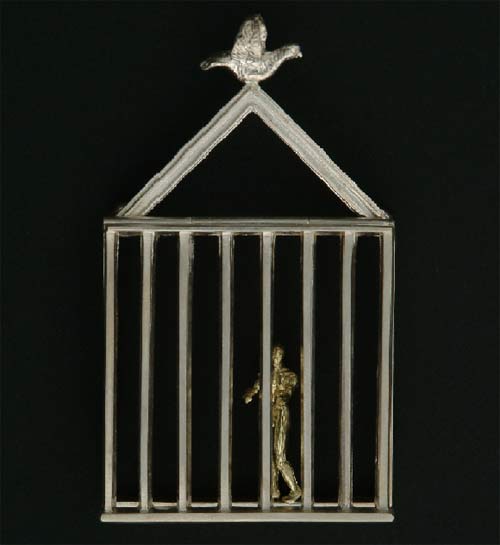
How best to live in jail. A pendant expressed by Jasmine Thomas-Girvan - “None but ourselves can free our mind” ...Bob Marley
Artisans beveled, curved and forged steel rods together to represent coils of branches, leaves, buds and filigree. The more ornate the better. This can provoke a neighborly competition and very soon a wrought iron pattern can become a fashion statement encouraging the entire street to following in suit.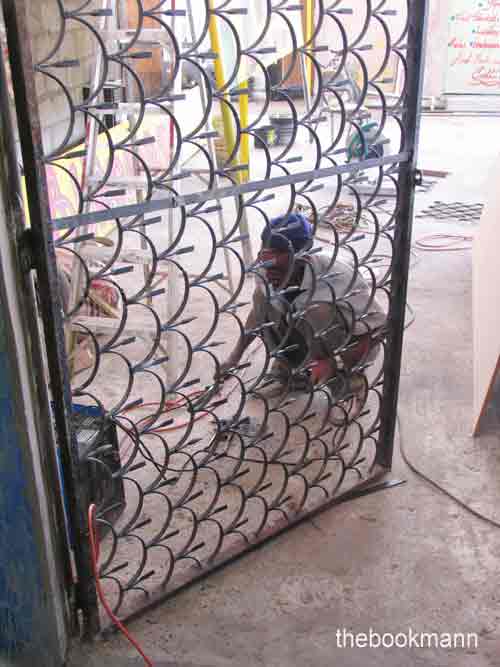
A welder working on a door with semi-circle patterns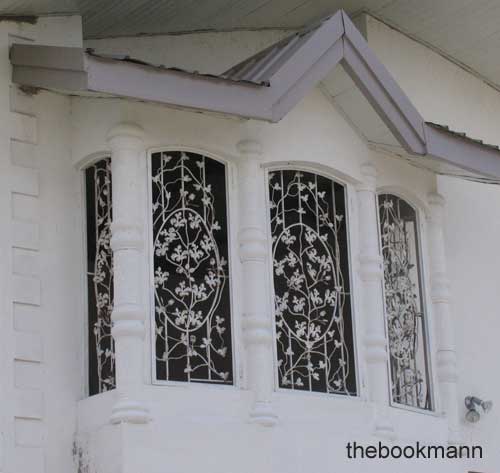
A popular filigree burglar proofing over a window, Central Trinidad, West Indies
Monday, May 01, 2006
A Wife's Tale For Extra Everlasting Love

An oyster vendor on the streets of Trinidad, West Indies
The man to the left of you is ready for some lovemaking. What he is waiting on is for a boost and the oyster vendor has the concoction of raw oysters pickled with pepper, vinegar, salt and lime to do the trick. One prepared, the concoction is consumed with one or two gulps. To locals in Trinidad and Tobago, this is an aphrodisiac and as soon as you drink it, you are overcome with a tingling sensation throughout your body as it prepares itself for some extra everlasting love.
Danny around the Queen's Park Savannah, Port of Spain, Trinidad
Everywhere in the world there are aphrodisiacs that are sought out mostly by men and a few women. Scary stuff like the horns of the Rhinoceros, or testicles of a bull. In Trinidad and Tobago, one of the sexual tonics of choice is oysters pronounced “oye-stairs.” You can get oysters around our famous Queen's Part Savannah. What is striking about the oyster vendor is the look and nature of the selling of the product. First of all, I’ve found to be a little thin unkempt Indian man. He can be seen wiping down his folded table with a rag that once may have been white, but now a matted to a grayish brown black colour.
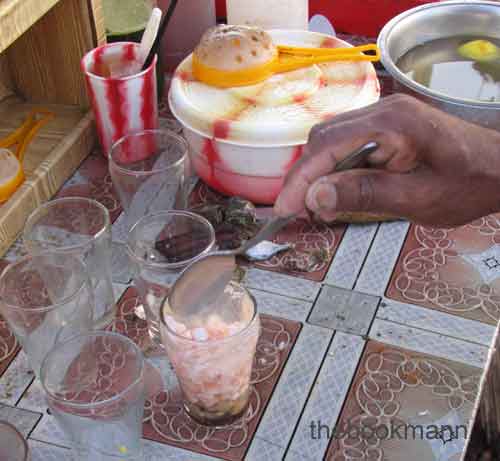
There are many glasses of water. Glasses those are similar to those old fashion ones used for alcohol. It is essential to mention the flambeaux- a bottle of oil topped with a flaming cloth wick Next to these numerous glasses are a pile of already opened oysters. A testimony to the popularity of the product and next to the unshelled oysters is a knife and sometimes two to three types of pepper.As a child, I was so curious about the oyster vendor that I begged my Dad to try one. Needless to say I was not prepared for the taste. I remember tasting the pepper and the wateriness and grit of the oyster. Then my eyes watered, my throat rebelled and my tongue went, “Yuck”: and I spat it out. I did not understand the attraction, but of cause many years later I realized it had nothing to do with taste but results. - Adele