Showing posts with label Photography. Show all posts

Tuesday, May 12, 2009

Doing justice to the weaker - Alice Yard

Best Village sets at Alice Yard Space - we eh reach

student

Erin Caner attempts to make the best of what is provided to her at (Alice Yard & Trinity-in-Trinidad incentive )

One of the critical problems of the Alice Yard space is the yard itself. I just looks unkempt. Can a artist's work be placed in its best light? At a recent photo exhibition in the yard, just walking into the space made you so repulsed that you were tempted to walk out. So why allow your work to seen so tacky, so unprofessional, why have it up at all.

A photographic student from Trinity College in Hartford, Connecticut finds out that her intriguing work she produced is completely destroyed by the lack of proper wall space to accommodate the photographs properly. Galleries such as the CCA7 InterAmera Space are sadly missed. If Alice Yard purports itself as a forum for contemporary artists, since its conception, it should have developed further after three years in operation and answered key questions to how best to make the space meaningful to serve both the administrative and artists alike. The experience should be a pleasant one, not that of tripping or dodging in an unleveled dark open air concrete patio. This is not a personal attack, this is a simple observation.

crixf
The Stations of the Cross enacted at Mount St. Benedict, Trinidad during the celebration of Easter is particularly intriguing. A pun, a self-portrait of how she, Caner was crucified by those who knew better in presenting art

Here is Alice Yard's mandate:

Alice Yard Spaceis a small gallery in the backyard of 80 Roberts Street--a nine-by-seven-by-ten-foot concrete and glass box designed by architect Sean Leonard, which opens in September 2007. It is just large enough to fit an artist's installation, a video work, a few drawings or paintings.

.....Alice Yard has been home to a series of weekly Friday-night "Conversations", bringing musicians, artists, writers, and audiences together for informal performances and interactions. The gallery now creates the possibility for another kind of conversation, by offering contemporary artists a space to show a carefully selected piece of recent work, or even work in progress.

You need to explain yourselves, where were the curatorial advisers?

.gate

A series of vignettes of the culture from Trinidad taken from a student exchange between UWI and Trinity Collage. The photographs are tacked to a iron gate.

............................................................................................................................................................

n a recent comment, a reader debates over the formability of how art can be place without structural grounding in its presentation to the public. Should one outweigh the other?

The comment: You clearly have no concept of spacial relations nor do you have an understanding of art in the greater sense. Art displays should not just be simple squares on a white wall. True creativity can be emphasized through unconventional displays and interesting use of a wonky space. This is not to say that Alice Yard cannot put on “proper“formal displays but simply that is is often more interesting to err on the side of creativity rather than dullness.

I was present at last Monday’s show and was incredibly impressed by the way that the artist chose to show her work. It showed impressive vision and a creative streak that might not be present in artists that are older and more set in their formal, and often boring, ways.

In response.. Therefore we concur that Art, or the practice of it, and in the many facets, can stand on the mere principle of concept without requiring any visual sensitiveness in its presentation. If Ms.Caner consciously made these decisions with her portfolio, then I am in (err)to a ghastly flaw for my genuine like of her photographs.

Believe me, if this is a war of ideologies, I tempt you no further to open the debate between, concept verses presentation. And please refrain from any Tracey Emin examples.

Rebuttal with a revision..

What was considered as a warm gathering of mainly students from Trinity College on a student exchange from the University of the West Indies, a photographer explores an unorthodox way of presenting her photographs relating to a spectrum of religious festivals taken from January till May, 2009. A series of photos are mounted against a partition illuminated by a 40 watt light bulb. On a major wall at the Open Space, and on the face of a concrete wash trough, she inventively hand paints an inscription explaining her experiences through the lens of her camera.

She writes, “Photographing Trinidad has been challenging to me, in confronting my own identity and how I am received, perceived in a new culture. Its been about encountering different conceptions of time and space….” and concludes with the phrase, ” I find the matrix of colors and forms to be revealing as a creation of a visual language to explain the unconsciousness.”
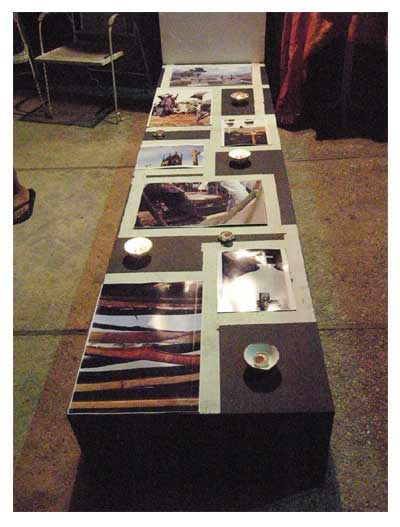

pictures

Other photographs are placed unconventionally on a mesh gate, and candles are placed in and about prints staggered on an elongated table thus giving a cosy ambiance to an informal gathering of well wishers in support to a show that will be fondly remembered.

Thursday, April 30, 2009

Nicholas Laughlin captures the Riches of El Dorado


Two superimposed photographs by Nicholas Laughlin, Statue of St. Peter in the Roman Catholic Cathedral; Cayenne, French Guiana, South America, 2009

The Trinidadian travel writer, Nicholas Laughlin, on his trip to French Guiana, South America in April, 2009, has posted a few snap shots of his visit which he says is just for memory sake. At these timely moments, the sites, places and people that captures him,
Mr. Laughlin takes his camera out of his leather canvas bag, composes the frame and squeezes the shutter button. The results, unknown to him are an inner compassion, his subtle beliefs in Christianity or more aptly the Christian motifs that mirror his poetic calling through the art of the lens.


Two superimposed photographs of a mural by Bagnard Francis Lagrange in the prison church on Ile Royale. Iles du Salut, French Guiana, South America, 2009

nicholaslaughlin-2

Superimposed photographs of a mural by Bagnard Francis Lagrange in the prison church on Ile Royale. Iles du Salut, French Guiana, South America, 2009

Nicholas Laughlin is the editor of The Caribbean Review of Books, a quarterly magazine and moderator of Antilles, the CRB blog. You may find out more about him at nicholaslaughlin.com.

Thursday, January 15, 2009

Minami + Carnival + Bore + Photographs


A series of carnival individuals photographed as portraits at the Softbox Gallery, Port of Spain, Trinidad

The Japanese photographer, Shizuka Minami has taken her 35 mm digital camera and snapped sixty large, medium and small photographs during the carnival season from 2005, 2007 and 2008 respectively. The exhibition at the Soft Box gallery in Port of Spain was well attended to see an aspect of Trinidad's carnival interpreted by a Japanese artist. Soft Box gallery proclaims she is the first Japanese photographer to show in Trinidad. Guests had wonderful things to say over the exhibition, uttering her work as Great.....no more no less.


A Fancy Indian taking a smoke and drink

Ms. Minami's subjects may have seized the opportunity to be snapped as portraits in a commonly fashion of just posing, and posing it is without any fanfare, spirit or feeling. Her stills taken at the Jean Pierre Complex or the Queen Park Savannah stage had more artistic resonance due to her focus of capturing a moment on subjects whose Trini posing was not on their agenda.


Shizuka Minami's gentleness and appreciation of Trinidad and Tobago though her photography at Softbox Gallery, Port of Spain, Trinidad

It should be noted that these digital photographs are printed precisely, they cost from $6000.00 to $900.00TTD. Minami + Carnival runs until 29, January, 2009.

Tuesday, September 23, 2008

My friends, my colleagues - Jeffrey Chock

I save your life - You pay me royally


Garry Chan inspecting the work of Jeffrey Chock's black and white photographs in aid of the photographer at Softbox, Trinidad. The prints he says are negatives that are quite old and of places that may no longer exists. The exhibitions runs until the 28th September, 2008

Photographers and artists have come to the aid of Jeffrey Chock who experienced complications of kidney and heart failure in Toronto, Canada.


.
Abigail Hadeed's subdued portrait of the traditional mas character representing the mythology dragon which is a fire breathing reptilian body with wings. The carnival protraits were taken during her session at Adam Smith's Square in Port of Spain, Trinidad and it embodies her role as to archiving these characters like her her colleague, Jeffrey Chock who had done in the past. The prints are signed and stamped by the photographer.


One of the pieces for sale in aid of Jeffrey Chock at Y gallery, Port of Spain

The thirteen photographers including Stephen Dalla Costa, Bertrand de Peaza, Alex Smailes, David Wears, Ian Chan, Gary Chan, Noel Norton, Abigail Hadeed, Mark Lyndersay, Stephen Broadbridge, Frederic Dubray, Wyatt Gallery and Jeffrey Chock have donated their work in his aid. The fund raiser is part of two exhibitions, where visual artists are going to be at the Y gallery, Port of Spain this coming Satuday. The proceeds are for Mr. Chock's medical bill which is the excess of $ 50,000 US dollars.
For donations to his health fund please contact Georgia Popplewell for further inquires.

A bank account has been opened for Jeffrey. Deposits can be made at any Trinidad and Tobago branch of Scotiabank. Cheques should be made out to "M. Mahabir". The account number is #4004891.

..............................................................................................................

Hippocratic Oath Modern Version

I swear to fulfill, to the best of my ability and judgment, this covenant:

I will respect the hard-won scientific gains of those physicians in whose steps I walk, and gladly share such knowledge as is mine with those who are to follow.

I will apply, for the benefit of the sick, all measures [that] are required, avoiding those twin traps of overtreatment and therapeutic nihilism.

I will remember that there is art to medicine as well as science, and that warmth, sympathy, and understanding may outweigh the surgeon's knife or the chemist's drug.

I will not be ashamed to say "I know not," nor will I fail to call in my colleagues when the skills of another are needed for a patient's recovery.

I will respect the privacy of my patients, for their problems are not disclosed to me that the world may know. Most especially must I tread with care in matters of life and death. If it is given me to save a life, all thanks. But it may also be within my power to take a life; this awesome responsibility must be faced with great humbleness and awareness of my own frailty. Above all, I must not play at God.

I will remember that I do not treat a fever chart, a cancerous growth, but a sick human being, whose illness may affect the person's family and economic stability. My responsibility includes these related problems, if I am to care adequately for the sick.

I will prevent disease whenever I can, for prevention is preferable to cure.

I will remember that I remain a member of society, with special obligations to all my fellow human beings, those sound of mind and body as well as the infirm.

If I do not violate this oath, may I enjoy life and art, respected while I live and remembered with affection thereafter. May I always act so as to preserve the finest traditions of my calling and may I long experience the joy of healing those who seek my help.

Saturday, July 28, 2007

British Petroleum's environmental scheme

A secondary school exhibition display on farming

In the atrium of the BP Building in Trinidad and Tobago, in front of Jacki Hinkson's mural, an exhibition is set up in a typical fashion. Plinths are covered with a black mat tarp and from a quarter off the floor, a decorative pattern runs along the edge. Distracting as this may be, it is also cluttered with matted photographs. These are the photography winners from the BP competition on the theme of the Energy for Life in Trinidad and Tobago.

But one wonders if truly the winners reflected particularity on the theme. The photographs encompassed images found in farming and the natural environment. These included animals, details of flowers, birds and photographs capturing the sun as the source of life, perfectly composed in the centre of the photograph and not neglecting the flare off some individual. Some photos looked doctored and others seemed staged including the first prize winner, Ronald Chung with his photograph of a farmer sprinkling beads of water on a plant. Second and third place winners captured Pigeon Point at dust and a child running with a fish, respectively. The winner of the amateur level, Brian Batholomew snapped a candid portrait of children and the overall photograph attempted to reproduce a Karen Sylvester moment with light permeating through a bamboo patch. images quite apt for an annual report cover and for their archive of over 500 submissions to which they have the rights to.

This exhibition could have been reduced to only five pieces, and the winner should have deservedly been awarded to Mr. Batholomew for the warmth and human element from his work. Otherwise, the exhibition showed an overwhelming degree of literal meaning, void by the theme itself, Energy for Life, and the pun on Energy/ BP/TT was never explored. Photographs were reduced to clichés and photographers romanticized the notion that all is well in this never ending flow of oil in picture-perfect-moments. BPTT Photographic exhibition at the atrium of the BP Building, Port of Spain runs till 29 July, 2007.

Fuel of the future: Hydrogen /Water. And when the oil reserves are depleted, the island will sustain it self with the abundance of hydro-liquid called, We Sea - thebookmann

Friday, July 13, 2007

Your destiny is on to you

Where did I go wrong...What has my Island become?
Before Newtown and Woodbrook, it was the district of Belmont. The place is in one of the most quaint parts of Port of Spain, Trinidad and Tobago. By this, it is the narrow alleys that aline the streets with small colonial or what we like to call gingerbread houses with open porches and white filigree molding to their entrances.

Many prominent Trindadians have walked the
streets, and there are stories of the diverse and rich history that included the the formation of the Rada religion, the German community enclave and the home to many important Mas-band leaders.

The older woman that is standing on the curb off the Belmont Circular road is in deep contemplation. It may be thoughts of her future or her past, yet her present is clearly illustrated by the Gang graffiti painted in blue on a white wall behind her - Bloody $. This represents the young people who find themselves hopelessly powerless in their destiny, and the life that everyone speaks as so sacred is worth no less that a cent. -thebookmann

Monday, July 09, 2007

Lapeyrouse Wall

Sometimes you come across a moment that stirs your senses from a image that seems so important. And as you capture it, it is in the capturing that a memory is stirred that leads you to another image painted on canvas.

This is when a thought occurs that you have seen it before. It is the impact. It stops in you tracks and in its recognition is what makes art important. It is the moment of the experience that can last for a lifetime. It may be small or large but art is impacting.


This is the wall of Lapeyrouse
cemetery in Port of Spain, Trinidad and a figure of a person is caught in a heavy down pore, protected by a light pink umbrella. What is unique about this photograph is that the likeness and composition has been captured before by a renown artist. The painting, Lapeyrouse Wall hangs within the walls of the Moma in New York.

See Peter Doig's (Lapeyrouse Wall) - What brought me to this place post

Tuesday, May 01, 2007

A journey to the past – Ontario part 2

When we speak of progress, what we really mean is to rape ourselves

If you are unfamiliar with these structures, it is because they may not exist today. These photographs was taken in 1993 before the city's facelift which has transformed it. - Take it or leave it.

On thebookmann's journey of documenting buildings in parts of the industrial areas of the Toronto, these images say it all because the structures have been erased from memory. So just north of King Street, Toronto, Ontario, there once stood the Gardiner expressway with its dual roadway concrete structure, and at the time, the building below was in being demolished on King Street, east of Yonge. - thebookmann

Monday, April 30, 2007

A journey to the past – Ontario part 1

Farewell my past, farewell

These photographs were taken from 1990, and it was at a time when thebookmann began to document building that were being demolished in many parts of the city. It was the last rite to the buildings which were once part of the Toronto's urban landscape and industrial past. -thebookmann


Saturday, April 28, 2007

Churches & Cemeteries series 4

The Trinidad Aesthetic - Time and Decay

Over the the years thebookmann has been interested in the themes of time and decay. He has traveled all over Trinidad and Tobago amassing photographs from cemeteries. It has been solitary and grimy work. It has wrought personal views on life and death, but also on traditions and rituals. He has asked aloud many times, what is happening with the preservation of our monuments? I have been fortunate to travel with him to a few places and seen first hand the sort of work involved. It takes a keen eye to not just take images of tombs, but of the personality behind the architecture. He lets us see the love and care of the living, as some family members leave photographs, write the family name in paint, leave plastic flowers, candles and incense.

Our cemeteries are historical documents. We can see areas that once were restricted to families of the highest classes. Areas where the Jews fleeing Nazi Germany are buried, the many orders of priest and nuns, new names of families who have come up in the world in a generation or two side by side with those who have gone down or remained in stasis.- Adele

These photographs mark ten years since the idea of the Trinidad Aesthetic. It began
with documenting churches and cemeteries such as the Anglican Trinity Cathedral, the Holy Rosary and Laperose cemetery in Port of Spain, Trinidad and Tobago. It has been an adventure in its self, and for example, at the time the mausoleum (centre) was photographed, howls and wailing sounds from the dilapidated crypt could be heard. thebookmann and Adele were not going to further investigate the source, we just wanted to leave as quickly as possible, until a large man unearthed himself from it. But to our horror, the same man, much later entered a food court in Port of Spain and calmly ordered a meal and drink, needless to say, we have never ventured back to the eatery since. How Trinidad Aesthetic -thebookman


Thursday, April 26, 2007

Churches & Cemeteries series 2

Hallways, Wooden archways, Roofs and Statuette Saints

The series of Double Exposures continues and these are photographs of the interior of the Roman Catholic church from the previous post. The Rangefinder, as one reader hints is that of a Leica, but rather it is a 1958 Konica, yet the optics on both cameras are considered comparable. The double exposures were a result of not advancing the lever completely to advance a full frame, it uses a double-stroke film advance. - thebookmann

Wednesday, April 25, 2007

Churches & Cemeteries series 1

Church bells, wooden Christ, stain windows, graveyard monument


These four frames were captured on a film during a visit to
public cemetery, and a Roman Catholic and Anglican church, all situated in Arima, Trinidad and Tobago. The photographs were taken In 2004 with a vintage rangefinder camera in which the film was accidentally double exposed. -thebookmann

Monday, April 23, 2007

Caribbean Flowers Series - Bromeliads

Where I rest, thus shall I sustain life

The Bromeliad plant Tillandsia fendleri is quite common in Trinidad and Tobago and actually it is quite lovely to observe the method in which the plant disperses its seeds. There are sacs at the top of the stem, and as the pod opens, thatches of silk haired strands are release into the air by a gentle gust of wind. The shape of the seed is best described as a wire framed umbrella that hovers in flight briefly and then disappears into the heavens.

Bromeliad can sustain itself by the atmosphere alone, and you may see the plant attached to electric poles, or between cracks on concrete. They are also from the family of the Pineapple.

In gardens across Trinidad and Tobago, many varieties of the Bromeliads are used to decorate around a garden's floor bed.
Epiphytes, or air plants are considered a type of parasite because they attached themselves to the branches of trees, but they survive off the moisture and nutrients from the air and rain.

If one has previously observed, the older photographs on this post lacked aesthetic quality produced from the modified Minolta Dimage 7i which suddenly failed, and abruptly ended the series on flowers. And trying to duplicated it just does not work, no matter how hard you try. Photography should be effortless. The Canon Pro 1 which the majority of photographs on this blog has been taken is rather a unsubstantial tool catering for candid shots using a tripod if possible. The grain can be noticed from 200 ISO. But as the saying goes, every thing has its place, make due with what you have and the best is yet to come. But the greater lesson is to focus on what you love no matter how difficult its appearance may be. -thebookmann

Saturday, April 21, 2007

A Pineapple, Jug and Stool

What I have found and not looking for......Pablo Picasso

It is interesting when your have limitations and the works that can be come out from it. Here are three objects are part of the series on the Caribbean fruit, but with a twist. Below, details of the Pineapple leaf.


Monday, April 16, 2007

Nothing in the world sweeter than.....

Man does lick down man to find it

Below are the lyrics from a Calypso by the Mighty Sparrow, and it is a testament of how sweet tasting Saltfish really is. We know that he is singing about something else. The Lord Kitchener also sang about Saltfish and he lamented how his Caribbean wood was too good for his lady friend's cooking. She had tried all other types of foreign wood, but they seemed not to heat up her pot, although Kitch's wood spoke otherwise and she yelled, "Kitch, take out yeh wood, it burning up meh saltfish".

In parts of the Caribbean, dried Cod fish is prepared and cooked in many ways. The fish is soaked in water to remove most of the salt. Some people just throw hot water on it, three times and it is ready, others soak it overnight. Cod can be stripped and fried or just seasoned with onions, sliced tomatoes and olive oil. Buljol is a favorite in Trinidad and Tobago and it is served with boiled eggs, slices of avocados and fried bake.

But you should also be wary when you buy at the market, some vendors like to add a bit of water to swell the meat, its weight and eventually its cost to you. Saltfish should be dry and covered with salt granules. -thebookmann

Saltfish stew is what I like
So doo-doo, give me day and night
I like you food, so don't find me rude
My favorite, I sure every man in here already eat it

Saltfish

Nothing in the world sweeter than

Saltfish

English, colloquial, Bajans

Saltfish

It's sweeter than meat
When you want to eat
All saltfish sweet

Very well, I like the taste
Though the smell, sometimes out of place
It hard to take, but make no mistake
I want you to know, it's because it extra sweet it smelling so boy it's

Saltfish

Big money does run behind it

Saltfish

Man does lick down man to find it

Saltfish

It's sweeter than meat
When you want to eat
All saltfish sweet

Some like it hot, some like it cold
No matter what, I take it young or old
When it serve with wine, man does stew it fine
Put no pepper, the bone in the centre does be sweet like sugar

Saltfish

Some men does get drunk to taste it

Saltfish

Some does go and hide to face it

Saltfish

It's sweeter than meat
When you want to eat
All saltfish sweet

Sunday, April 15, 2007

Watermelon and Okra


The Caribbean series of Fruits continues. This time it is a composition of fruits....namely a slice of watermelon and a dried Okra

Okra is quite loved in Trinidad and Tobago and it is a vegetable that originates from West Africa. It is the main ingredient in Coocoo
which is type of Polenta. Coocoo is a Sunday meal which is generally served with Callaloo and fried King fish. Callaloo also has okra and coconut milk which is added to a mixture of boiled Callaloo Bush and salted meat. Its greenish and gluey consistency may not be appetizing, but it is delicious to the pallet. But some people dislike the mucus texture of the okra seeds. To test how young a okra is, the tip of the fruit should break off easily.

Trinidad may not be blessed with the finest beaches, but on Saturdays and Sundays people commute to the coastal areas for the day to take a good sea bath. And nothing better can describe the Caribbean as the breeze hits your saltwater soaked skin while you are devouring a slice of
watermelon.

Watermelon in art: In her last work produced in 1954, a still life of watermelons, the Mexican painter Frida Kahlo inscribed on the painting the words, Viva la vida (Long Live Life)

Tuesday, April 03, 2007

Caribbean Flowers Series - Hibiscus


In 1998, Wendy Fitzwilliam was crowned Miss Universe. It was a proud moment for Trinidad and Tobago as she was the second Trinidadian to receive the title. But if one remembers, Ms. Fitzwilliam wore a Hibiscus in her hair. The Hibiscus is the national flower of Hawaii and it also thrives in Trinidad and Tobago.

In Caribbean folk medicine, the flowers are used for herbal tea remedies for ailments such as high blood pressure or constipation. Chows are also made. There are many varieties or grafted variations of this tropical scrub, but in 1988 many Hibiscus trees were devastated by the pink mealy bug infestation. -thebookmann

Sunday, March 04, 2007

Tobago - immortalized in gelatin

Abandonment and emptiness where voices filtered once through is silent. Here stands a whistling instrument to the wind


T
he delightful image of the children sheltering from the rain, their hands and faces gesturing upward, asking, ’Is the rain over yet.” Transforms you. You feel a part of the scene. But let us look closer. The vertical reds of the parlor helps focus your eyes on the children. The colour is sharply contrasted and make this photograph an artistic one.


Is Tobago this way today? In some ways, but it is changing. thebookmann's eye is acutely tuned to colour. It is the basis of all that he does. He is sensitive to its impact. So when he says that he is a colourist, know that he means in all media colour is his technique and his tool.


The old house with the broken window pane is a pastiche and the bookman comes back again and again to the abandoned spaces. The colour and the texture of this piece is further highlighted by the sense of perspective.


The interior of a house, framing another along the way with its weather beaten roof compel me to reach for V.S.Naipaul’s writings on the Caribbean and the framing of the two men amidst the vertical and horizontal lines of the building, the pink wash and whitewash providing texture. You tell yourself that it feels like a Sunday. - Adele

Monday, February 26, 2007

Owner and Stefan around the Savannah


Stefan Falke's photograph of a homeless man, Trinidad, West Indies

It is very rare that you come across a photographer whose work is so poignant in every respect. The photograph above is by Stefan Falke and the German photographer has spent a great deal of years documenting the Keylemanjahro school of Moko Jumbies.

Mr. Falke along with his official website, also has a blog, and his portfolio of work comprises of his photo shoots assignments all over the world. Yet, Trinidad and Tobago has a special place in his heart. The island’s rich and colourful culture gives him great pleasure with his art.


The homeless man painted by Tassa Alexander

Stefan Falke's latest post is deeply touching, and it is of a homeless man who sits on the bench around the Queen's Park Savannah, Trinidad and Tobago. The individual has been observed writing in his journals come rain or shine. On rainy days, he covers himself with a clear plastic tarp.

Saturday, May 27, 2006

A Criteria for Caribbean Artists and Photographers

Fourth world photography


The National Library's exhibition foyer. Shows are generally displayed on plinths or tables.

Coordinated by Patricia Mohammed and Rex Dixon, the Caribbean in the age of modernity is a photographic exhibition organized by the Conference of Caribbean Studies Association. Thirteen Caribbean artists participated in this show at the National Library of Trinidad and Tobago as they dabble into the world of photography, questioning the very standards of Caribbean photography itself.

Although
amateurishly displayed, this exhibition included professional and non-professional alike. Abigail Hadeed for an example stuck with her journalistic view of the Caribbean diaspora. From Jamaica, Annie Paul documented a Dancehall event and Patricia Mohammed took snap shots of wall paintings in Haiti, but her reproductions were poor in terms of its caliber. Errol Brewster from Guyana produced a grainy collage from 35 mm negative and was one of the more successful prints. So the question is, are these the standards set by artists and academics from the Caribbean?


Steve Ouditt's orthodox stills of Hindu sites in Trinidad and Tobago. The Caribbean in the age of modernity, runs till June 8th.

Disclaimer:

Views expressed on thebookmann are not affiliated with any Art Organizations and an “Art Review” may be open to interpretation as it is an observation at face value.

Amendments to such articles if misleading or with grammatical errors shall be corrected accordingly.

All photographs, Feinin studies, accompanying quotes, articles and visual headers appearing on site are the exclusive property of Richard Bolai © 2004 - 2010 All Rights Reserved.

Any fare use is restricted without written permission