(Forget the Bauhaus, learn to speak Artspeak publicly without stumbling over any Big Words. Postmodernity, I have to pronounced as Post-mo-dernity, That’s it, that be it, me, me sitting here, King, King of the Art world)
Here it is boys and girls, the formula:
The History
The idea of postmodernism was first introduced in 1934 by the Spanish writer Federico De-Onis in his Antoloqia de la poesia espanola e hispanoamericana to describe a reaction within modernism. In 1938, the term postmodernism was used by Arnold Toynbee in his A Study of History. Toynbee identified postmodernism as the new historical cycle epitomized by the decline of Western capitalism and rise of Non-Western cultures and pluralism (Jencks, 1986 )
Ambivalence and Elasticity of Postmodernism
In discussing postmodern art education Clark (1996) sounds a cautionary note :In regard to the communicative elasticity and deliberate ambivalence associated with postmodernism. He emphasizes three main characteristics associated with the term. First, postmodernism is transitory : it suggests only what it is not rather than what it is or.Second, postmodernism is transcendent, which means that postmodernism is reflected in a variety of disciplines. It can be seen as a cross-disciplinary practice. There is a specialized terminology that demarcates a postmodern discourse (e.i., master narrative, simulacra, decentered subject,etc) and theoretical frameworks such as poststructuralism, deconstruction, reconstruction, and feminism.. Third, Clark sees postmodernism as transitional, which means that postmodern theories do not always depart from modernist principles (Clark, 1996) He points out that a feminist or postcolonial theorists may speak from the perspectives, that are modernist, postmodernist, or somewhere in-between” (Clark,1996,p.l).
Defining Postmodernism
Why do we need a clear definition of postmodernism in education? As a preliminary response to this question, the following paragraphs point to the variety of language and concepts covered under the umbrella term "postmodernism" In some sense, any attempt to define fully postmodernist, that is, to provide fixed explanations seems to be antithetical to its underlying premise that is, the nature of postmodernism is ultimately against totalization and fixed concepts (Usher & Edwards, 1993). The postmodern condition can be perceived as a "sensitivity to differences" or a ‘var on totality’. It is a period in which everything is delegitimized” (Jenks, 1986,p.10). It was modernism that was interested in definitions and descriptions of itself in order to underline its timeless ideals (Sarup,1993). In today’s education of artists, postmodernism is mainly discussed as a radical break from modernism and its formalist discourse.
The irony here is that in taking such a stance these advocates have made postmodernism as fixed and doctrinaire as the formalist approach to art once was. But education in a rapidly evolving world needs to remain flexible and open to discourse from a multitude of perspectives. If post modernism is be a credible and viable educational. influence, it too must be capable of flexibility. As Usher & Edwards ( 1994) state,
To talk about postmodernity, postmodernism or the postmodern is not therefore to designate some fixed and systematic “thing”. Rather, it is to use a loose umbrella term under whose broad cover can be encompassed at one and the same time a condition, a set of practices, a cultural discourse, an attitude and a mode of analysis (p.7).
Transcribed: A thesis submitted to the Faculty of Graduate Studies and Research in partial fulfillment of the requirements of the degree of Master of Arts. Art, Study and teaching, Philosophy. Postmodernism and education, Aesthetics, Modern 20th century. McGill University Libraries, National Library of Canada. Download the pdf file
Sarah Lucas' installation with memories of Tracey Emin and Damien Hirst union
One of the hardest things to reconcile as a student is presenting a concept in a professional way if you have very little experience at it. I remember when I was in college and survey time came around. This provided an opportunity for students and faculty to see the best of the semester. Students were allotted a specific space, and it was up to you to co-ordinate that space.
What this exercise did, was it encouraged you to see your work beyond the concept. It helped you to build character as the artist you were purporting to be, because in presentation, you literally had to stand by your work and have it represent you. One semester a student decided to do a twenty foot image of himself in caricature, hanging from the ceiling in chalk pastels. Another decided to put his entire portfolio on film, and consider that his work in presentation. Did these things work? Yes and no.
This is not only true in school, this is also true in the real world with showing work to the public. Today, Art is tested as anything and everything. The artist Cai Guo-Qiang works with fire, smoke and explosives. Sarah Sze works with chaos theory and Sarah Lucas works with cigarette butts and produce and is one of my favorite British artists at the moment. These works are not package able, nor easy to characterize, yet what these artists have in common, besides very strong concepts, is an ability to craft their thoughts into resonant, dynamic imagery. It is very easy to argue, what about work that does not look neat, clean or even healthy? Take the many works using meat in the last decade. Or taxidermy?
There are many people who deliberately misrepresent Installation Art as something beyond what it is. Installation Artists like the very famous Christo sell representations of their works that are transient. At the end of the day an artist is a professional, wanting to make a living like anyone else, and art is a fickle profession as Serrano Andres of the famous Piss Christ may attest. Today’s Art Star may be tomorrow’s window washer. The flexibility of what is Art shall always swallow and spit out its progeny. It plays no favorites. Art is best understood in the future.
Cai Guo-Qiang produces artworks with fire and explosives - (visually uncontrolled)
With that said, we in the present respond via a series of markers. Some of them are technical ability, concept, skill, intention and presentation. But of late, for some, it is also is it hard to understand? Am I revulsed? Then maybe it is good. No one wants to be caught sleeping at the wheel of the next art trend. Again, when I was in college there was a guy who had great skills, he could technically render anything to look like the real thing. However, he lacked something very crucial, concept. He was reduced to being a good draftsman because of it. When I started teaching, I came across a student who had great concepts, but she could not make them jump off the page to save her life. This reduced her to a position of idea person, needing someone else to bring her vision to light.
It is very true that presentation can make something very droll, exciting and filled with more meaning than the thing ever intended. The same can be said for concept, where more can be read into something than is actually there. These challenges of perception is one of the many things that prove that art is far from easy to do, but more so, that the argument of what is good and what is not, is not so clear cut.
There are many people who deliberately misrepresent Installation Art as something beyond what it is. Installation Artists like the very famous Christo sell representations of their works that are transient. At the end of the day an artist is a professional, wanting to make a living like anyone else, and art is a fickle profession as (…) of the famous Piss Christ may attest. Today’s Art Star may be tomorrow’s window washer. The flexibility of what is Art shall always swallow and spit out its progeny. It plays no favourites. Art is best understood in the future.
Sarah Sze's kinetic chaos motifs
With that said, we in the present respond via a series of markers. Some of them are technical ability, concept, skill, intention and presentation. But of late, for some, it is also is it hard to understand? Am I revulsed? Then maybe it is good. No one wants to be caught sleeping at the wheel of the next art trend. Again, when I was in college there was a guy who had great skills, he could technically render anything to look like the real thing. However, he lacked something very crucial, concept. He was reduced to being a good draftsman because of it. When I started teaching, I came across a student who had great concepts, but she could not make them jump off the page to save her life. This reduced her to a position of idea person, needing someone else to bring her vision to light.
It is very true that presentation can make something very droll, exciting and filled with more meaning than the thing ever intended. The same can be said for concept, where more can be read into something than is actually there. These challenges of perception is one of the many things that prove that art is far from easy to do, but more so, that the argument of what is good and what is not, is not so clear cut. - Adele
A statue of Saucy Pow at Tate Modern, really, well...not really. Culture verses the understanding of it
Can a local artist be satisfied when they show abroad and the writing on them is not substantial? I had the opportunity to read some writing on a promising local artist recently, and I was very excited and happy about the fact that the person had succeeded in taking their vision further. They have worked a very long time, and have kept their focus for several years. They have shown abroad before, so I was expecting a really good bit of Art writing on the person’s work.
To my surprise, I found instead a confection. A puff piece of particular delicacy. The person sounded more like a curiosity than the actual hard working Artist that they are. The references given were to another person long since dead, and no reflection on fellow contemporary artists working in that oeuvre were mentioned. I was left quite cold.
One of the most difficult things to reconcile with writing on an artist, Is that most artists who are more than just Sunday painters, want proper critique. They want to know that their work is moving someone in some way. They want to know that they are making connections with their audiences as well as their peers. When someone writes a piece and gives no other information than what the catalogue provides, or no more than perfunctory information it frustrates the reader who loves art and wants to know more about it. It really does a dis-service on all levels, because it provides no further dialogue on that person. It puts the work in no category and moreso, it provides no room for growth, for the Artist or the subject matter. It assists in continuing certain work along a stalled path because there is no friction to feed off of.
So for those artists who get angry with critiques, actually, the anger allows for some sort of abstract awareness of a position or positions that lead somewhere. Exactly where remains to be seen, but it encourages a history of sorts for the two players. Yet, when there is full agreement of what is written, it also implores the artist to proceed apace. For the work is never for an audience of one.
Addendum
If the foreign writer has very little to connect the work of a West Indian artist, can you imagine the difficulty in finding the local research to give an interview or review ! To find good information, you have to know some older artists who live and work in the island. But also, you have to know what is fact and what is simply conjecture. You would have to know the history of the place, and a close history at that, as the writing would be less about innovations in art, and more about dates, times and influences.
To me this is an urgent situation. There are very capable people who can do this, but I believe that there is no financial value in it for them, so they decline. Perhaps memoirs may be written in the future and from that, a history can be culled.
Kwynn Johnson's thesis catalogue as an artwork, am I part of its history?
Article courtesy of Sexypink Last week I went to see the work of a young, up and coming Artist, Kwynn Johnson. Her show at Softbox, titled, “Red, appropriated”(sic),was in part fulfillment of her Masters in Cultural Studies. Looking at her presentation, I could not help but hark back to a long conversation that I had had with the Artist Christopher Cozier many years ago on the work of his wife, Irenee Shaw. He had told me in regard to my own work, Hit! In 2000, where I used red embroidery, that Ms. Shaw had had a show in 1989, where she used red thread on her canvases. Red thread has also been part of the visual language of the artist Richard ‘Ashraph’ Ramsaran, who in 2001 used a thin red thread through his biographical works titled, de Line at CCA7. The use of red thread has a deep, resounding influence in contemporary arts of Trinidad over the last twenty years. If it has been pervasive before I would appreciate further information on the topic. It is because of this knowledge that I was saddened when in my reading of Ms Johnson’s catalogue, I found no such historical references to this material that informed all of her work. This is difficult to state because I am somewhat involved as an artist working in embroidery and favoring red thread. One is inclined to assume special interest on my part. But it is because I use thread in my own practice that this observation bears notice. Particularly because of the fact that there is also a very big difference between those who use embroidery and those who use thread. I also would not be so reactionary if her show was simply one for public viewing.Her show is a visual academic thesis. It is in fulfillment of a degree and so, it must stand up to the rigors of research and specifically the lack of documented research that is retained in the memories of our older art community who can recall much of the history. I have been extremely fortunate to be the recipient of many small volumes of writing published in the sixties, seventies and eighties on Art, dance and culture. These have been marginally helpful, yet, they too neglect to add certain things that help theoretical discourse because they are largely personal opinion. I find this concern in writing on my own blog. I enjoy writing about Art as a practitioner of it, and in my own way, I am very aware that what I write is being read and quoted, and so I want to be faithful to facts as well as recollections. If I am very concerned, and this is just a blog, then by all means, we all must care about the lack of facts in the documents that pass as research, particularly when these facts are used by academia.
You can't be a preacher without knowing the bible The Anti-Fucking-Aesthetic: Essays on Postmodern Culture Postmodernism: does it exist at all, and if so, what does it mean? Is it a concept or a practice, a matter of local style or a whole new period or economic phase? What are it's forms, effects, place? How are we to mark its advent? Are we truly beyond the modern, truly in (say) a postindustrial age? The essays in this book take up these questions and many others besides. Some critics, like Rosilind Krauss and Doulglas Crimp, define postmodernism as a break with the aesthetic field of modernism. Others, like Gregory Ulmer and Edward Said, engage the "object of post-criticism" and the politics of interpretation today. Some, like Craig Owens and Kenneth Frampton, frame its rise in the fall of modern myths of progress and mastery. But all the critics, save Jurgen Habermas, hold this belief in common: that the project of modernity is now deeply problematic. Assailed though it is by pre-, anti-, and postmodernists alike, modernism as a practice has not failed. On the contrary: modernism, at least as a tradition, has "won"--but its victory is a Pyrrhic one no different than defeat, for modernism is now largely absorbed. Originally oppositional, modernism defied the cultural order of the bourgeoisie and the false "normativity" (Habermas) of its history; today, however, it is the official culture. As Jameson notes, we entertain it: its once scandalous productions are in the university, in the museum, in the street. In short, modernism, as even Habermas writes, seems "dominant but dead." This state of affairs suggests that if the modern project is to be saved at all, it must be exceeded. This is the imperative of much vital art of the present; it is also one incentive of this book. But how can we exceed the modern? How can we break with a program that makes a value of crisis (modernism), or progress beyond the era of Progress (modernity), or transgress the ideology of the transgressive (avant-guardism)? One can say, with Paul de Man, that every period suffers a "modern" moment, a moment of crisis or reckoning in which it becomes self-conscious as a period, but this is to view the modern a historically, almost as a category. True, the word may have "lost a fixed historical reference" (Habermas), but the ideology has not: modernism is a cultural construct based on specific conditions; it has a historical limit. And one motive of these essays is to trace this limit, to mark our change.
A scene from the art film Slacker, 1991. Pay close attention to the book that he puts in his bag.
A first step, then, is to specify what modernity may be. Its project, Habermas writes, is one with that of the Enlightenment: to develop the spheres of science, morality, and art according to their inner logic." This program is still at work, say, in postway or late modernism, with its stress on the purity of each art and the autonomy of culture as a whole. Rich though this disciplinary project once was--and urgent given the incursions of kitch on one side and academe on the other--it nevertheless came to rarefy culture, to reify its forms--so much so that it provoked, at least in art, a counter-project in the form of an anarchicavant-garde (one thinks of dadaism and surrealsm especially). This is the "modernism" that Habersham opposes to the "project of modernity" and dismisses as a negation of but one sphere: nothing remains from a desublimated meaning or a destructured for; emancipatory effect does not follow."
Kenneth Frampton explains on the urban landscape and modern architecture Although repressed in late modrnism, this "surrealist revolt" is returned in postmodernist art (or rather, its critique of represenation is reaffirmed), for the mandate of postmodernism is also: "change the object itself." Thus, as Krauss writes, postmodernist practice "is not defined in relation o a given medium...but rather in relation to the logical operations on a set of cultural terms." In this way, the very nature of art has changed; so too has the object of criticism: as Ulmer notes, a new "para literary" practice has come to the fore which dissolves the line between creative and critical forms. In the same way the old opposition of theory and practice is refused, especially, as Owens notes, by feminist artists for whom critical intervention is a tactical, political necessity. The discourse of knowledge is affected no less: in the midst of academic disciplines, Jameson writes, extraordinary new projects have emerged. "Is the work of Michel Foucault, for example, to be called philosophy, history, social theory or political science?" (One may ask the same of the "literary criticism" of Jameson or Said.) As the importance of a Foucault, a Jaques Derrida or a Roland Barthes attests, postmodernism is hard to conceive without continental theory, structuralism and poststructuralism in particular. Both have led us to reflect upon culture as a corpus of codes or myths (Barthes), as sat of imaginary resolutions to rel contradictions (Claude Levi-Strauss). In this light, a poem or picture is not necessarily privileged, and the artifact is likely to treated less as a work in modernist terms--unique, symbolic, visionary--than as a text in a postodernist sense "already written," allegorical, contingent. With this textual model, one postmodernist strategy becomes clear: to deconstruct modernism not in order to seal it in its own image but in order to open it, to rewrite it; to open its closed systems (like the museum) to the heterogeneity of texts" (Crimp), to rewrite its universal techniques in terms of "synthetic contradictions" (Frampton)--inshort, to challenge its master narratives with the "discourse of others" (Owens). But this very plurality may be problematic: for of modernism consists of so many unique models (D.H. LAwrence, Marcel Proust...), then "there will be as many different forms of postmodernism as there were high modernisms in place, since the former are at least initailly specific and local reactions against these models" (Jameson). As a result, these different forms might be reduced to indifference, or ostodernism dismissed as relativism (just as postculturalism is dismissed as the sbsurd notion that nothing exists "outside the text").
This conflation, i think, should be guarded against, for postmodernism is not pluralism--the quixotic notion that all positions in culture and politics are now open and equal. This apocalyptic belief that anything goes, that the "end of ideology" is here, is simply the inverse of the fatalistic belief that nothing works, that we live under a "total system" without hope of redress--the very acquiescence that Ernest Mandel calls the "ideology of late capitalism." Clearly, each position on or within postmodernism is marked by political "afiliatios" (Said) and historical agendas. How we conceive postmodernism, then, is critical to how we represent both present and past--which aspects are stressed, which repressed. For what does it mean to periodize in terms of postmodernisn: to argue that ours is an era of the death of the subject (Baudrillard) or of the loss of master narratives (Owens), o assert that we live in a consumer society that renders opposition difficult (Jameson) r amidst a meritocracy in which the humanities are marginal indeed (Said)? Such notions are not apocalyptic: they mark uneven developments, not clean breaks and new days. Perhaps, then, postmodernism is best conceived as a conflict o new and old modes--cultural and economic, the one not entirely autonomous, the other not all determinative--and of the interests vested therein. This at least makes the agenda of this book clear: to disengage the emergent cultural forms and social relations (Jameson) and to argue the import of doing so. Even now, of course, there are standard positions to take on postmodernism: one may support postmodernism as populist and attack modernism as elitist or, conversely, support modernism as elitist-as culture proper--and attack postmodernism as mere kitsch. Such views reflect one thing: that postmodernism is publicly regarded (no doubt vis-a-vis postmodern architecture) as a necessary turn toward "tradition." Briefly, then, I want to sketch an oppositional postmodernism, the one that informs this book.
Jurgen Habermas reflects on his studies
In cultural politics today, a basic opposition exists between a postmodernism which seeks to deconstruct modernism and resist the status quo and a postmodernism which repudiates the former to celebrate the latter: a postmodern of resistance and and a postmodern of reaction. These essays deal mostly with the former--its desire to change the object and its social cotext. The postmodernism of reaction is raf better known: though not monolithic, it is singular in its repudiation of modernism. This repudiation, voiced most shrilly perhaps by neoconservatives but echoed everywhere, is stategic: as Habermas cogently argues, the neoconservatives sever the cultural from the social, then blame the practices on the one (modernism) for the ills of the other (modernization). With cause and effect thus confounded, "adversary culture is denounced even as the economic and political status quo is affirmed-indeed, a new "affirmative" culture is proposed. Accordingly, culture remains a force but largely of social control, a gratuitous image drawn over the face of instrumentality (Frampton). Thus is this postmodernism conceived in therapeutic, not to say cosmetic, terms: as a return to the verities of tradition (in art, family, religion...) Modernsm is reduced to a style (e.g., "formalism" or the International Style) and condemned, or excised entirely as a cultural mistake; pre- and postmodern elements are then elided, and the humanist tradition is preserved. But what is this return if not a resurresction of lost traditions set against modernism, a master plan imposed on a heterogeneous present? A postmodernism of resistance, than, arises as a counter-practice not only to the official culture of modernism but lso to the "false normativity" of a reactionary postmodernism. In opposition (but not only in opposition), a resistant postmodernism is concerned with a critical deconstruction of tradition,not an instrumental pastiche of pop- or pseudo- historical forms, with a critique or origins, not a eturn to them. In short, it seeks to question rather than exploit cultural codes, to explore rather than conceal social and political affiliations. ......................................................................................................................................................................
During my studies at Art school, I remember one of the students in my core group got so frustrated with the language that she literally pulled out strands of her own hair. The Anti-Aesthetic: Essays on Postmodern Culture.
The text is the preamble by the author, Hal Foster, first published in 1983. The Anti-Aesthetic includes works by, Jurgen Habermas, Frederic Jameson, Edward Said, Kenneth Frampton, and Douglas Crimp.
The whole approach to criticism applies to the very act of observation, like the Art object itself, it falls into the category of a public arena, and asks the question of; meaning, interpretation, debate and value in societal terms
Many Artists I know deny strongly that they are entertainers. They seem to consider the very idea a dirty word. But in my understanding, the artists who know that it is a component of Art, are those who fair better in its unpredictable seas. However, this also depends on what ‘better’ really means. I have been alive long enough now to know that fame is not necessarily the thing to court. So, if Art is about entertaining, and fame is fickle, then what about opinions? Why take stock in them at all?
I have looked at a great deal of work from many places over my lifetime, and patterns emerge from this constant observation and attempting to make sense of why one image can make you feel longing and another can leave you cold and unresponsive. I am still impacted by this, even now. I must leave room enough to look at things afresh, and that is why for example in something even more fickle, like Fashion Design, a shifting of silhouette can make all the difference from year to year. Fashion knows its role, and so does Art.
So, with this known, Art can be maddening in its intent. Some things can excite now, itch your retina for more, but as a dear friend says, in a flash, it is like fast food. Not particularly healthy memories.In fact that is the point of some work. Today, one good idea can be stretched out and exploited to such an extent that the original is rendered useless. My point ultimately is that with all the media and imagery floating about, much rises to the surface, and these things that do, demand observation. Those observations encourage further interpretation and analysis. Criticism is part of the process. It actually is the steering that gives the work its compass.
Above: Self portrait superimposed with Michelangelo di Lodovico Buonarroti Simoni
And now, for an entertaining hour on Arts Criticism......the adjudicator exits with a jester’s bow
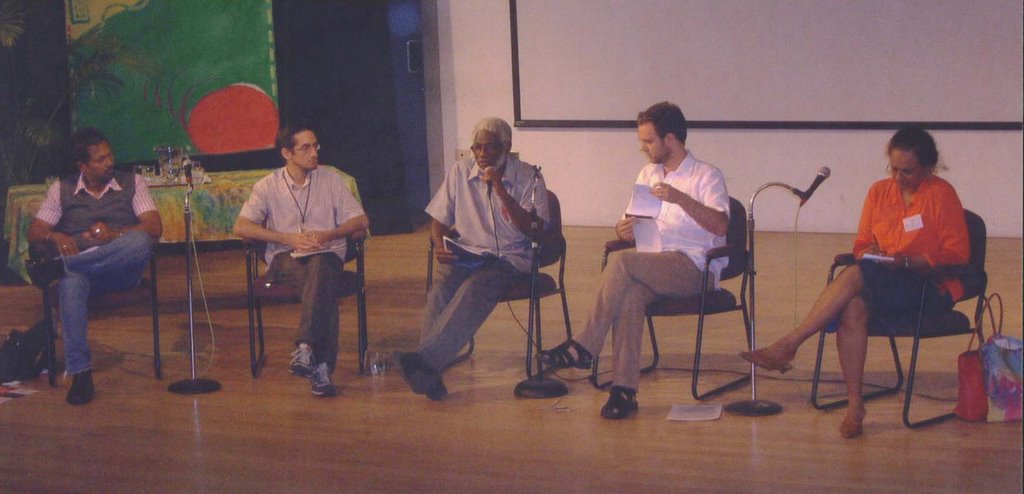
At the Second Caribbean International Arts Education Symposium at the University of the West Indies, Steve Ouditt, Nicholas Laughlin, Louis Regis and Leon Wainwright presented their papers to a parse audience. The hour long lecture was moderated by Annie Paul.
Dr. Leon Wainwright began his findings by questioning the curatorial decision from a traveling art exhibition in America. America, Black Power Movement and Art, failed he said to acknowledge Caribbean Blacks in the show. The editor of Caribbean Beat, Mr. Nicholas Laughlin spoke of the humble beginnings of the Caribbean Book Review and its struggle to be published in Trinidad and Tobago, and Steve Ouditt debated over the role in selecting artwork from a curatorial level.
Views expressed on thebookmann are not affiliated with any Art Organizations and an “Art Review” may be open to interpretation as it is an observation at face value.
Amendments to such articles if misleading or with grammatical errors shall be corrected accordingly.
Richard Bolai lives and works from Trinidad, West Indies. He is a bookbinder,Graphic designer and the author of thebookmann, which from 2004, has written and photographed independently aspects of Trinidad and Tobago's art culture.
In 2008, he began a series of self studies called Feinin which incorporated digital superpositions of artists who have left a mark in art history by using the internet as the core of reference. He also produced parodies relating to anthropological studies of Trinidad and Tobago, for example, folklore or observations of the society via class and stereotypes
The work then expanded by actually creating dimensional replicas, capturing a map over the subjects to explore the underling subconscious in the form of art. This aided the ability to analyze art by producing art parodies to understand the meaning behind it. No money was spent or assistance in producing these compositions from common items found in his home, a chair, a mirror, or old tyre.