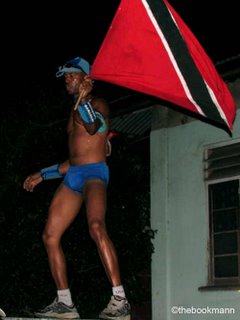
The Flag of Trinidad and Tobago - Red with a white-edged black diagonal band from the upper hoist side to the lower fly side. This masquerader is showing off his weeks weight training and twirling our flag as if he was a flagman.
Flagman jumps down from the wall to get a last lap wine from a passer-by. The woman foreground is the friend of the woman with the Flagman.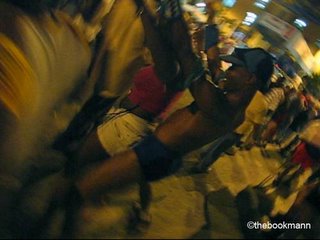
Flagman grooving to a Soca Chutney tune, Madam is the white shorts is working at his crutch 
Friend (standing facing forward) is not amused and walks up to the couple and says quite dismissively; Tracy don’t break the focking stupid man little wood….come on! Then she proceeds to grab her hand and walks off leaving Mr. Flagman somewhat crestfallen. Note that she was capable of squeezing in the words, stupid and little.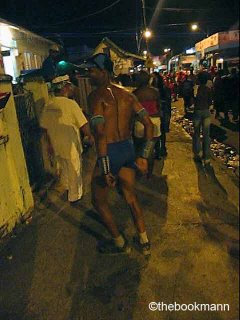
Fixing his shorts after a gentle let down, carnival Tuesday, 2006
...............................................................................................................
The National flag of Trinidad and Tobago: What the colours mean - Red to symbolize the warmth of the sun and of the population, Black for fortitude and wealth and White as a symbol of purity, hope
Flagman or Flagwomen: The person who leads a steelband during the Panorama competitions in Trinidad waving a flag
Sunday, March 05, 2006
Let Me Down Gently (Flagman)

Saturday, March 04, 2006
Folksy Period Art - Adrian Camps-Campins
 Adrian Camps-Campins is one of the most known artists in
Larry Bascombe. At one point Mr. Bascombe�s work was extremely commercial. It is likely that a whole generation of Trinidadian and Tobagonian people see his work as classical art of the island because he painted vanishing images of the islands, many with people going about the rituals of washing clothing, cooking and cleaning. His work is still in print, still available in stores, and can still be seen in many businesses throughout the island. He tested the saturation point of the genre, as Mr. Camps-Campins has done.
 But unlike Mr.Bascomb, Mr. Camps-Campins continues to create work that he shows constantly. Showing work in more commercial ways was considered controversial because it seemed like suicide to many artists. The thought in the 1980�s was that if you went the way of the greeting card business, you were somehow diluting your messages, and making the work similar to poster art. If your work looked commercial like poster art, then you couldn’t play with the” big painters” like Leroy Clarke.
However today, many artists have let their work be reproduced for sale, Dr. James Isaaih Boodhoo, Carlyle Harris, Noel Vocrossen. Even Leroy Clarke has allowed the reproduction of his work in book format, it is only a matter of time before he allows some of his work to be reproduced even more commercially.
In 2005 what was perceived as selling out in 1982 is now considered fiscally sensible. The fact that some artists want many people to see and appreciate their work is no longer in question. Artists have many more choices today than ever before.

Mr. Camps-Campins saw this need twenty something odd years ago and to his credit has remained steadfast in his resolve to do for his work what he sees it needs. He has been painting the rapidly vanishing architecture of
YUFE's ? - Public Art on the walls of Port of Spain

YUFE's ? Of all of the wall signage that I have written about, this one is a head scratcher. I have to say first off that the people look like images straight out of magazines from the 1980�s. They also look like clowns because of the unusual amount of white in the faces, and most of all they look like clowns in a Camps-Campins painting or postcard. I feel much better getting that one out from the start.
Friday, March 03, 2006
I swear by Hirst

The macabre in Art shown here in this Carnival Costume, Trinidad and Tobago, 2006
When carnival rolls around, the world revolves around Trinidad for me. I have no desire to hear anything from anywhere else. However this does not mean that Ido not know what is going on elsewhere, as I respond to my email and do look at CNN and other media. All of this preamble has to do with the work of Damien Hirst that was just featured online. Mr. Hirst’s show at the Hilario Galguera gallery in Mexico City, Mexico was met by expected controversy for Hirst, who left before the sparks began to fly.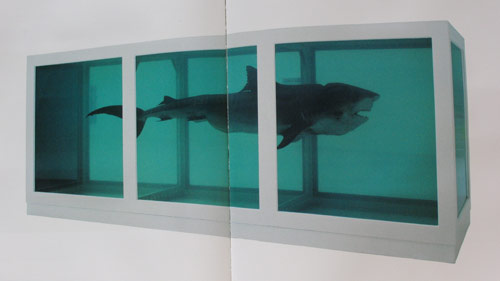
Damien Hirst's ticket the 1991 Tiger Shark in a formaldehyde filled tank. (This work was destroyed in a Saatchi warehouse fire 2004) A copy of this work called "The wrath of God'" is on exhibit at the Hilario Galguera gallery in Mexico City, 2006
I have followed the works of Mr. Hirst from his cadaver splitting days, that clearly are not over by a long shot. This body of work in Spain has a clear Catholic overtone, with Jeff Koon’s inspired, Hirst perfected formaldehyde animals, cut and splayed. What is very effective about Mr. Hirst’s work is its artifice. He has a sense of what he wants to produce.His is a calculated body of work that has almost vaudevillesque contrivance that nonetheless encourages the art world to take notice. These works over the last few years is basically the private museums of old brought to the jaded public of the present. But it is much more.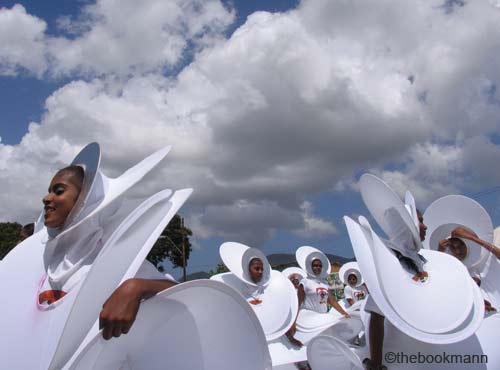
Same old "Hat Trick," a 1984 Callaloo costume returns in "The Sacred Heart" 2006
For Carnival 2006, Peter Minshall offered the band, The Sacred Heart, referencing the issue of AIDS prevention. His band featured many images that have become iconic to our country. Yet, if innovation, or lack of it, may have disappointed, his understanding and interpretation of the theme through Performance was as always stellar Minshall. In fact what it showed was that Minshall could live another fifty years and show work fourty-nine years from now and still be more current, more relevant than everyone else presently involved with ‘mas’.
Damien Hirst too, has this staying power. The work in Mexico City was not rivetingly new. In fact, to ask for something new is a bit unreasonable of any art fan.These days it is about interpretation more than it is about newness. What struck me about this work was that it was an extension of Hirst’s own language. Much like an iconography as much as Minshall himself showed us this year."Good Ideas" are always good, and when you are the creator of the concept, what you do with your trademark is up to you.
A man looks at a bull's heart pierced with needles in a formaldehyde solution, a piece by British artist Damien Hirst called 'The Sacred Heart of Jesus', during the opening of his exhibit in Mexico City, Mexico on Thursday Feb. 23, Damien Hirst slice away. - Adele
..................................................................................................................
Terms and meaning
Peter Minshall is a Mas designer from Trinidad
Thursday, March 02, 2006
Queens in Port of Spain
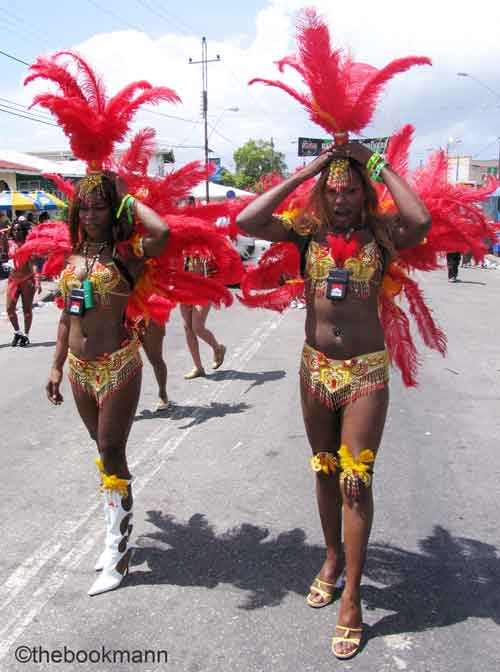
Miss Universe, 2006, a shared titled
Drag queendom on Carnival Tuesday. The very idea of men wearing dresses is not often acknowledged far less discussed. I need not explain the fear involved in male sexuality, particularly when it falls out of the purview of the familiarly heterosexual. Women in pants is so old hat, no one looks at all. Was there ever a fuss? That revolution is past. It is alright to enjoy Ru Paul a few years ago. He does not live on the island. It is quite different to view Johnny or Terrance or Vishnu in all their flamboyance. It is just too close and in your face.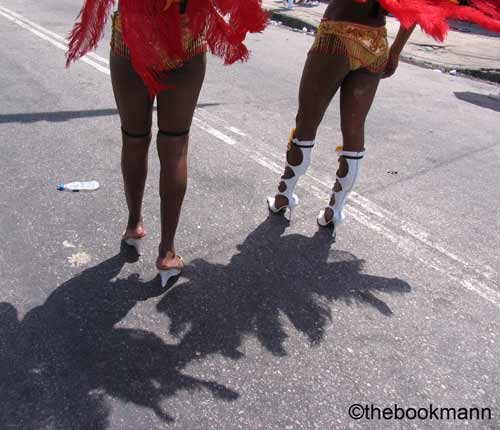
Working the catwalk on the streets of Port of Spain, Trinidad
But this year, 2006, two beauties with the perfect gait of Miss Universe contestants caught the eye of the Bookman. These six foot tall girls were gorgeous. They were noticed because they were so well groomed, better groomed than most women…sorry. I had not thought of the role men can and do play in carnival in their real attempt to fit into the lives they have made for themselves, and I was quite heartened to see these two girls walking proudly along, dressed as they wanted to be, unmolested and magnificent. It is easier for women, they appear harmless as they hug and fondle their girlfriends. But ‘hard back’men…well, it isn’t descent!Yet there are a few who say to hell with it and express themselves because they know of no other way to be, and to you girls, I salute you. - Adele
Wednesday, March 01, 2006
Playing Indian
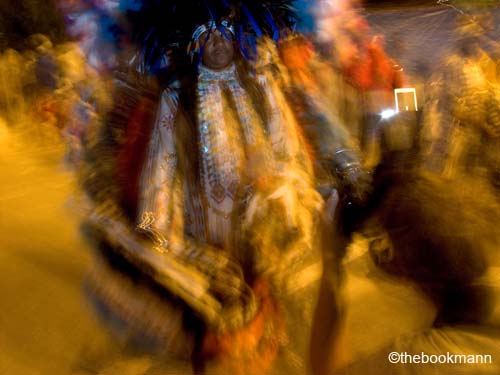
An elaborated headpiece belonging to a Fancy Indian at Victoria Square, Traditional Mas in Port of Spain, Trinidad, 2006
Fancy Indians are an adaptation of the indigenous peoples of North America. Step by step, the mas designer follows the descriptive drawings from books related to the First Nation peoples. During the performance, a masquerader will proceed with a series of body jesters which begins with a callings, then yells a blood-curdling war whoop and followed by a ritual dance which may be a stamp, hop.
"Out" In All His Glory 2006
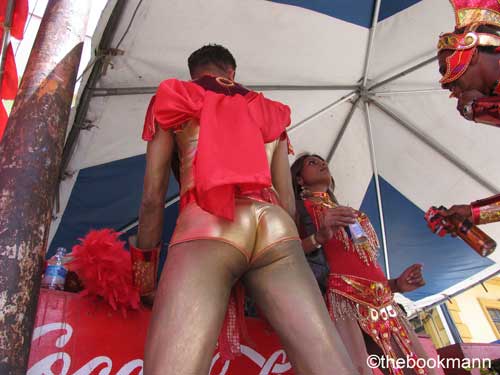
Rome 2006 as we have never seen it, and this liberated soldier is wearing a pair of golden poom poom shorts as he works on the ass off the young chubby girl. See other Masquerading Queens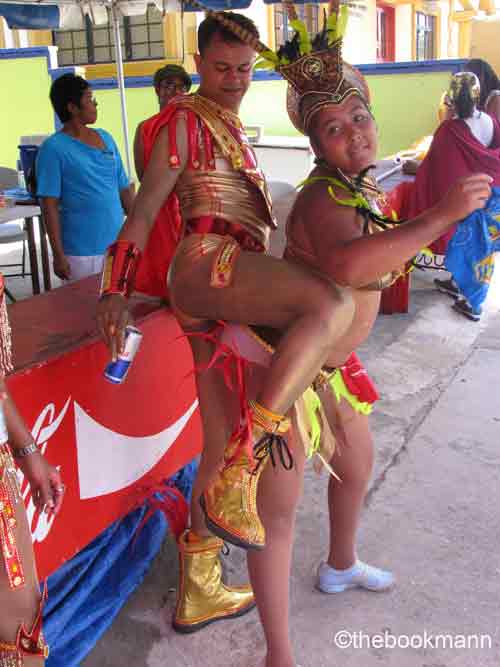
Conquering a ass, but preferring a jackass 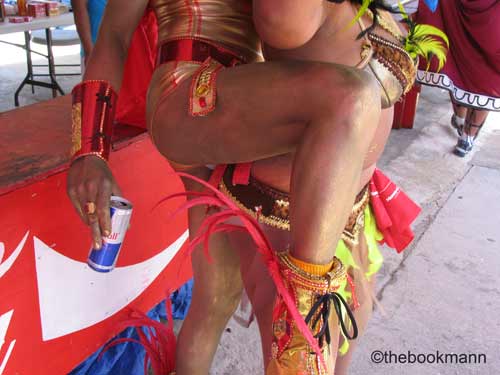
"Girls" watch out for his manish vigour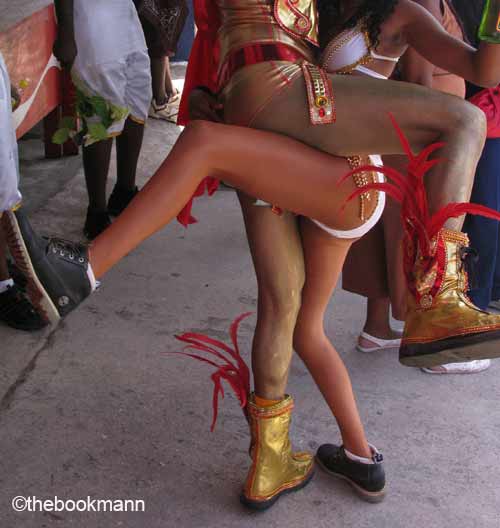
The Kama Sutra wine- See more of the Art of Rome Trinidad and Tobago style
Tuesday, February 28, 2006
Last Lap Carnival Tuesday
The Carnival Band "Tribe" on Tuesday night on their final route home, Port of Spain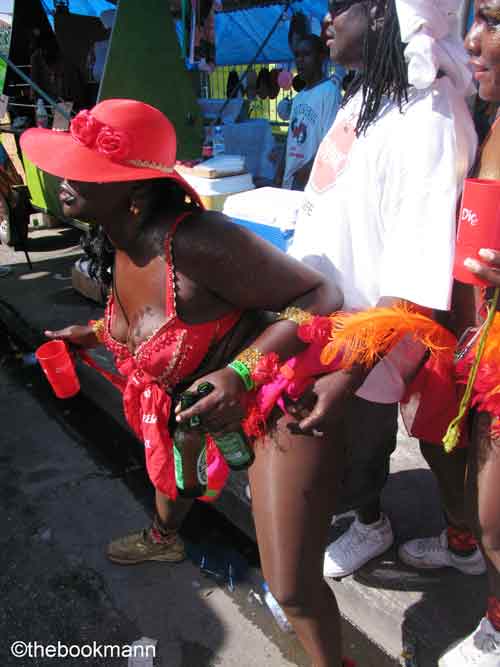
Earlier during the day, this masquerader heated up and was ready to "Roll and Go Down" to the unsurprised couple standing and viewing the parade, Port of Spain. 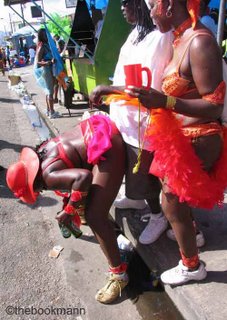
The receiving end of the female masquerader seems she should roll it a little harder
Two true "masqueraders" strutting their skills on a happy victim. As a rule, women are in full control here and are the initiators of this brief 30 second wining (courting) ritual. Carnival in the Republic of Trinidad and Tobago

Monday, February 27, 2006
The Midnight Robber Remembers

Here is a painting of the popular Midnight Robber from Trinidad and Tobago's carnival, and this portrait is in respect of a masquerader named Andrew 'PUGGY' Joseph. The painting was part of a costume from the Band, Mystery Raiders, in Port of Spain, Carnival Monday, 2006. See also The Midnight RobberTalk
Saucy Pow's Monday wining

Demonstration wining at Adam Smith Square, Trinidad Carnival Monday, 2006
The man who goes by the nick name Saucy Pow is showing the public, this carnival Monday how to wine, and to also, how to make a public spectacle. At the finale with his series of grating dance moves, he dropped his pants and exposed his white laced pantie.
Working the crowd who just to watch
Getting ready to drop those pants
Here is Saucy Pow dancing at Smoky and Bunty Bar in St. James in 2007
Sunday, February 26, 2006
I salute the Soca Warriors
I salute the Soca Warriors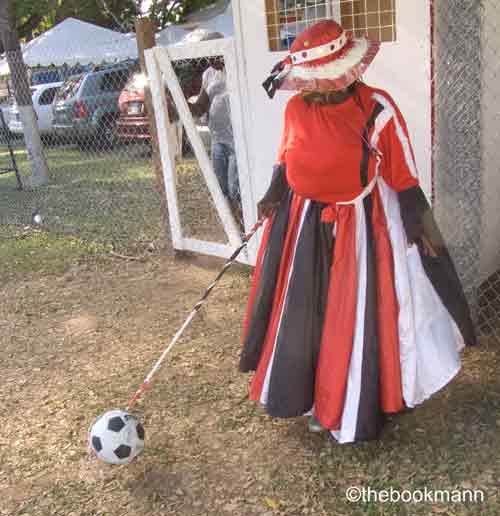
Joan Harding as a Dame Lorraine at Victoria Square,Trinidad, 2006
Derived from slaves mocking the French aristocracy from the 18th century, this contemporary Dame Lorraine is in the 21st century and this time she is by mocking Trinidad and Tobago's national football team, the Soca Warriors as they take part in the World Cup later this June.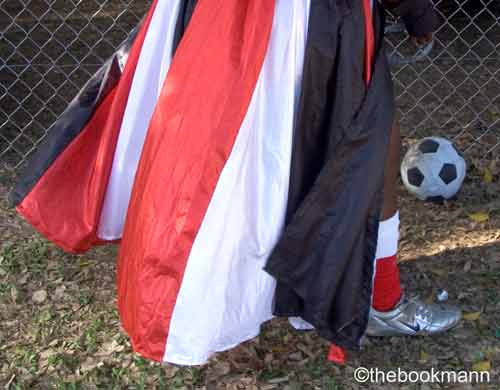
A Soca Warrior ready of Germany, 2006
And just before this photograph was taken, Joan Harding was tackling and body swerving a football into a open field. Fast and swift, she could not be captured in time. The Dame Lorraine is a Traditional Carnival character and beneath her ring hooped skirt, Harding was wearing a pair of football tugs and matching socks.
The Dame Lorraine costume is emphasized by the physical characteristics of the female derrière. This is helped by padded pillows, and only the Caribbean woman can deliver the swing that exaggerates the movement of the skirt.