 Just at the corner of Prince street, Port of Spain, there is a tourist gift shop that sells a number of memorabilia items related to Trinidad and Tobago. From pepper condiments to wood carvings and an artist with an ingenuous skill to the front of the store.
What he is doing is carving the surface of a calabash with a common knife utensil and producing a variety of decorative imagery that makes up the culture of Trinidad and Tobago or the Caribbean.
There is the Hibiscus flower with the Hummingbird, the palm trees at sunset and a panman with his steelband drums. The artist is faster than a lathe as the short video uncovers.
In Caribbean folklore, to drink water from the shell of the calabash may reduce the discomfort of menstruating....the words from the human lathe as he whizzed away at his calabash.
Sunday, December 16, 2007
The tourist lathe

Tuesday, October 16, 2007
My other Bread and Butter - Susan Dayal
Susie Dayal - Am I an Artist or am I an Artisan?  At the Horizons Gallery in Port of Spain, Trinidad and Tobago, the wire sculptor, Susan Dayal has her work on show. The gallery has made an adjustment for this exhibition as parts of the space are barred off. The wall partitions are painted in white, and Ms. Dayal's masks and busts surround the room under lighting which has been carefully orchestrated. The art community has come out to support Ms. Dayal's efforts fully, there is hardly any breathing space.
This has been a two year journey, Ms. Dayal says as she explains the process, and the theme which emerged from a strand of wire and developed into a cage of sorts. Each corset is constructed by measurements taken from her body, and the ribs are mashed to form a figure adorned with flowers and leaves. Anthuriums are her choice, aluminum, galvanize and copper are her materials.  Titled, Third Eye Flowering, the exhibition also shows a series of lotus flowers worked in copper. Parts of the copper are beaten to add an aesthetic to it, and the artist uses a spiral markings to fan out the membrane of the shape. From its core, facets and tubing are interweave to decorate each part. The show includes fourteen facial masks which take on the look of a Jester, and three large body corsets that combine an element of the traditional Fancy Sailor, a carnival character to Trinidad and Tobago. But this is by coincidence as the work just developed into those familiar forms.
For many years Susan Dayal has debated over the difference between art and craft. It is her craft that brings in her earnings. Nevertheless, both practices take the same amount of energy. Yet they can vary in detail, complexity and price. The question here is what determines it? This is the journey to which she must decide. Am I an Artist or am I an Artisan? The work at the show could be considered as decorative craft Art, but the large cage corsets seem to have an independent strength, a kind of offering of the shell of oneself to another. There has been some discussion regarding the direction or stagnation that Ms. Dayal finds herself. The body torso has become her signature since it was produced in 1998 at the Lips, Sticks and Marks exhibition. Then, it had an edge to it. One recalls, the cage's labia was formed as jagged sheets of metal. She also had applied performance with her early dress piece using a crinoline shaped structure as a body suit. But after a decade, she is stuck with the same idea and seems unable to connect the dots which can produce work beyond the decorative element. Work more daring, more flexible, more polished or statuettes in nature.
Definition: Craft - Loose and generally crude in its construction. Art - Clean and seamless in its form and construction.
Third Eye Flowering
Susan Dayal At Horizons Gallery, Trinidad, West Indies continues till the 27th October, 2007
Monday, March 13, 2006
Bunty O’Connor’s Catching The Spirit

Bunty O’Connor’s clay works at the Trinidad Arts Society, Trinidad, West Indies.
The Ceramicist Bunty O’Connor’s invitation came to me through the mail a few weeks before her show, and the image was both playful and provocative. Just enough to peak my interest. In the past Mrs.O’Connor has produced work that she goes on to also sell in her shop, quaint images of Trinidad and Tobago along with more complex cut coloured tile works that she pieces together to create elaborate table designs. She also has an open house at her workshop. Here you can see the working process of ceramic making. It is easy to believe that hers is a fairytale existence,where choosing such a profession seemed a calling that just led her to make all the right decisions. 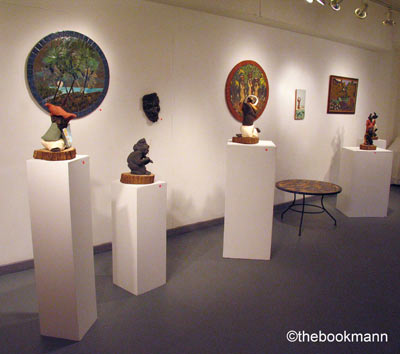
An exhibition worth seeing
What many do not know is the struggle to get her work done and seen over the fourty years of loving clay. The fact that she has managed to have her store and herworkshop and her exhibitions is a testimony to very hard and consistent work. With this show, it is worth going to see how far she has come. The exploration of colours and the use of paper mache to enhance and expand her forms are worth seeing. She also had a one day workshop that I regret I missed. She wanted teachers and students to be able to learn her techniques. The show itself is filled with some of her old faithful works that she has sold over the years. 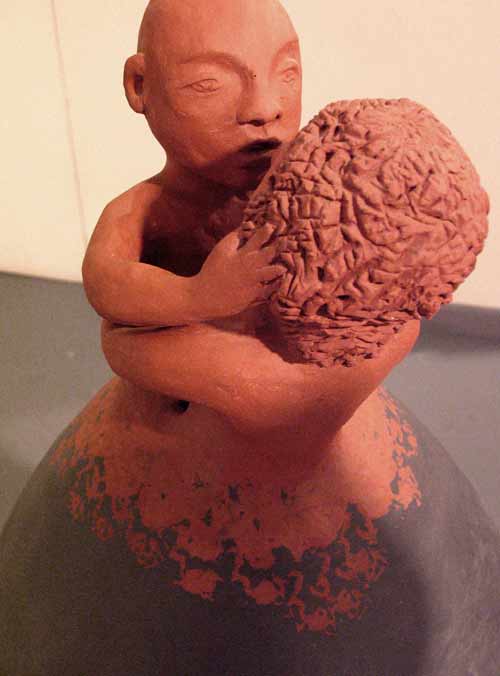
An experimental sculptural piece
But the real treat is the experimental sculptural works that sit on cut tree trunk pieces, enhancing the natural colours and twisting, turning movements of her shapes that from every angle give a slightly different look. There is a lot to see in these compact pieces. What a delight to go to a show where there are things to discover and really enjoy. She has really come into her own with these works. I strongly recommend this show.- Adele
Saturday, January 07, 2006
Playing Mas With Washi
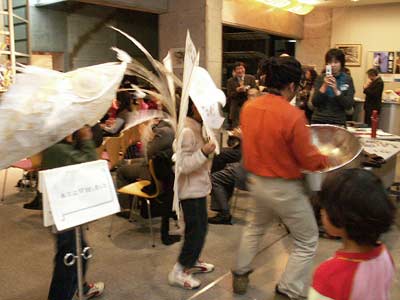
Prancing Japanese in Mino, Japan with a Trinidad and Tobago twist
A washi carnival costume, Mino, Japan, 2005
Look closely at the image above. This is a proud moment for Trinidad and Tobago. Don’t mind the blur, what is important is that the camera has captured Japanese children wearing carnival costumes made from washi and they are also prancing to steelband music played by a Japanese pan player. The Trinidadian artist Marlon Griffith designed these costumes at the Mino Paper Village Artist Residency in 2005.
Artist in Residency is Japan’s key to promote their culture through the vision of international practicing Artists. The Mino Paper Village project since 1998 have invited artist to the city of Mino, a rural town in Japan’s Gifu prefecture historically known for its handmade paper washi.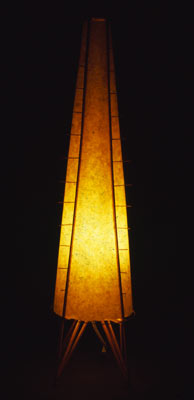
Thebookmann's Washi Lantern, 2002
One of Mino’s annual festivals is the Washi Paper Lantern competition. Over 700 entries throughout Japan participate. The exhibition includes professional and non=professionals and draws a crowd of over 20 thousand people through the two narrow streets in the village of Mino.