A Zulu Chief and Witch Doctor wining together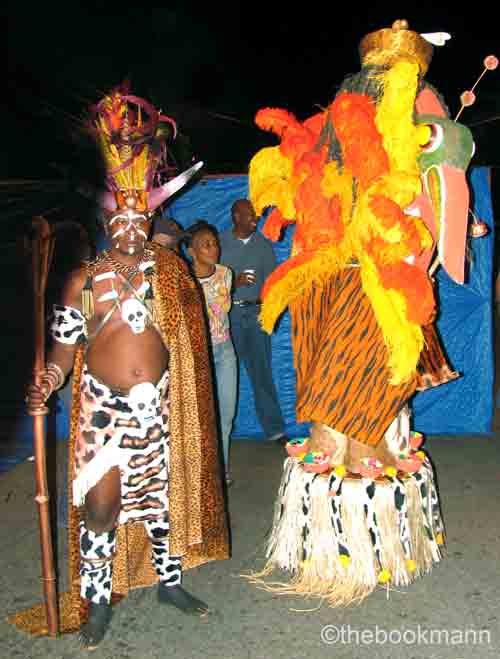
Carnival Hollywood stars in Trinidad and Tobago
These two portrayals are representing the African roots in Trinidad and Tobago. At the Traditional Carnival venue at Victoria Square, Port of Spain in 2006, a Witch Doctor and Zulu Chief posed before the paparazzi moments before entering the stage through a blue nylon sheet. This is what African representation means to Trinidad and Tobago, with many of the ideas merely lifted from magazines like National Geographic. They are kitsch and vile at the same time.
A warrior from a region of Africa, he ain't out to play mas
Sunday, February 26, 2006
I Africa

Saturday, February 25, 2006
At the Amphitheatrum Flavium in Rome

Nero in a toga and in a costume too horrific for the lions to maw, carnival Kings and Queens, 2006
At the Amphitheatrum Flavium, the Emperor Vespasiano ordered the wooden gates opened in retribution to the quality of Kings and Queens represent for Trinidad carnival, 2006. A pride of lions bolted into the Coliseum to suppress and do justice in the name of Rome herself. At the centre, mas designers and masqueraders portraying the Empire of Rome were going to experience the full force of the Emperor. Even Peter Minshall parodied himself with a warmish King, and oversize head puppet for his Queen.
..........................................................................................................................................................................
It should be noted the many idea on Rome came out in 2006. This was influenced by HBO's television series on the subject.
Friday, February 24, 2006
The carnival character - Bats

The bookmann's interpretation of the carnival bat
The Bat is one of the many characters from Traditional mas in Trinidad and Tobago

A masquerader in his costume crawling, flapping, dancing and folding his wings in a series of choreographed movements imitating the bat. Sadly, he was the only bat portrayal present at Viey La Cou in 2006.

Bats performing at Adam Smith square in Port of Spain Trinidad, 2006
.................................................................................................................
Viey La Cou - A venue didicated to Tradional mas from Trinidad and Tobago. The project began in 1988
Thursday, February 23, 2006
Rights of Passage - Alex Kahn and Sophia Michahelles
Play de Devil, play it bad....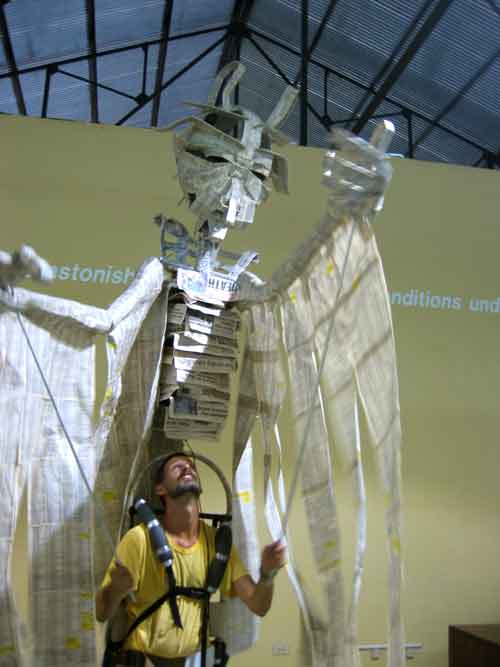
Alex Kahn in the harness operating the large Bookman puppet
As part of their artist residency in Trinidad and Tobago at Caribbean Contemporary Arts, CCA7, the American puppeteers, Alex Kahn and Sophia Michahelles have devised a contemporary adaptation of a traditional carnival Dragon band. The project consists of puppets and masks made from waste materials like newspapers and discarded telephone books. On Carnival Tuesday, their small carnival band hit the streets of Port of Spain, and they both experienced the full magnitude of the festival that requires the stamina and endurance to carry these large costumes on their backs all day.
Sophia Michahelles in her Dragon costume playing mas in Port of Spain, Trinidad in 2006, using razor wire as the frame of the mystical beast, and covered loosely with strips of green cloth. She also toyed with puns over how she sees the Trinidad mystic, and how people barricade themselves from the outsiders with high walls surrounded by barbwire trimming. See the Canadian artist Paul Fortin version of being barricaded. ***
................................................................................................................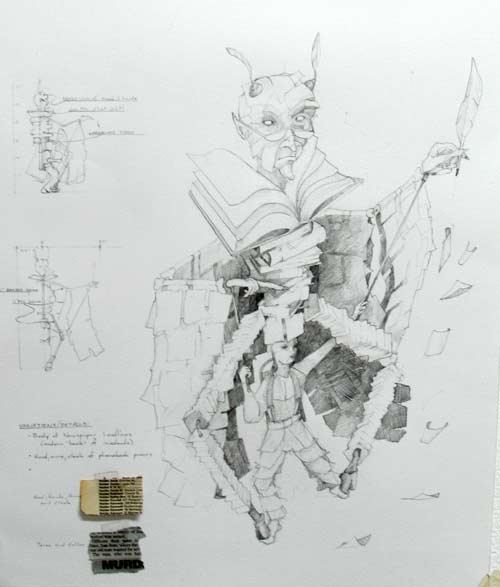
A view from outside: Working drawings of the Bookman costume
First conceived in 1906 by Mas-man “Chinee Patrick”, to integrate Chinese mythic iconography into the Mas, the Dragon Band consists of three basic components. The Bookman leads the troupe, taking note of the misdeeds of mankind, followed by the Dragon, who struggles against the chains of torments of his keepers, the Imps. The Dragon Dance is triggered at the band approaches a body of water – any gutter, puddle, or river-crossing will do. The Dragon is associated with the Devil; and thus with fire, while water symbolizes the Holy Water of the Church, and by association all the prohibitions and hierarchies implied by any authority structure. The suddenly fearful Dragon writhes, shrinks, recoils, lashes out, and does anything in its power the avoid crossing the water, but eventually, dragged by the Imps, he leaps across, and continues down the road. Whether this crossing implies a supplication or a transgression, or both, is deliberately ambiguous. In either case, one can see The Dragon Dance is a cyclic enactment of constraint, conflict, and release, and as such, a microcosm of Carnival itself.
As outsiders to the Mas’ we have decided to work within the structure of the Dragon Band, to express our personal experience of class divisions and conflicts that currently pervade both Carnival and Port-of-Spain in general. Murders, kidnappings, and assaults have spawned a pervasive apprehension in Port-of-Spain, fueled by daily newspapers’ ghoulish and sensationalistic tally of Trinidad’s crimes for the year. Traveling by foot and by taxi, a precarious feeling of prohibition of movement is palpable amidst admonitions from locals about the various neighborhoods one must absolutely avoid. But mobility is constrained in the opposite direction as well. Crime (and fear of crime) arise from economic disparity, and our daily Maxi ride from the residency house to CCA7 confirms the vast gulf that divides Laventille from Maraval. As the corporate bikini-and-beads Mas Bands become the dominant expression of Carnival, an increasing number of Trinidadians are being priced out of participation in a festival whose very roots are defined usurping class hierarchies and creating a fleeting moment of equality (“All ah we is one” as Trinis say). As Carnival becomes the province of middle-class pretensions “All-inclusive” bands have become the very definition of exclusivity.
Text and images courtesy of Alex Kahn and Sophia Michahelles
King Sailor - The Ghost Drummer
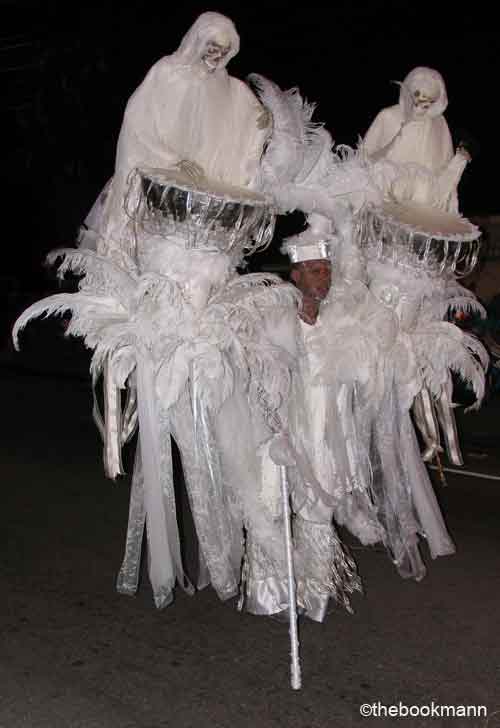
Fancy Sailor, the Ghost Drummer, 2006
Kevin Quammie is in his King Sailor's costume called, Ghost Drummer. The 16 year old is taking after this father’s traditions of playing mas and liking power very much. The carnival band is called De. B.O.S.S. The abbreviation stands for the, Belmont Original Stylish Sailors and Kevin’s father says, these unique costumes traditional to Trinidad and Tobago's carnival are being overtaken by commercialism and by the trends sort from Rio Carnival, namely the pantie and draws covered with feathers, plastic beads and costing masqueraders over $2,000 dollars TT.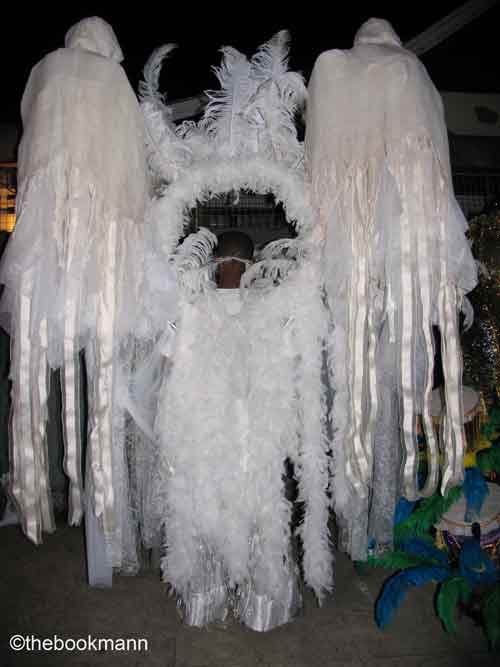
Ghost Drummer with African drums made from a discothèque balls between the white feathers and skulls pulsing with electronic diodes.
As a wire bender, Kevin father speaks about of the process it takes to build one of these costumes from the frame up. There are many factors a mas designer should know, weight, flexibility and movement of a costume, he says. The wind at the Savannah could take yuh, and that will be the end of you. The Ghost Drummer is in tribute to Andrews Beddoe, one of the finest African drummers and craftsmen in Trinidad and Tobago.
.................................................................................................................
Liking powder - Relating to sailors who throw baby power at each other during carnival in Trinidad and Tobago
Wednesday, February 22, 2006
Calypso in Art
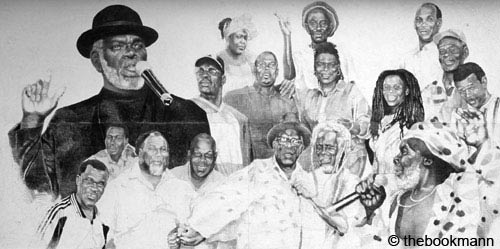
A rare billboard for a calypso tent at the former De Luxe theatre. Port of Spain, 2000 Trinidad, West Indies (Unsigned by the Artist, this billboard no longer exist)
Carnival is not necessarily colour. As imagery for Carnival goes, it is rare to come upon drawing such as this. I was very excited when I saw this large drawing, about 7 feet long by 3 to 3 1/2 feet high. It was produced for a calypso tent that was started at De Luxe theatre. This theatre no longer exists. In its place is a new night-club called Club Zen. The old theatre was one of those rare buildings that featured architecture from the period of Art Deco. What was particularly interesting about this old movie house was the bathrooms. They featured wrought iron details and geometric and floral tiles done in the delicate, quirky semi-restraint of the period. I miss the old place. There are so few symbols of pre World War II architecture, we seem to only save some of the cute ginger bread houses.
This beautiful, life like pencil drawing of calypsonians was rendered with love and respect forall of the musicians involved in that tent. Shadow is drawn the largest and is dressed in his symbolic black, he is sensitively detailed, and is represented on the bottom right of the poster, giving a strong diagonal and framing to the piece.
Whether the artist used photographs of the musicians or drew them from life is unclear, and not a detail that really matters because there is definite skill in the work that is unquestioned. I was surprised when I saw this drawing that it was not treated in any way to suggest value. It was handled like a billboard, and if sprayed or painted over with a binding agent to secure it from fading, it was only just done. It had no adornment to raise it to the level of masterwork, no glass panel over it, no border of wood to claim it. It seemed simply drawn and placed, propped up on the staircase outside the building. Although it was clear that a lot of skill and attention was paid to making it known that it was a good work. After all it was advertising the tent. But it was so by the way, like so much of our best work in Trinidad and Tobago. 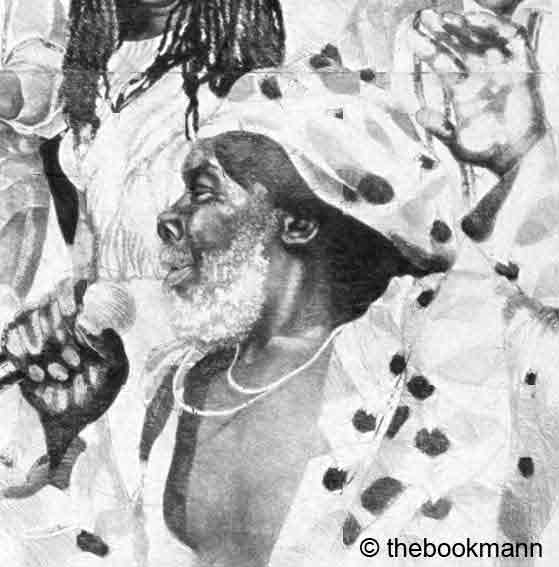
Stalin in a billboard, Port of Spain, 2000 Trinidad, West Indies
The poster was part of a larger banner that held the names of all of the participants in the tent, and that was done in simple Sans Serif text on a green background, separate and apart from the drawing. This drawing to me said less about the whole ‘afro centric’ question (or statement) and more about building up our icons for themselves. It reminded me as well about some paintings I have seen in Chaguanas on the main road. Someone has a group of very realistically rendered portraits of Mas man Peter Minshall among others. By its placement and care, the artist was talking about respect and regard for things Trinidadian. Not for things based on racial coin, and I think that that is where we have to go. There is nothing wrong with racial pride. It is important for self-esteem.
What I am stating is that we live on an island, despite how big we feel, we are very small, and our wealth is within our diversity. Surely we can embrace everything we are, whole, whole, and develop what we know we can become without marginalizing other groups into feeling that only one kind of work is what our country is all about.- Adele
Tuesday, February 21, 2006
Speckling Off A Drawings To Rome

Derek Mohammed stepping back and admiring his work at Anthony Johnson’s mas camp, Woodbrook, Port of Spain, Trinidad West Indies, 2006
Airbrush artist Derek Mohammed can whip up a picture-portrait rendering in forty-five minutes. He pauses, steps back and fine-tunes his work. Untrained, he began airbrushing because he liked it, and with the help of his mother, the essential tools for this love were bought. Fifteen years later, Mohammed owns his own studio called, Realistic Airbrush Concept. 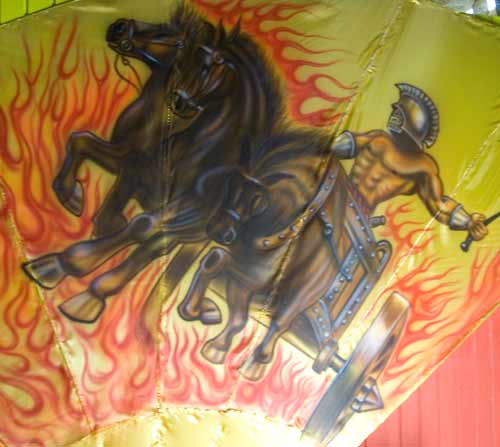
A Trini Revilers' costume – Chariots of Fire
Monday, February 20, 2006
4x4΄x 2˝ Doodle - Eddy Bowen
“.....The works explore and stretch techniques in acrylics. The attempt it to find a new visual metaphor, or to break new ground in the articulation of the landscape.” - Eddie Bowen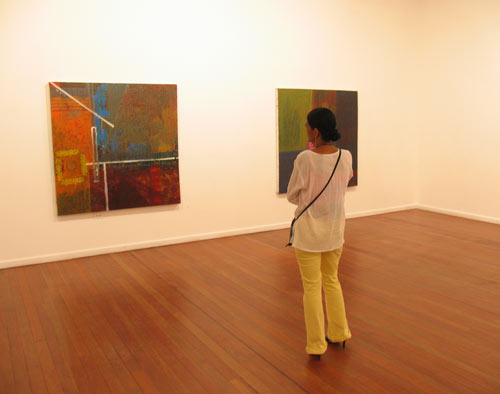
A series of primitive paintings of dwellings, fences, shrubs, tribal markings, and architectural aerial plans layered with indents or doodles made with a blunt tool. Eddie Bowens' recent works at CCA7, Trinidad, West Indies
For those of us familiar with the work of Edward Bowen, affectionately known as Eddy, one expects a pastiche of strong personal drawing style on a scale that gets the work noticed. Over the years Mr. Bowen has not only experimented with his love of pencil sketching of architectural elements, but has looked at working in alternative spaces. His has been a very long and solitary career, much informed by his desire and love of the work for itself. He is one of the rare contained artists, whose works happen despite support.
With all of that said, this latest offering from Mr. Bowen entitled 9 x 5 features a group of large canvases of architectural structures. What is relevant about these pieces is his investigation of colour. There is a lot to look at in these pieces. I recall the recent experimental works of David Hockney, a delight of colours and scraping textural surfaces. But these investigations are not about being pretty, but about looking at the complexity of structures as they age and change in meaning. I enjoyed being able to look at the canvases squarely, looking all around and through the technique at what I believe to be his narrative about all of the contradictions of our world at this time.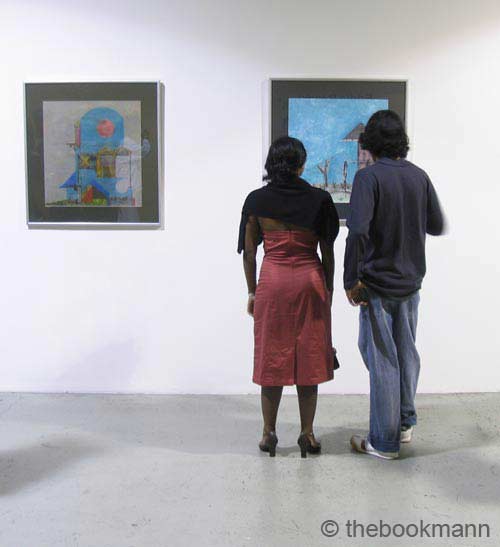
Eddy Bowen's complex kinetic pencil drawings that expresses his inner obsessions with mechanics, cogs, rods, and mathematics.
An Bowen invitation card from 1991
Sunday, February 19, 2006
The Bookman literally - Viey La Cou
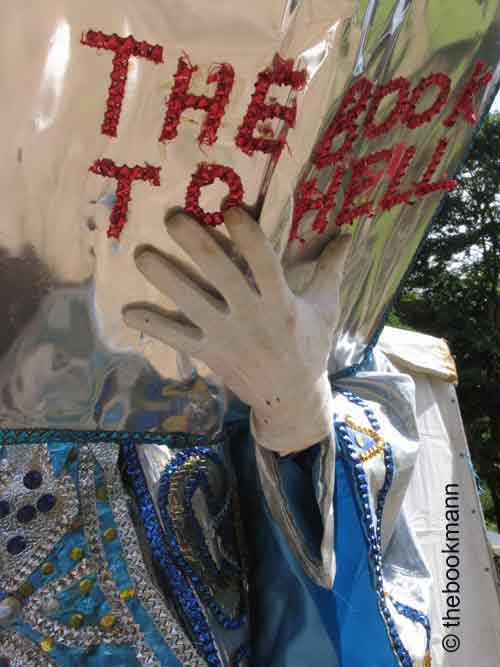
The Hand of (The Bookman) thebookmann's name is absent from the list to enter the gates of bacchanal
An illustration of Bookman or Gownman from the Heritage Library of Trinidad and Tobago
The Bookman or Gownman is a feature of devil mas portrayals. The costume consists of Tudor-style pants, or embroidered gown made of velvet and satin, with a pleated or fluted bodice and a cape festooned with a biblical scene.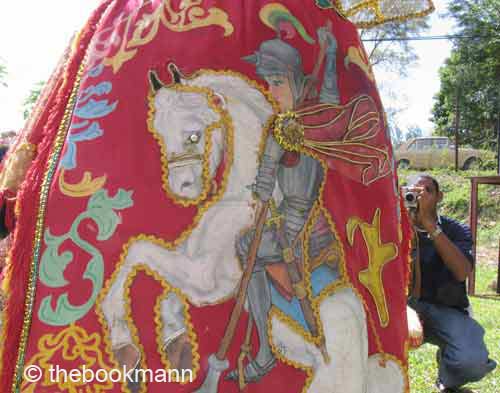
Detail of the cape
The bookman carries a pen and a large book where he writes the names of prospective souls for the devil. The bookman is the principal character in the devil band characters, the others are the imps and beasts. Known as the Ruler, he performs in dance by a waltz-like movement with intermit bowing. The musical accompaniment may be a orchestra of trumpet, saxophones, bass or drums playing conventional tunes.
The headpiece is an oversized mask with mounted horns and the mask that mirrors the face of (Lucifer) himself
The series of these photographs are characters from traditional Carnival in Trinidad and Tobago. Sadly it is a vanishing Art. (Elements of the text from the Heritage Library of Trinidad and Tobago)

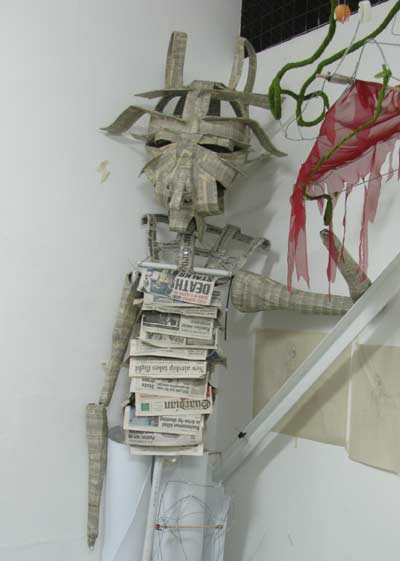
The Bookman out of newsprint called "Rights of Passage" Alex Kahn and Sophia Michahelles Artists in residence, CCA7 See the complete project
thebookmann
Tags: Trinidad Traditional Carnival Characters Bookman Devil RichardBolai thebookmannSaturday, February 18, 2006
Jackie's Port of Spain Murals
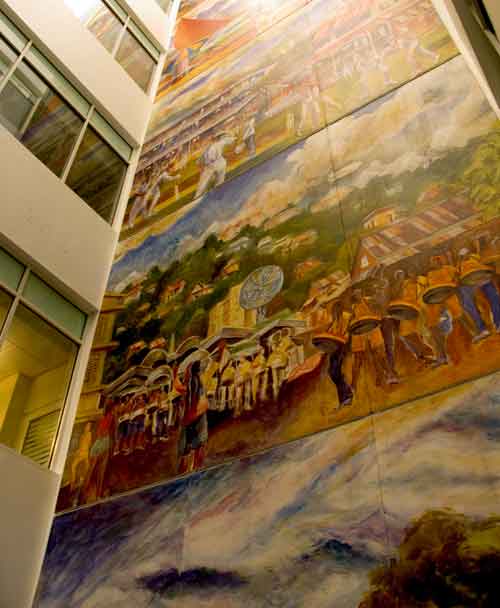
The atrium at BP Trinidad and Tobago
Although the atrium of British Petroleum is light,high and airy, the glare from the skylight makes Mr.Hinkson's work difficult to enjoy in its totality at certain times of day. However it is remarkable to see so much of his work filling such a large space with such ease. Ours is not a positive tradition of keeping and maintaining murals by artists. One has just to think about Carlisle Change's work alone. Although this is not a public mural, but privately owned, this work is best seen from the elevators as only then can one actually really appreciate the many levels to the panels of the paintings. To do so the general public would have to go during the week and ask for access,as the elevators are not accessible on the weekend. - Adele
Subscribe to:
Posts (Atom)