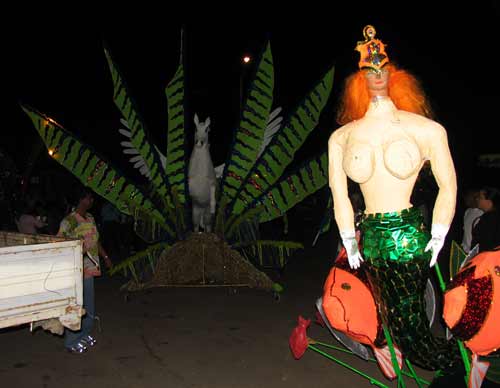
A mermaid and Unicorn carnival costume parked as if they were in a car lot
At the first stage of judging the Kings and Queens of Carnival, 2006 one competitor is quite upset over the weight of her costume, she says after crossing the Grand Stand, Nah, I eh carrying focking dat, it too heavy. The costume in question is this hefty bosomed strapping shoulder transgender papier-mâché Mermaid surrounded by Parrot fish that are quite bamboozled by the camera's flash.
Friday, February 17, 2006
Watch Meh In Meh Glitter

Thursday, February 16, 2006
The Curtain Closes - Boscoe Holder
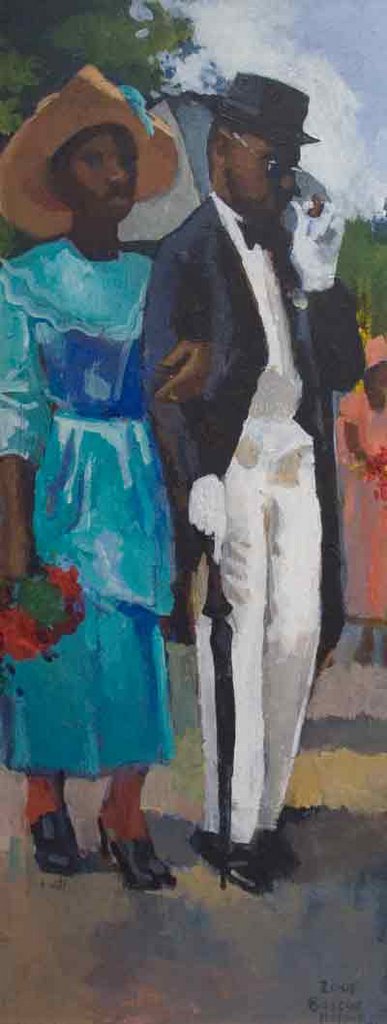
A Tobago Wedding -The end of an era
The Art Society of Trinidad and Tobago and Gallery 101 hosted fifty-eight works of the artist. The pieces dated from 1991 to 2002. Mr. Holder has been painting for over fifty years and he could be considered in some ways our society painter. ( As well as our oldest and most important working artist) He is known for his renderings of people of colour. This is no small thing in our culture, as there is a love/hate relationship still to this day with shades of brownness. He also represents a long lost past in his fondness of having his female sitters wear white brody anglese and French doyettes. Mr. Holder has not painted recently due to illness, and as I walked around the white space I found myself feeling a mixture of sadness and pleasure while looking at the pieces. The names, Boy with Sombrero, Grande Riviere, Martinique Headtie, Semi Nude with Bandana, these works encouraged a train of thought about much of the works I have seen recently by artists who have had very long careers, and have shown their latest offerings lately.
I was pleased to see works that were more involved with the environment, and I was especially struck by Mr. Holder’s technical restraint with his paints, this he used to a nearly completely dry finish on many a work, as though he were seeking out the very patina from the colour, wanting to apply it in a raw way to enjoy the contrast against the skin that he layers to produce its many hidden facets of red, yellow ochre and his signature blue detailing. At some point every artist has to look at their career’s meaning and purpose, it is not enough to just talk about sales of the product. 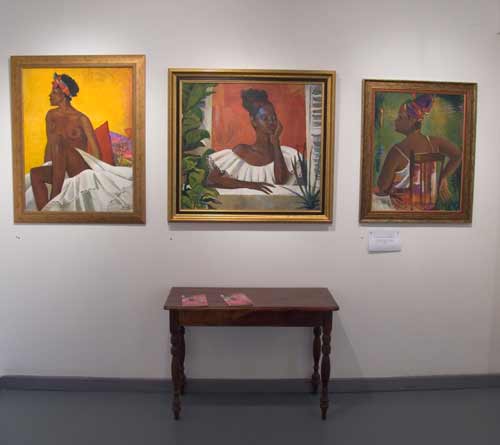
The renderings of colour
Last year there was the work of LeRoy Clarke, the photographer Noel Norton A retrospective, and this year, the work of Wayne Berkeley and friends. Mr. Holder’s has been better represented in terms of planning, lighting and placement of works. His prices are also quite reasonable for someone working so consistently. On the low end the works start at TT$5600 with the high end between TT$20,000 to TT$40,000. His work sold very well, with about half selling when I was there. What I wondered with Mr. Holder’s offering was about the standards that older artists work toward as they get into their twilight years.
In some instances it seems that older artists are encouraged to dust off and prettify pieces based on the value of their name. I have a serious problem with that! After all an artist does not work their whole life to bring their work to a certain standard and then compromise late in life! Surely not! I have walked into many a show and wondered how the works were chosen. What was the intention of the curator? Where is the restraint? Why not just show the best instead of displaying the work like market produce? But that aside, the older artist can teach us so much, and when their work is compromised…well, all falls down indeed. No longer can one look at the career, instead it becomes like the story of the Emperor’s new clothes. No one dare say that the work is a warmed over meal from some bygone time. 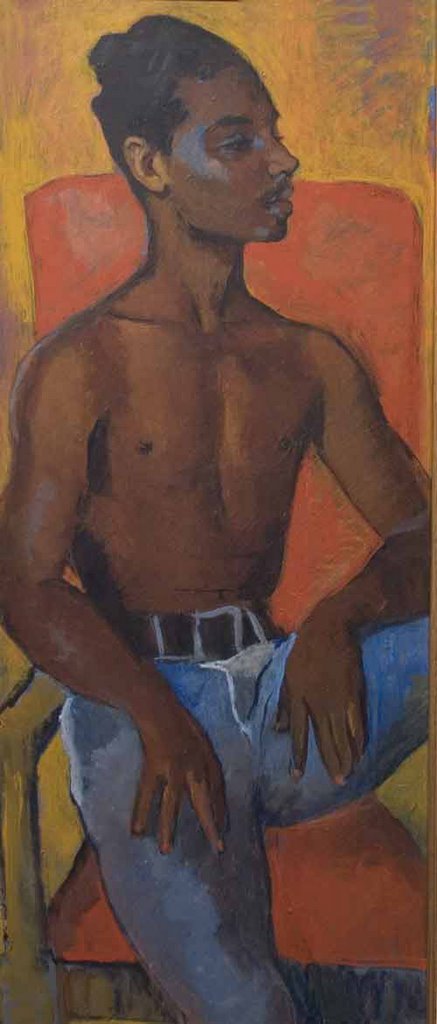
The pleasures of the male
To his credit I saw growth in Mr. Holder’s pieces. He has always had a stellar work ethic, and despite illness over the years he has shown in his pieces a joy in the investigation of colour and form. You do expect to see his black people in headscarves and his occasional paintings of men loaded with a homo-erotic undercurrent. These things are like signatures of his process. Underlying all of his work is a sense of love for a simpler way of life, a Trinidad and Tobago that could be mapped. In that way one could see the past ebbing away like sand as we try to hold to it. Those times are gone forever.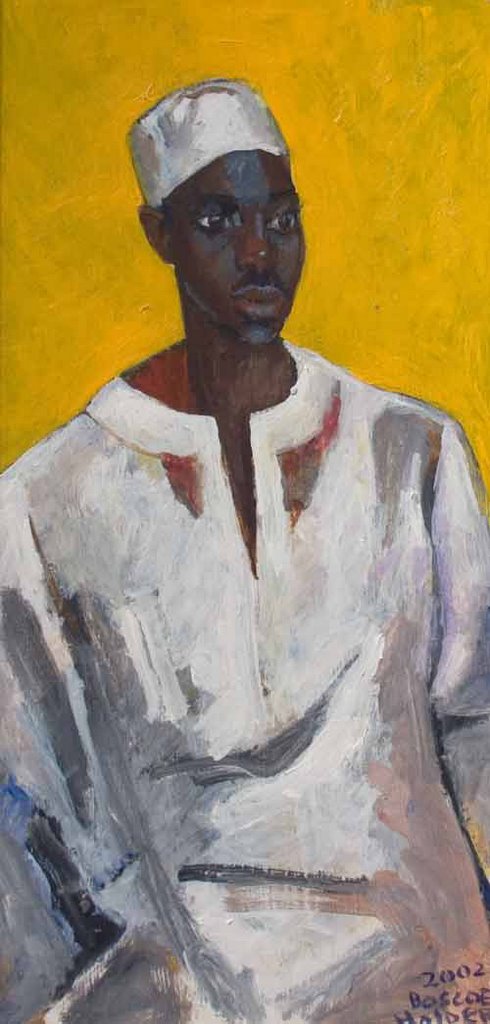
Holder's later work 2002
Who will replace such an icon? No one really. The closest technician to him to me is Irenee Shaw, whose work does not portent to want to explore such a path. However hers is a body of work that has captured present day people in environments that reflect a stillness and a leisure class, and is by no means a wasted form of working if she should choose to do more of such work. But it will never be the same, it shall also never really be a continuation either, as the gild is off the rose. When it was important to ask, the questions never came. We never stopped to see what this dedication to ourselves was really about, and how we could be honored and challenged by it, and so we are doomed to make another spiral of our knowledge because we fail to see what our artists are about. - Adele Todd
The beauty of being Black
Tuesday, February 14, 2006
Dingolay Ray

A Trinidadian disgused as an American, Ray Funk at Gayelle's television studio in St. James, Trinidad and Tobago, 2006
Rare footage of the Lord Kitchener and a early American calypso melody of Rum and Coca Cola.
Ray Funk has been a trial judge in Alaska for the last seven years after serving as a public defender and assistant attorney general. He is an historian when it comes to world music and Trinidad and Tobago has a soft spot in his heart. His collection of calypso music is unmatched anywhere else in the world.
Ray as the Ravenous Raven of the North, for carnival 2006
Sunday, February 12, 2006
Obsession in Princess Town
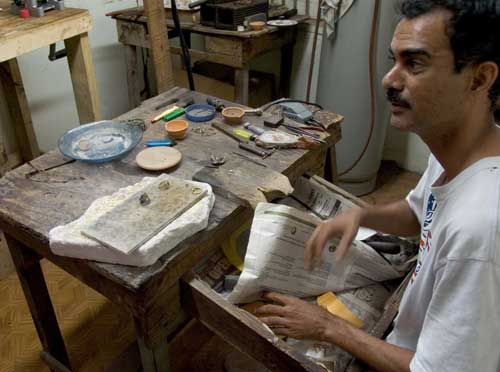
Billy S. Mahammed, the owner of Luck’s Jewelery Shop, Iere Village, Princess Town, Trinidad. His first profession is drinking at a bar called Obsession
Driving through Princes Town, Trinidad and Tobago, the homes are all freshly painted with well kept lawns and smooth roads. We were puzzled with how quaint everything appeared on our Sunday drive to find some amazing imagery we had seen on past visits. As we rounded the bend, we saw three small booths perched on the corner where people go to apply to learn to drive.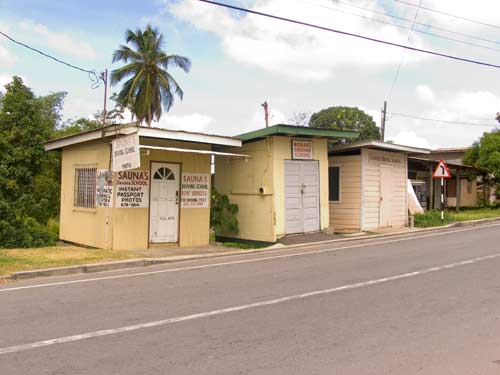
Learning to drive in the pleasant Village of Iere, where the roadways are blemish-less and racetrack smooth
Next to this trio is the easily missed home of a kind gentleman who helped guide us to the third of a series of bars called Obsession. Billy S. Mahammed led us into his humble house to show us his working studio where he makes jewelery. He was taught by his father he told us with pride. We wanted to write this little note about Billy because he is a reminder to us as to what is always so wonderful about our island. People who are just themselves, kind, helpful and doing the best that they can. - Adele 
A bar called Obsession: Pushing the artistic vision of interior and exterior motifs further with these blue and pink walls and with a series of wall art depicting a Victoria Secret knockoff
Saturday, February 11, 2006
Chateau de Tack
Were money had taken us higher, to a place far and beyond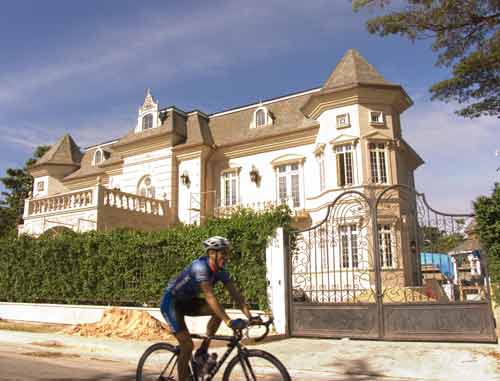
From the road, a Chateau too small for its grounds, at St. Clair, Trinidad. At Christmas they plan to import snow.
Well, let’s start with a Balustrade and follow it through with an Acorinthian Column. Put in an Entablature and what about a Festoon? Give me a Patera, Pier, Putto, Fluting, Quatrefoil, Quoins, Spandrel Motif and for my yellow Hummer, a Porte-Corchère. Any why not complete my monstrosity with a Widow's Walk to maco meh neigbour yard.
Shop at your own risk. A park bench in front of a shed selling concrete fountains on one of the busiest Highways in Trinidad and Tobago.
Looking to refurbish your home? Do you need Pillars, columns and fountains in a variety of colours and cast in Royal concrete, stop here, shop here and take in the beautiful view of a highway.
The making of a home with less garishness, Central Trinidad
Friday, February 10, 2006
Side by Side We Stand - Tassa and Soca

Prayers and offering to Ali Asghar at the Hosay observations in St. James, Trinidad, West Indies, 2006
Where in any country would you observe a religious rite side by side to a pub blaring soca music from large fete speakers, and with couples grinding on the curb holding alcohol bottles loosely and swinging in tempo ? In Trinidad and Tobago of course.
The origins of the Tassa drum is an adaptation from the classical Indian Tabla drum. The drum consists of a clay base where the goat skin is stretched over and held by straps. If this drum falls it will shatter. A hybrid to the Tassa is a drum made from iron sea buoy cut in half. The shell is fitted with a synthetic material taken from a drum kit, and the quality of the sound produced from this instrument is in comparable to the natural goat skin. Only a keen instrumentalist may pick up on its flaws. Tassa drums are heated to preserve its pitch.
Tuesday, February 07, 2006
Picking a Pantone Colour, My Dear
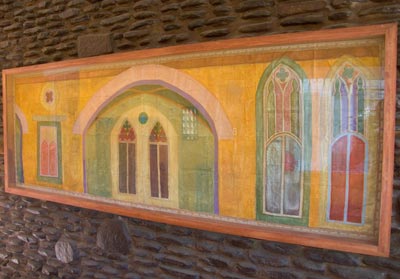
Pantone chart for a house paining
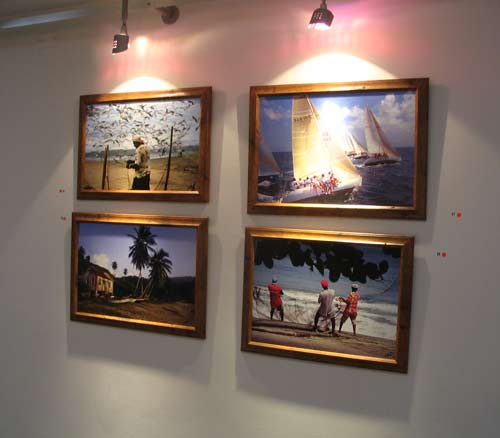
What does it take to put on a show about the history of someone’s career? What does it take to put on a show of recent work by someone with a very long career of successful work? In Trinidad and Tobago this task seems to be impossible. It is with sadness that I write that the shows that I have been seeing that focus on the works of artists and photographers who have built solid reputations over the course of their career have left me asking more questions than can be answered. I do not understand why the shows are produced so very cheaply. The framing, hanging, lighting, none of these things seem to been taken into account. I choose not to mention what shows these have been, as it is a phenomenon that I have witnessed no matter who put on the show.
I am also concerned about whether the people who have built these long standing careers are in fact fine with the outcome of these shows? Most recently one such pioneer produced a series of new works that greatly reduced what I have come to consider their strong sense of originality, craftsmanship and beauty for a very commercial, low quality, high priced churned out collection. I know that crime is our main concern in Trinidad and Tobago at this time. But as an artist myself I have to state here that in my profession where so many of my colleagues complain that they are not given enough respect or funding, there is the other side, what is the real quality of what is produced and displayed? I have been trying to monitor the cost of art over the last ten years and the trends that I have observed are quite questionable. There are people who come right out of A’Levels and the University of the West Indies Art programme and begin to sell work at prices on par with artists who have been working for several years. It makes me ask, who regulates these prices? I must be clear here, I have nothing against people making livings in art. What I wonder is who and how do these costs get calculated? 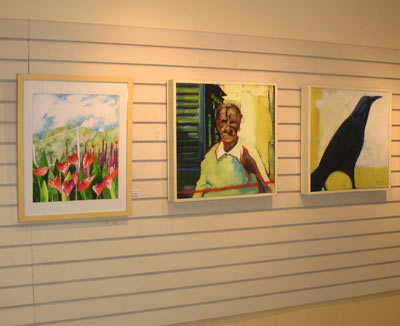
A King exhibition in 2005, Art Creators Gallery, Port of Spain
What are people paying for? The framing? The skill of the artist? What? So much of the work that is seen in gallery spaces looks alike, so you know that you are not buying something that is necessarily original. Yet many things sell consistently from year to year, yet other things do not. Sometimes I find myself admiring the frames and not the works. Many artists themselves have pre conceived notions about what the public wants, and go out of their way to produce work in a sort of indiscriminate way, putting as much as they can on display, with no thought to whether the pieces stand together to produce a cohesive whole. Then there is the fact that the public does not ask but reacts. Yes it is true that a work should speak to you and move you, and ultimately once you purchase something, you live with it and enjoy it long after the money has left your account.
Also, yes, I remember the bad old days when people would come into a gallery space and say that they wanted something to go with their couch. That is just the way people felt at the time. I recall one woman using a Pantone colour chart to pick the tones she saw in an artists work, She breezily said that she was just repainting her house and wanted those colours from the painting! What gall! I must add one more memory of those times, I also recall some very well off people whispering to an artist whether they should buy the work of the very senior artist whose work they had come to see. They had no interest in the work at all, in fact they could not understand it. You see, they knew that he was looking a bit frail and were told that whatever they bought, the work should appreciate in value when he died any day soon. I am happy to say that the person lived a few more years and had many more shows.
What I want to say about work and cost and attitudes ultimately is that we in Trinidad and Tobago have about one hundred years of work by artists, and just like our carnival, it seems to be a very disposable commodity with no checks and balances. Surely we can do better than we have. Talk about what gives work value, put on quality shows that show an actual regard for our long working artists. We boast that we are so sophisticated in many ways, and yet we keep trying to dig the eye out of everyone else, giving people a 6 for a 9. Come on, crime does not only come in bodily harm. Just something to think about. The value placed on Art in this Republic, Trinidad and Tobago. -Adele
Friday, February 03, 2006
Thursday, February 02, 2006
Rachel Pringle, the Notorious Barbadian Madamme
Rachel Pringle, the power of an almighty orifice  I’ve taken some liberties with the story of Rachel Pringle, the famous 18th century Barbadian hotelier, entertainer of princes and commoners, sailors and soldiers… But, no, let me rephrase that right away – I have taken a lot of liberties with the story of Rachel Pringle, the notorious Barbadian Madamme…
A Negro’s weight in Gold
Because history here has this quirky habit of sanitizing and making politically correct the facts, especially in these parts, the West Indies - and whereas it is possible that Rachel Pringle was never in fact a madamme, in all probability she absolutely was, and a powerful, even heroic one at that, and, I dear say, a woman of major importance to West Indian history, whore or not – and, indeed, for to me, as a whore, she accrues even more stature, more monumental dignity and historical significance, for all the struggle and strength and fortitude implied in that profession.
So… the liberties I have taken are to visit her establishment as an observer moving from room to room in the manner of Jean Genet's Balcony, a luxury that only the imagination can offer. Historical accuracy was never uppermost in my mind, the real trappings of whoredom in 18th century Bridgetown being at best minimal, at worst, a kind of flea-ridden destitution and squalor a la Hogarth or even Goya. No, I have taken the path, very consciously, of John Cleland in Fanny Hill- and Fielding in Tom Jones - or, if you prefer, and more to my own field of art, Courbet and our own Brunias, with a touch of grime here and there, like dirt under the fingernails, for surely there is a little grime in most sex, , if only to spur on excitement, or there would be no whore houses, no whores, and, just as a side thought, no self righteous indignation or reason for policing by either church or state, either - just a thought. The Princes of the opening sentence – well, one prince, really: Prince William Henry, son of George 111, soon to be Duke of Clarence, eventually King William IV, who wrecked the Pringle establishment in a drunken frenzy with friends from the British Royal Navy, docked at Bridgetown harbor at the time, probably en route to the American War of Independence, a source of much prosperity for the lady, without which she undoubtedly would not have been able to add to her wealth the procurement of no less than 10 properties along Canary Street in Bridgetown. For boldface as she was, immediately she was capsized from her chair by the prince himself as he lurched out of her toppsy-turved premises, she picked herself up out of the detritus and set to work at her bill of damages, which the prince immediately the next morning, and without refute, honored to the full of 700 pounds. A good business woman, too, to boot!
So… the liberties I have taken are to visit her establishment as an observer moving from room to room in the manner of Jean Genet's Balcony, a luxury that only the imagination can offer. Historical accuracy was never uppermost in my mind, the real trappings of whoredom in 18th century Bridgetown being at best minimal, at worst, a kind of flea-ridden destitution and squalor a la Hogarth or even Goya. No, I have taken the path, very consciously, of John Cleland in Fanny Hill- and Fielding in Tom Jones - or, if you prefer, and more to my own field of art, Courbet and our own Brunias, with a touch of grime here and there, like dirt under the fingernails, for surely there is a little grime in most sex, , if only to spur on excitement, or there would be no whore houses, no whores, and, just as a side thought, no self righteous indignation or reason for policing by either church or state, either - just a thought.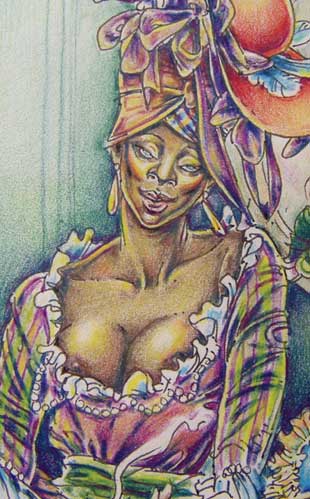
Stuart Hahn's younger Rachel Pringle
The Princes of the opening sentence – well, one prince, really: Prince William Henry, son of George 111, soon to be Duke of Clarence, eventually King William IV, who wrecked the Pringle establishment in a drunken frenzy with friends from the British Royal Navy, docked at Bridgetown harbor at the time, probably en route to the American War of Independence, a source of much prosperity for the lady, without which she undoubtedly would not have been able to add to her wealth the procurement of no less than 10 properties along Canary Street in Bridgetown. For boldface as she was, immediately she was capsized from her chair by the prince himself as he lurched out of her toppsy-turved premises, she picked herself up out of the detritus and set to work at her bill of damages, which the prince immediately the next morning, and without refute, honored to the full of 700 pounds. A good business woman, too, to boot! The Famous Rowlandson Cartoon is the only visual reference to this remarkable woman that anyone knows. I use it in this ongoing project with reverence to the great cartoonist and erotic master, emulating in my own way his wonderful joyous spirit and sensuality – maybe not so evident in the Pringle portrait, but certainly elsewhere in his pornographic outpourings.  Lastly, a few words about eroticism in art in these parts, something I wrote for something else, but which seems appropriate here: Who knows what treasures lie hidden in draws, stacked away against secret corners of studios, works that artists have chosen not to show, far less exhibit publicly, in Trinidad and Tobago, at any rate. The clandestine nature of a recent exhibition of erotic works – for selected adult guests and prospective buyers, only – and the – I suppose understandable, in present circumstances – insistence of the young artists themselves to remain out of the public eye - no reviews or media publicity of any kind - are symptomatic that nothing is going to change in the near future, not the attitudes of either artists or public. Surely we must appear rather ridiculous in the wide world of international eroticism – re Japanese animated S&M for instance. And, of course, lest we forget, the American pornography market is a multi-billion dollar enterprise, and no longer a criminal one. And, in comparison with all this, and amongst it, in the wide world out there, how do we look, as far as the quality and content of our work - at least that which is seen - is concerned? - TAME, to say the least, I would think! - certainly not very experimental or forward looking! On the other hand, may be something wonderful will be squeezed out of all this, something unique and powerful, if the – self inflicted - bear hug hold doesn’t cut off our oxygen altogether and kill us. But I doubt it - nothing I’ve seen indicates that this is going to happen. But who knows. For is that not the way of art itself, squeezing out of oppression and repression, and despite ourselves, some of our most powerful utterances? Well, we shall see. - Stuart see more of Mr.Hahn's work here
Wednesday, February 01, 2006
From A La Carte to Liberace

Theatre at the Masquerade opening, Horizons Art Gallery, Port of Spain, Trinidad
This is new work and one year in the making says, Aaron Schneider, one of the three Artists including one of Trinidad and Tobago’s Carnival icons, Wayne Berkeley. With Ricardo Nanton, a collaborative project in ornamental craft is on display at Horizons Art Gallery, Trinidad and Tobago, and conceptualized, composed and constructed are jeweled masks entitled Masquerade. Under the direction of Mr. Berkeley, an assembly of beads, sequins, plumes, palettes, lace ribbon, costume jewelry and synthetic flowers are clustered together and set in seventy-six individual recessed boxes. The ornaments are fixed to a felt fabric backing, and the Artwork is matted with a kaleidoscope of coloured boards. The Artists have signed each work using an everlasting - silver marker!
Plumes from a splash from La Cage Aux Folles
What is astonishing about this exhibition, “Masquerade” is that many Art patrons simply love it and by the expressive jesters demonstrated at the opening, the bewilderment, pure exuberance and joy just viewing these shimmering masks is an indication of the Art buyer's market in Trinidad and Tobago.
Owning one of these Jeweled Masks is really for its prettification, non-engaging feel and it is ideal to adorn hallways, hotel lobbies, homes, or to Glee at social gatherings that you have acquired one. Uncomplicated, unsophisticated and expressive of the kitsch way the Carnival Band Designer thinks of himself, and what he can clearly getaway with.
Heavy weights in attendance, television personalities, a video crew, Carnival Band leaders and "Artiste"
With encouragement from “Artiste” Pat Bishop, she writes in the elongated card-o-loge from the Carnival Institute of Trinidad and Tobago; “In the Trinidad Carnival context, this exhibition demonstrates the breath of Berkeley’s influence on local manifestations of the festival,” further stating that the use of the jewelry is contemporary and fashionable….“Bling," yet ambiguous to her are the differences between "Bling" and "Tin." Previously, Ms. Bishop played with the idea of miniatures, abstract paintings adorned with metallic rings mounted upon mat over mat board and set in a similar recessed box.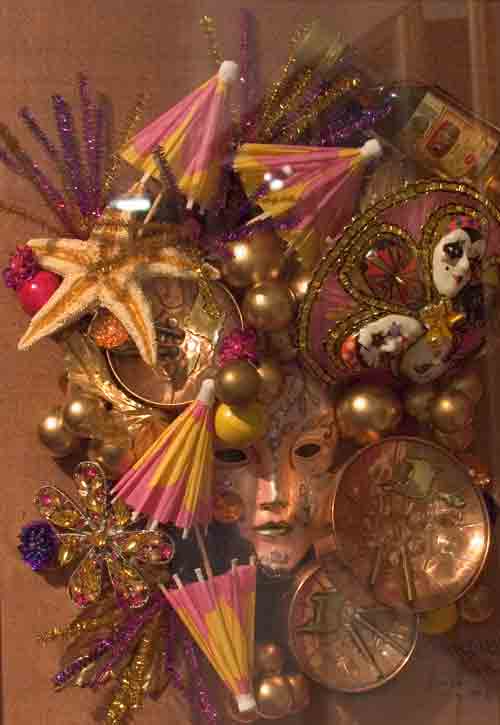
Panorama # 26, subterfuge for what Berkeley can getaway with as Art
Devine, Liberace and Walt Disney’s Mermaid under the Sea, collaborate together in an exhibition entitled Masquerade. Moved from the Carnival Booths from the Queen’s Park Savannah to Horizons Art Gallery. Decorative jeweled boxes in subterfuge for what Mr. Berkeley says; "There is consistency here, There is an eye for the particular detail, a commitment to the fine finish and the extension of the Carnivalesque into a longer lasting application." and by this he means, Hawaiian paper umbrellas, a sample bottle of Rum, Tourist copper Steel Drums with the islands of Trinidad and Tobago, Bulbs and Costume Jewelry fabricated in one of his works called Panorama. 
Pure exuberance and joy at the shimmer of each mask and appropriately timed exhibition, as the Carnival fever is creeping up, adding to the urge to absorbed, “We Culture.”
Labels are posted below each Masquerade Masks to tantalise the buyer by prose, leading to the details placed in the collage: "Listen to the sound of drums and this mask will direct you to the rhythmic music of the Caribbean. Most noticeable is the bottle of rum in the upper portion of this mask. Without the Rum there is no panorama......." Titles written from a hallucinogenic state. Other notable names; Neptunes Treasure, Strawberries Ripe and Don't eat the Daisies.
This exhibition may be enjoyed by the subtle differences in each Masquerade Jeweled Masks, for others, it may be the opportunity to own work from a legend in Trinidad and Tobago Carnival. 
Thebookmann’s Masquerade Mask made from buttons and trinkets from a haberdashery junk box, with the confession that designing the layout of the Art piece was quite therapeutic.
Note: Wayne Berkeley’s 1975 Carnival Band, "A La Carte" is remembered as Mas with great care attention to detail
thebookmann
Trinidad Carnival Art Masks Wayne Berkeley Kitsch Richard Bolai thebookmann
Subscribe to:
Posts (Atom)