Tuesday, October 31, 2006

Remember thy fallen heroes

Whatever a Nation sacrifices for itself - A greater Nation will emerge


The 1939-1945
King George VI Star awarded to nationals who served during British Empire


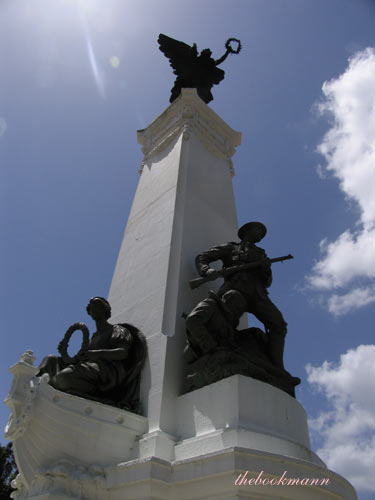
Memorial Park in Port of Spain, Trinidad honouring the death from both World Wars. The Winged Victory holds a wreath at the crown of the Monument.

What would Trinidadians truly fight for? The abolishment of carnival, the ban on roti and red sweet drink or the protection of freedoms and rights of the individual entrenched in our constitution? The War Monument at the
Memorial Park stands in honour to those who gave their lives during World Wars I and II. During the day, school children march up and down the park and at carnival, masqueraders rest on the grass just before entering the Grand Stand. And on those wet days, young boys enjoy a game of football as they battle each other in sweat in front of the monument. But are they unmindful of those young men who endured bleaker conditions in the trenches across Europe, and give their lives so that we would be free.

Monday, October 30, 2006

For quality art with a local vision - The roadside painter


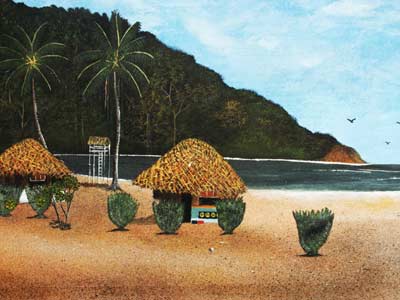
Drive along the Foreshore on the way to the most expensive mall in the Caribbean and you would come across a sight that seems endangered. To stop on the highway to purchase these symbols of the Caribbean one has to take their lives into their hands, as the artist has set up on the shoulder of the highway to do so. At one point the work was put up on a pirogue that was beached on the site. Now the work is set up on makeshift easels, and they are of everything that people expect the Caribbean to be, birds, flowers, landscapes and seascapes. Trash litters the area near to the works and not to far down from the mall one enters another world-arguably the world of the upper class, mostly Caucasian and Syrian set balanced between middle to lower class Africans before the beaches and hotels built for the foreigners called ‘yatchties’ who dock their boats in the harbour.


Maracas bay, Trinidad

These works not only tell us about a Trinidad and Tobago that we hold to for dear life, but one that we insist must continue to live in our artists works. However how many of the people of highest and lowest echelons actually stop to buy a painting is unknown. I do not know how well this guy’s work sells, but as far as works of this kind is concerned, it is better than most works of its kind in gallery spaces. There is a proficiency from having done these scenes a hundred times before, and the scene of Maracas beach is both quaint and reasonable close to what can really be seen. If you walk there today. The people who will never be remembered by anyone. Does this make their work unimportant because no one knows their name? The artist sits out in the open and paints from his heart and paints for a driving public and a curious public. For whatever its worth every time I drive along that highway I see different work put up along that road. There is a place for everyone selling art, I tell myself, and this man chooses the highway. The other artist takes his way. ........at the end of the day art is a process, and the market place is as big as your mind can process it. Who is to say that our roadside artist cannot one day aspire to a large gallery space or our gallery space artist aspire to the roadside painting? Ponder that.- Adele


Open Studio, Trinidad, West Indies. An impressionist painting at a Museum in Chicago aspired this Artist to paint. John Alphonso Webster As his business card states: “For quality art with a local vision”

Top: On the road, Trinidad, West Indies. Centre: A detail the idyllic place, Maracas Bay, Trinidad

Friday, October 27, 2006

Rewriting the Annals of Biblical History

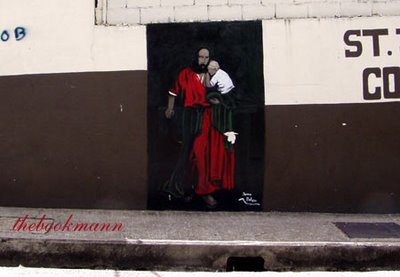
Joseph's cut-eye look Jesus, But wait, dis child dou look like mine


A life-size wall painting portrait Joseph and infant Jesus, St. Joseph College, St. Joseph, Trinidad and Tobago

Near dusk, Pope John Paul II emerged from the National Athletic Stadium into the open field. Local Catholic nuns, dressed in their earthy brown habits displayed a carnival mentality never televised before. They were not unperturbed in prayer, genuflecting to his Holiness in a proper Church-Mass manner that would be expected of them, no, they bolted like a startled herd, galloping towards the stadium’s athletic track to see their JP2, superstar circulating in his Pope-mobile. Orgasmic really, as they gyrated their hips side to side, and chiped to the calypso rhythms in chorus sung together in unity from a stadium packed with all religions and creeds. “We Pope.”

This is a nation of staunch Catholics, who carry the iconography of the Virgin Mary in their homes, businesses, cars and on themselves. It is in San Jose de Oruna, one of the oldest “New World” territories that a wall mural displays not only the talent of a great painter, (Trini standards) but also of his Catholic upbring displayed as contemporary motif, a masterpiece to all who pass by.


A child rests, his hands are nestled on the shoulder of his father and is hidden between his regal beard. (what a clever way not to show the painted hands) Clothed in a white short sleeve “Polo” shirt, he has an uncanny resemblance to Pope John Paul II at the age of five

Rewriting the annals of biblical history...

Jason Belaw is proud enough to sign his name to his newest testament, a life-size portrait of Joseph and the infant, Jesus. Emerging from the dark background, the four by seven masterwork is dominated by the figure of Joseph dressed in a full roman scarlet-red Chasuble and seated, if you believe, on a throne draped with a sea-moss green table cloth. His left arm is placed gingerly on the armrest. His other hand, under the heavy strain of carrying this sixty-pound child, is quite petite, and his feet are well protected by a tanned hide “Clarks”. No Rembrandt here, but a subject painted under a illuminated 10-watt bulb. A winner in the “Trinidad Aesthetic” Hall of Artistry.

Jason Belaw choose not to use emulsion for this painting, only the best he thought, and that would have to be the Everlasting Berger low-sheen house oil paint. The German chemist, Lewis Berger in 1760 developed a new formula for pigments popularly known as Scarlet-red, Sea-moss green, Dominica brown and Pitch-lake black. The lacquer, applied layer by layer, gives the Berger high-gloss-house-paint a lustre of eternity. Father Joseph gestures with a “cut-eye” as he holds the Messiah who appears not to be his child. Is the artist inadvertently trying to say something about himself?

Christians have paraphrased the interpretation of Jesus’ life, convincing the masses that the Holy icon closely resembles a “New World” look. If he looks like one of us, then he must have originated from here. The fact that Jesus was a true historic person, a Jew, a humble craftsman whose beliefs and faith written decades after his execution, has trickled down to us. It is as if we were using an empty Nestle condense milk tin, twine stung taut of over the millennium, connected to muddled words and meaning, images and paintings of his life, yet still celebrated in his spirit on the walls of St. Joseph College.

Wednesday, October 25, 2006

Deciding Our Ethics


Drive past the controversial ornate St. James sign and make a sharp right turn. You come to what is known as The Police Training Barracks. Turn right after the police bungalow and you come upon the tennis courts. Drive past the courts and you come to a group of Art Deco inspired cottages that house media based companies. The surroundings feel like an interpretation of ‘old’Hollywood that you see in movies starring Clarke Gable or Vivian Leigh. As you park your car, you see a small ‘parlour’. You almost expect to see a reedy man in khaki pants and a vest walk out of the establishment with a cigarette hanging from his mouth. The place feels as though you have stepped back fifty years or more, and next to this parlour is the censors’ board.‘The Censors’ Board! Does that place still exist? What with readily available DVD’s and the latest movies reaching us almost the same day they are released in the United States.


The Bookman and Adele remembered when the board censored the film, the Exorcist. Pronounced Ex-or-sis to many. We were too young to see it, but were shocked by the rating system that our parents had to explain to us. There is a whole generation growing up thinking that they can see anything they want. Oddly, not being able to see something at a certain age made you aware that you wanted to grow up and be able to see what the fuss was about. The censorship board still looks at movies. Whether they have any control over what we watch is dubious. But there was a time when they were all powerful. - Adele


The Top: The Censors board sign next to a small snack shop, St. James, Trinidad, West Indies. Centre: In a dark cramped room a projectionist is rewinding the film the “Illusionist.” Bottom: The screening room as official as a Court room with a gavel to approve or disapprove a scene that may be objectionably. See an old movie house

Saturday, October 21, 2006

From the light within....Divali

Purifying the Heart of Man....

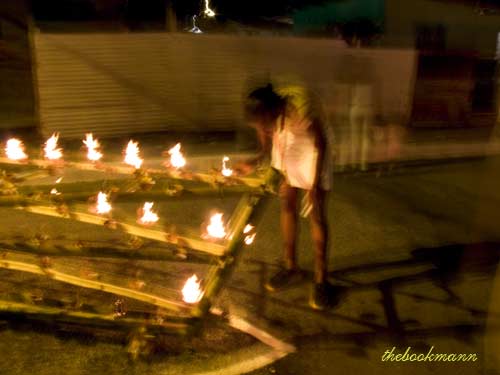
"The Festival of Lights," symbolises the victory of good over evil, and Dayas are lit as a sign of celebration and hope for mankind. Here on the small Caribbean island of Trinidad, a family and scores of people from a community join in and celebrate Divali.


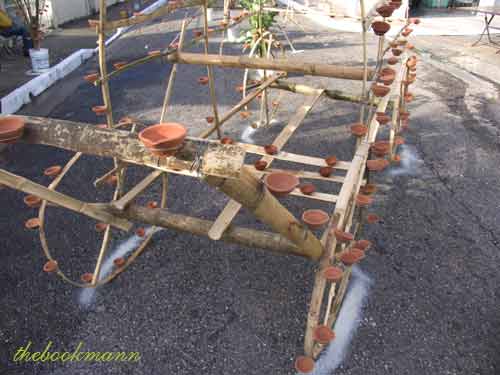
An bamboo frame constructed as a Boat.

On a short stretch off Ethel and Finland streets, St. James, Trinidad and Tobago, Mr. Beem Singh watches his family prepare for the festival of lights. For seven years his family has celebrated Divali on the streets outside his home, and with his community. This year his sons have built an array of sculptural objects made from Bamboo ribs, and the lamps are secured by wire loops that work as holders.


A Bandwagon mounted with Dayas secured by simple wire loops to beautify the object.


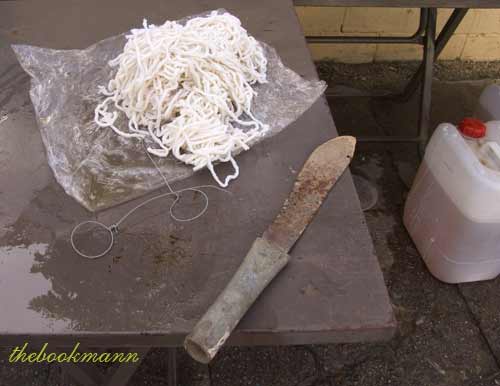
Wicks are soaked with oil just before they are inserted into the Dayas.

One in particular is a play on a local political theme, and an elaborate bamboo frame is constructed to resemble the State owned surveillance Blimp, commonly called “Eye in the Sky.” This piece Mr. Singh says, took twelve days to build with special add-ons such as Christmas decorative lights and a red siren. There are other fancy objects like a Bandwagon, Boat and Canon, all completed in less than three days, and all set with lamps filled with coconut oil and wicks that has been soaked with oil.


The head of the family is shown at the centre praying to the Deity goddess Lakshmi.

Mr. Singh had constructed a shrine for the occasion, and it was the Hindu goddess Lakshmi carved from styrofoam and decorated more towards the side of a Carnival costume piece, yet it had a sacred presence.


The State Blimp, commonly called the “Eye in the Sky," St. James, Trinidad and Tobago.

And as people congregated and filled Ethel street, they began to lit the Dayas in a co-operative and methodical way. Mr. Singh's home was opened, and he catered to serve two hundred people where for a brief moment, all creeds would sit together and share a vegetarian meal, thus experiencing his light within.....Divali See last years Divali post


A young girl lighing the lamps, St. James Trinidad

Friday, October 20, 2006

The Chinese Descent

Where we have come from and where we are going...


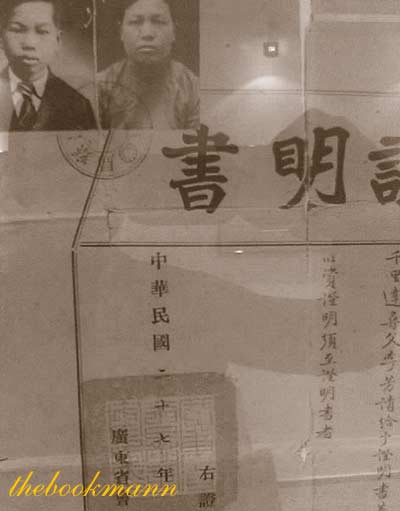
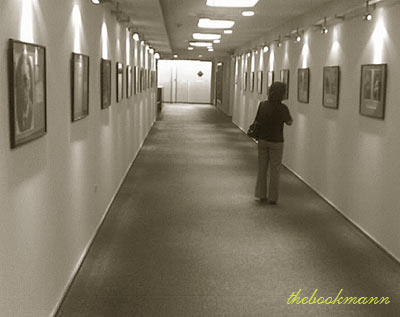
Two hundred years of the Chinese presence in Trinidad and Tobago is being commemorated this month at the Clico Gallery in Port of Spain, and also at The Public Archives. On view are images of the ancestors of five Trinidadian families dating back to six generations and brief stories of how they came to Trinidad and Tobago. The curator, Sonja Dumas has taken great care to make this show interesting to the public, with the assistance of Gary Chan and Jeffrey Chock. The photographs are reverently displayed under softlighting along the corridor of the narrow gallery and separated by decorative Chinese coins wrapped insignature red ribbon. There are also documents and objects. For example, the accounting system for the Lee Lum store that produced a special minted coin that was put into circulation in La Brea, Trinidad in 1
890 to 1906 as a form of legal tender.


The bookman was quite touched to see a picture of one of his relatives, he was unaware of that particular person until he read the name. He had never seen the image before. It was a piognant moment to say the least. You come away from the exhibition aware of the very hard and selfless work of all who were brought here,or came for an arranged marriage or to work the plantations, yet, no matter what the circumstances were. We know that everyone came with the hope tore-built their lives, lives that would help make the small Republic of Trinidad and Tobago stronger, and for that we are all grateful. Shows like this are very important and must continue to be presented. We need to be more aware of our history as a nation, but moreso, we need to get the message that everyone has struggled and worked to make our islands what they are today, and we should be proud of all efforts made, no matter if it is the effort of a man in khaki pants on a donkey or a woman in a pinstriped suit in an SUV. - Adele


Top: Photographs from five Trinidadian families dating back to six generations. Centre: Memorabilia showing legal documents. Bottom: Bottom: The China Roots; Trinidad Branches. Clico Gallery, Trinidad. Exhibition ends 1st, December, 2006. see the
Chinese Laundry post

Monday, October 16, 2006

In My Irie Heart - Roberta Stoddart

I gave you a gift and look what you have done with it
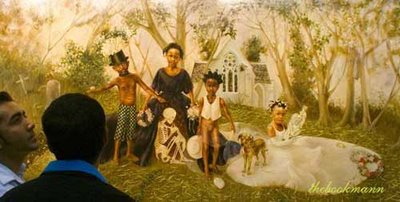

God’s Bride at the Softbox gallery in Port of Spain, Trinidad, 2006

Last year, Roberta Stoddart invited the bookman and Adele to her studio in Port of Spain, Trinidad. She had drawing tables set up for her classes and towards the back there were a few small paintings of dogs and fowls reproduced from photographs. Stoddart has a fondness for dogs and in one of her pieces, she paints them fucking.

In Jamaican circles, Roberta Stoddart is regarded as her country's finest painter. At the exhibition, a suitable distance, she showed works from her personal collection including God’s Bride (1996, 48ins x 96ins) a painting with the refinement of a Flemish master, but also a work with an allegorical meaning towards an unwed woman and forgotten children.

God’s Bride shows Stoddart's ability as a fine art painter, the subject however has a lesser appeal as it deals with an unconformable issue. The painting expresses her internal torment subjected by social obligations and to the destructive force which it illustrates; West Indian, Jamaica, Church, Blacks, Sex, Marriage and Death. One particularly drawback is her tendency to be paint flat and to construe the perspective to squeeze in every element.

At Stoddart's exhibition at CCA7 a few years ago, she focused on the homeless, and painted vagrants as large canvases. The subjects were characteristic of their circumstances and the painter intensified parts of their unkempt body to amplify the social neglect placed on them.

..........................................................................................................................................................................

This is quite daring for a white West Indian, she has run up against people demanding to know why she has chosen to paint 'black people' as though it is out of bounds. As stated before, Roberta Stoddart is painting from a personal space,and searching out meanings from her subjects. As with her smaller works of angels who look caught up in spun sugar, there is both a sweetness and a macabre nature to the images that are pricked with a fine needle, a drop of blood escaping their hearts, as though Ms. Stoddart empathizes with all the travails of being black in a white world. She has an innate understanding of the outsider, so who else could put this across, but one who can feel what being outside feels like? This is obviously beyond colour barriers. Her work's depth come from technique as well as experiences, and pushing past her own comfort zones to make sense of her world. - Adele
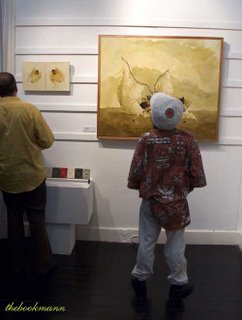
At Softbox gallery in Port of Spain, Trinidad.

Saturday, October 14, 2006

This is WAR


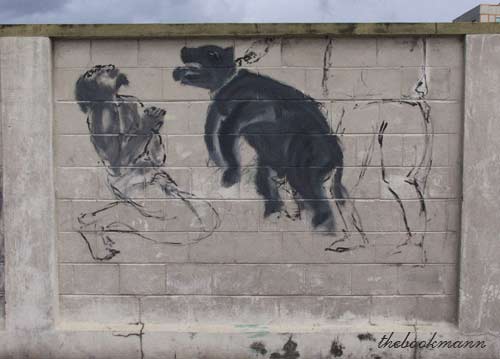
More on the Tagging War. thebookmann and Adele have been privy to the many spaces in Port of Spain that feature the work of Mr. Alinton. The graffiti artists, "Louse" who we have named “UGT” (underground Graffiti Tagger) has most recently been freshly painting, seeking out fresh spaces. But sometimes, he has encroached on Alinton’sturf, and that ‘war’ is very, very interesting.

The UGT had stenciled an image of a baby first on one side of the wall. Ye Mr. Alinton interpreted the baby in black housepaint and dabs a few black marks over the stencil as “Respect.” UGT has found is own space a few blocks further along from a huge mural done by Alinton. This mural consists of boxers, with text saying things like,“Don’t give up.” A grey painting of a boxer in his corner, straining to make it to the next round. “Fight a good fight.” A overly sexualized woman in pink with enormous breasts, a green handgun exploding, all against a very textured stone wall, in full colour. UGT has found is own space a few blocks near Green Corner, Port of Spain and along the wall there is a hand, a spray can, and the
peeing boy, like a notebook of signs that he test strips, to place elsewhere in the future. What we are seeing is a marking of territory in an aggressive way which both graffiti artists are evolving before our very eyes. - Adele

Friday, October 13, 2006

Painter Of The Year - Trinidad and Tobago

Creativity is born in the bowels of Trinidad and not in the galleries...


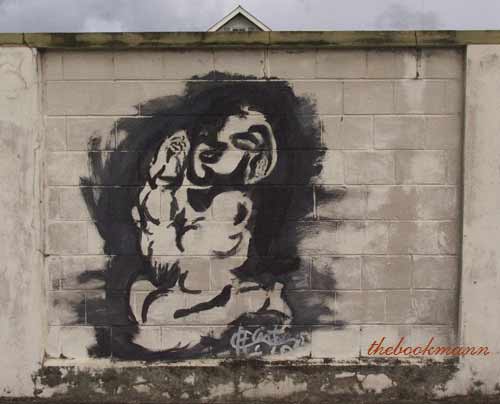
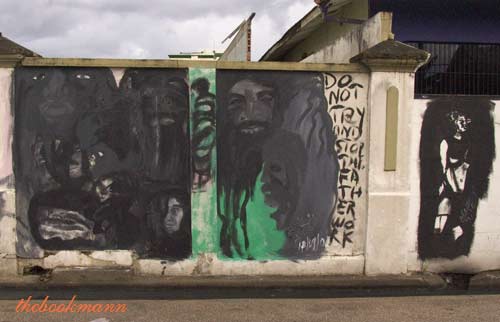
The images you see here are the ravings of a mentally ill painter, probably someone who has never ventured into a gallery space. As thebookmann and Adele were taking pictures, a woman walking up the street informed us that the person who makes these images is homeless. He has expanded his public canvas from across the street from the PNM house to across from the site planned for a new Indian High Commission, as well as a few hidden side streets of Port of Spain. What is clear to us now, is that Mr. Alinton, as we try to make out the name that now embellishes the walls with equal gusto, is adding text and making bolder and bolder statements about the state of the country, the difficult emotional congress between men and women, the status of blackness, the search for identity, the threats of living on the streets and the desire for hope.


This we see in the face painting with one eye placed over a circular hole placed for a electric meter. This hole suggests possibilities of something better to live for, something untouched by ‘our’ reality. Two weeks ago many artists went to Soft Box to see "A Suitable Distance." Meanwhile, a suitable distance away, a tag war goes on without fan fair between Mr. Alston and the ‘Underground Graffiti Tagger called "Louse". For real ‘turf’ on the city streets. Nothing is sacrosanct, you may have walked over a tag or a painting And didn’t even know it. Here on the gritty, filthy floors and walls of Port of Spain, house paints come out in the heat of the day and treachery of night. Real heart to heart, painful, passionate needs to create, while elsewhere Artists grapple with finding a way to make art they claim, for the public, and woefully miss the mark. See the


Some of Mr. Alinton’s imagery are painted in black upon black of black people, which reminds me of the work of the painter Chris Ofili in its desire to tell stories of pain and pride. For Mr. Alinton, you can go to his gallery whenever you want. Real art is happening here. - Adele

Tuesday, October 10, 2006

The Drawing Room


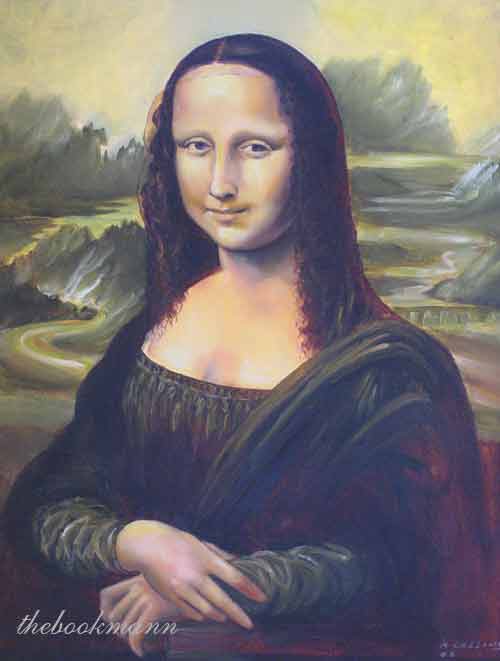
Helen Kelshall walks through with her clients and discusses in detail, each of the Artist's concepts or history. The most recognised painting in history painted by a Filipino expatriate who is captivated by the Renaissance

The “Drawing Room” is a gallery that places art where it can be best appreciated, and this is in a drawing room. The director, Helen Kelshall says the purpose of the space is to give amateur artists some exposure and the room is full with easels and mounts in support of her venture. But the income comes from her framing shop which in turn supports her passion for Art.


The prospects of seeing the work in right setting may be a good incentive to buy, ie; your living room. The Drawing Room gallery in Diego Martin, Trinidad
................................................................................................................
Terms and meaning - Drawing room means a living room

Monday, October 09, 2006

Celebrating its first anniversary - thebookmann


The Bookman celebrates

The idea to cover underground art in Trinidad and Tobago led to the creation of the blogspot, thebookmann. This was the desire to find a home for our ideas, and the bookman endeavours to continue to ask the question, what is art in Trinidad and Tobago? What is culture, what is the Trinidad aesthetic? Since its inception, we have seen others take up our concern, and that has proven thebookmann’s influence. However we could not do what we do without the people who make the site possible and so we will like to thank all of the people we have met in our travels who were so kind and forthcoming with information about how work was made, by whom, the materials used and in many instances, the purpose.

Ours is a desire to have those of you who seek out this site, know that our major interest is to enlighten, to encourage thought and even a slice of humour to what is seen and sometimes a needed pong where necessary. We also are looking at montaging and collaging what we see to make high what is considered low art.


The bookman blog is the result of Public Art from the bookmann website, and since then it has documented some interesting public Art in the most unusual places throughout Trinidad. The bookman has also influenced how artists view their work in Trinidad and Tobago, and it has opened the door where obscure street art is now being examined as a form of Contemporary Art making. The blog is the source of Art for International readers, and thus it places the importance in viewing Trinidad and Tobago in a accurate light without any political bias. On behalf of thebookmann, Adele and Stuart, we wish to thank you. See the post of the year.

Saturday, October 07, 2006

Passport pictures at Back in Times


Mr. Smailes’ photographs were partly stagnant

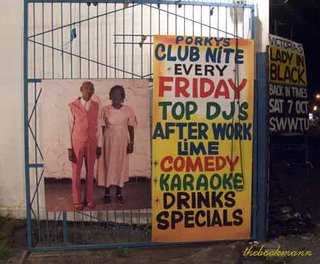
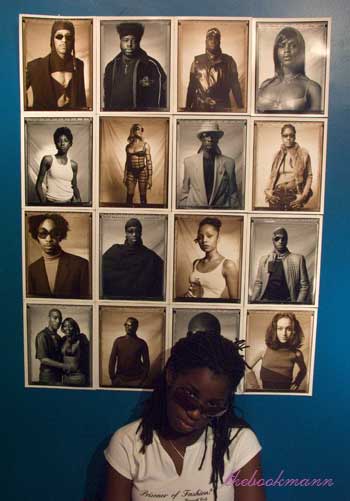
Alex Smailes looked smart and he was dressed for the occasion as if he was going to be photographed himself or participate in a sweat down later that evening. This was the driveway to SWWTU, Port of Spain, Trinidad, and an exhibition of his portrait photographs of regular fete goers who come to an event called, “Back in Times.”


SWWTU is ingrained in us and It is a Rite of Passage for some older Trinidadians. On the weekends and late at night, you can see couples coming out of their Datsun 260c cars, dressed to the hilt in their matching silver lamé or Caribbean blue polyester garbs designed especially by the family's tailor and seamstress. Here is a panache that stands out, and if this does not do the trick, an elaborate hair weave may make you bend your head backwards to catch a glimpse of a hairdo that took 12 hours to prepare. The lady majestically balances it on her shoulders as she walks and dodges portholes with her 6 inch high heels and white straps that wrap up her shin.


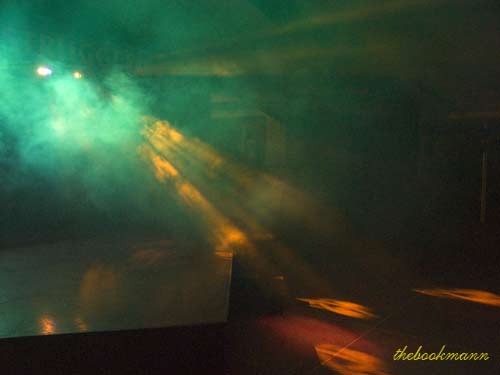
The Dance hall of SWWTU, where couples congregate towards the walls and permanently stain their clothes by perspiring in the heat of the dance.

“Back in Times” is an offshoot of Carnival, and a history of slavery where people mimicked their masters. It is an opportunity to masquerade in a fantasy where men are Manly, and women are Womanly. Also, it is the idea for Couples Only and more so to compete with a fashion style characterized by the SWWTU street posters, such as Lady in Red, Black and White Ball or Birth Night. And in the hall of SWWTU, Saga Boys and Lovely Ladies congregate towards the walls of the dance floor but freshly starched white trousers will be permanently stained by grooving to a slow tune.


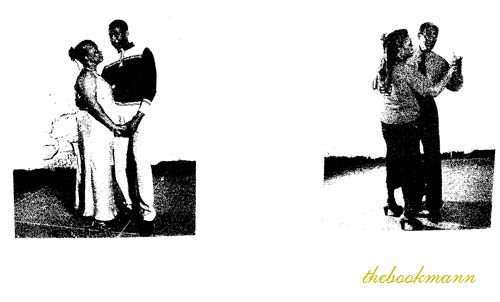
A women holding on

Mr. Smailes’ photographs were partly stagnant with the exception a old women glued to her young catch. She is totally captivated by him and this is an essences of what Back in Times brings, otherwise, they looked like passport portraits. Later that evening, the work was removed by organizers of the Club. Trinidadians don't much care for dat type of art, but rather the feting one.


Top: Open gates at SWWTU. Centre: The dance floor at SWWTU. Bottom: A small gathering at a brief opening. A pan of the corridor and exhibition via a mobile video phone on youtube

Friday, October 06, 2006

Pedro Almodovar in Port of Spain

A thick woman to a older man; I dou suck, I dou touch, I dou move in one of the meat shops on George Street


George Street, Port of Spain is the hub of interesting things to experience. There are the street market vendors and meat and fish shops bustling with people, and a hidden gem that pop up in the most unusual place.

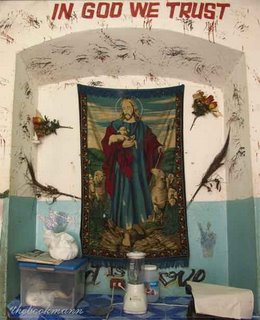
This is not a Pedro Almodovar film set, but a fish market. The man gutting the fish behind the counter had no clue what the name of the place was, yet an interior ornamentalist somehow did to make the place look and smell like a fishermen's port. There are scenic paintings of pirogues and fishing nets, fan corals and plastic flowers hang from the walls. The archway has a tapestry of Jesus with his flock of sheep to bless the place and a Hand Peace sign is covered over in glitter. Yet
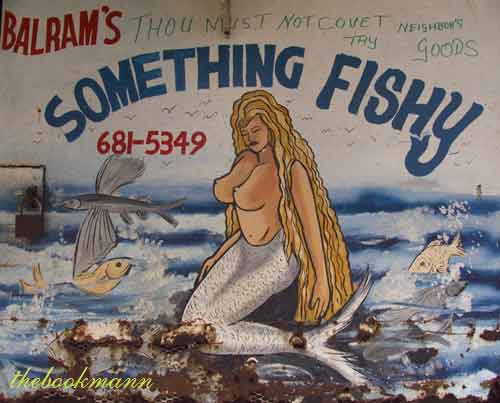
Balram fish mart quotes from the Bible, Thou shall not covet thy neighbors goods, to deter people who forgot their money home.


Balram; Thou shall not covet thy neighbors goods, just above, the sign, Something Fishy

Fishy sign George Street feels like Trinidad, circa 1880. Old buildings groan above the riotous colour, sweat and weight of street vendors plying their trade, with dub music and cussin’ and gambling and women swaying their hips with loads of groceries, new born babies, hair piled like fresh pineapple and powder visibly on their chests.

A sign catches our eye amidst all of this goings on. It is actually a very neatly done painting. A chunky mermaid suns herself, helping to sell the freshest fish. Above her head is the scrawled text, Do not covet thy neighbours goods.. in a knowing way. Our mermade’s skintone is a healthy light brown. A ‘light skin’mermade, with ‘good ‘ hair, telling a moral story with her womanly wiles. - Adele


Shark and George Street, Trinidad, West Indies

Thursday, October 05, 2006

Drawings - Finished and Unfinished

But is Carnival, it just have to stand up for two days, trow it after


The Bottom Line Drawing has taken a back seat to landscapes and the like, so I was looking forward to seeing the show, The Bottom Line. An exhibition of drawings by thirteen artists from Jackie Hinkson and Eddy Bowen to Dean Arlin and Akazuru. Walking into the Cotton Tree Foundation I was very willing to reserve my judgement in favour of exploring the works on show, but yet again, I was disappointed by the curation. I asked aloud, what is the purpose of a show of drawings? Framed works were interspersed between rough sketches. Some works were very skilled against others that were mere doodles! I have to confess that I wanted to throw up my hands is disgust because I could just hear people saying to me, why do you always have nothing good to say! Little do they know that I want to be able to have something good to say. I really do. But the problems are always so obvious, so glaring, that I cannot believe that I am the only person seeing them.


I am extremely happy to see so many shows on at the same time. I am very happy to see very different shows, focusing on very different things. I am not happy to see the opportunity to show the best wittled down by sloppy decision making and not asking the right questions of the showing. I am also beginning to wonder about artists themselves, how can you allow your work to be represented so badly.
LeRoy Clarke has some gorgeous drawings, Jackie Hinkson’s drawings are larger than life joys to behold, so imagine my shock to see small sketches by Pat Bishop framed in soiled frames! A person who prides herself on presentation, and then there was Akazuru's installation placed in the centre of the space. Does this mean that drawing can be viewed this way? What is going on?

Can someone place explain this to the public at large! A show like this needed to explore or expose a variety of standards of what drawing is and means to us at this time. Perhaps showing sketchbooks, works in progress and finished studies. At this time, the show looks like a hodge-podge of things with no cohesive centre. - Adele -Temperature – cool Work - cool
Top image : Kimme, Bottom: LeRoy Clarke at the Cotton Tree Foundation, Port of Spain, Trinidad.

Wednesday, October 04, 2006

House of Gerard Gaskin

“My Cat always bounces back”…..From a conversation about rough sex at the small gathering at Gerard Gaskin’s show


At a Different View Bookshop in Port of Spain, Trinidad, the
photographer Gerard Gaskin sits down with the bookman and Adele. He is here in Trinidad to photograph local artists and to also give his first public exhibition, Walk in the park at Tattoo Farm.

In a large box, Gaskin shows his original prints, and this is what real photography should look like. Since 1992, he has infiltrated the New York Drag Queen scene to document Ballroom Competitions. What started his intrigue with Peek Shows was to expelled he says, his inner demons behind the culture of hustlers, drag queens, whores and to question his youth as an altar boy. The issue of sex and love had been misconstrued by a priest.


Walk in the park at Tattoo Farm.

Gaskin's sex themes are uneasy. You have such other nice photos is a polite way his mother deflects the embarrassment she feels. The photographer is not phased by this as Art comes before as anything else.


We also discussed photographers who work here, and their need to step back for a moment, and see where they can push the envelope to make photography an art itself. In New York there is real competition and you can’t become lazy. Trinidad is a bit lax, and the quality of the work is less prone to be scrutinized.
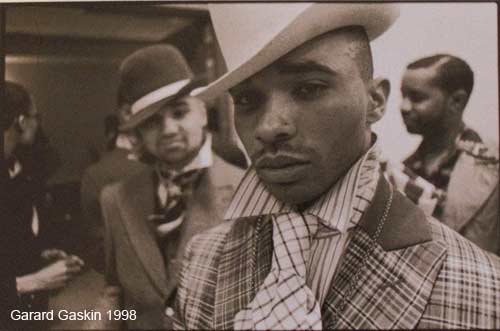


As a straight man, his ability to convince these eccentric individuals characterized by names such as a military dyke or thug homo, Gerard Gaskin passes the test, that his balls hang quite low. To be an Artist means to make money from your profession and grow into a style that is distinctly yours, five years after leaving art school. Only now is this beginning to materialized for him.
Tuesday, October 03, 2006

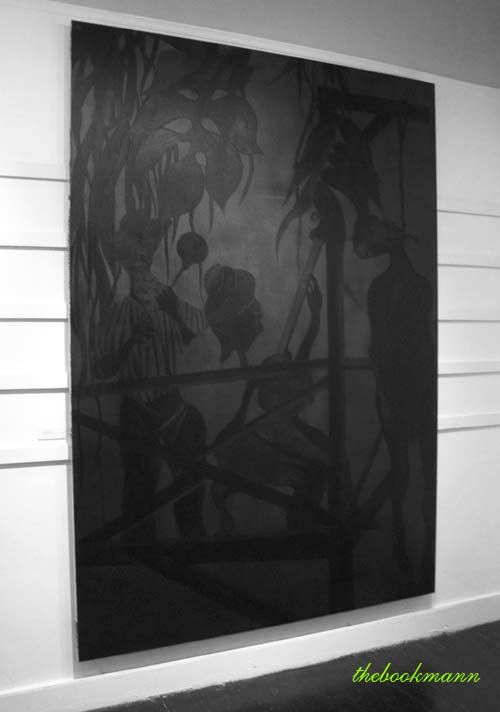
Iscariot Blue - Ofili's Parang

Paranging at Ofili's house


Iscariot Blue, a group of parang players on a veranda and to the right, a man hangs from one of the rafters. The image of the parang group was lifted from a plaque.

At the suitable distance exhibition at Softbox, 2006, Chris Ofili shows his work,
Iscariot Blue, 48x199 ins (2006). It is a portrait of parang players and of an execution set between the mist and foliage of a darken moonlit evening. The work is beautifully painted and the meaning behind it may be a complex mirage hidden over a palette of blues. The figures look like a naive cartoon and this is a quirky style which is distinctly Ofili. Curiously enough, Iscariot Blue has a textual appeal to Vincent Van Gogh. If this was Ofili's intention to emulate the Impressionist painter, his work may be read as having a familiarity that seems important in the history of Art.

Iscariot Blue
is provocative, musing and relating to black people and the subjects are part of a Trinidadian custom, whether or not if Ofili understands it fully. It is a reminder of what he thinks of this mystifying place, and how he treats a candy store full of untapped ideas readily to export.

Monday, October 02, 2006

A Suitable Distance – Impressions by five artists

Too many pieces to small a space


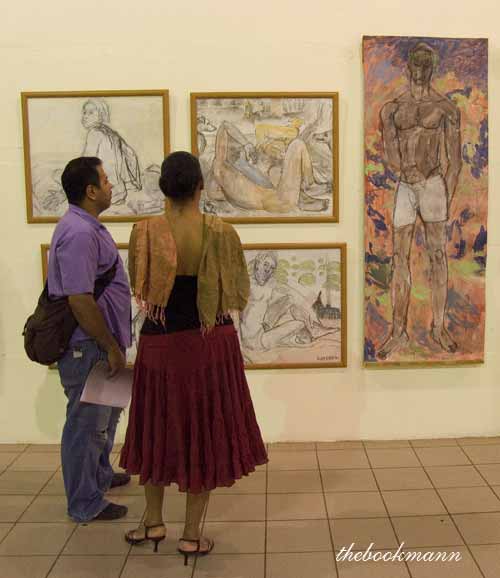
Of all of the shows on at this time, none interested me more than this one. A Suitable Distance features the work of Roberta Stoddart, Rex Dixon, Kofi Kayiga, Peter Doig and Chris Ofili. The latter two are arguably the most important British contemporary artists of their generation, and it is quite reasonable to say that the show is worth seeing purely for that fact. Anyone who knows something about art at least knows about Mr. Ofili’s piece, Madonna defaced by an irate New Yorker. It is Mr. Ofili’s first showing of work in Trinidad and Tobago. Let me say what disappointed me, and get that out of the way right away. It should be clear by now what it is, the curation. Too many pieces crowding the small spaces. This show deserved to breath. For such large pieces and several smaller ones, the show should have struck out for difference from all other art spaces in Trinidad and really sent a message and stood out boldly for where art should be going. How hard would it have been to gut the building of the everyday working environment in favour of one work per room?


This has never been done as far as I am aware, and the works of Stoddart, Doig and Ofili needed just such attention. Here is an opportunity for the art weary public to really see how art can be, and instead the decision was to pack it in, not to choreograph, and for that, I felt cheated.

Yet, I am thrilled to see the work of such luminary artists in a very new gallery space, what a coup for Soft Box and Andy Jacob who conceived of the show. Here is an opportunity to draw a line going upward stating what art should be, if we really want it to. Five foreign artists explore what working in this place means to them. I must say that this show left me thinking about colonialism and post colonialism, the expat culture and where local art stands at this time. I found that very good for me, as these issues are very real and worthy of discussion. I hope that those who were at the show also took away a sense of provocation about art, and not just the privilege of saying that they saw some work by some internationally known artists and that was all. Temperature – air conditioning cold Work – warm. - Adele


Top: Chris Ofili Cente: Roberta Stoddart (Detail) Bottom: Rex Dixon at "A Suitable Distance" exhibition in Trinidad, West Indies

Sunday, October 01, 2006

Apposing Beliefs

A man carries out his passion amidst his circumstances


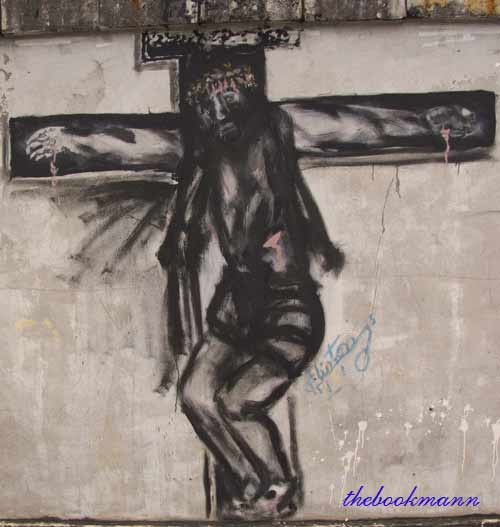
The crucifix painted opposite the PNM headquarters, Newtown, Port of Spain.

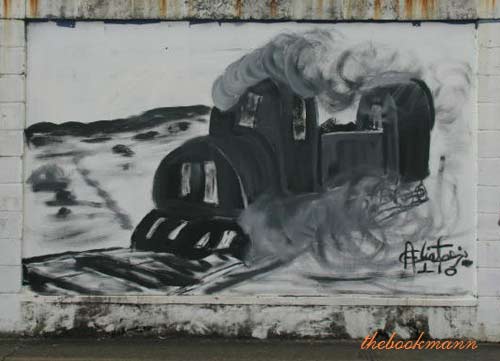
This street artist paints a narrative surrounding his circumstances and his compassion for Trinidad and Tobago. His images speak of national unity and also of the social ills which he knows quite well. Since 2004, the Bookman has documented his work from what began as a simple drawing in pencil and this has expanded into an elaborate mural which occupies the wall opposite to the PNM headquarters in Newtown.

His recent addition to the piece is a crucifixtion. The Christ figure is crown with thorns and the painter has put dabs of red paint to signify blood. The interpretation is of Jesus Christ as a Rastafarian with ropes of his dreadlocks beneath the crown.
This particular detail shows his sensitivity towards his faith, and to a nostalgia under which these images reflect his inner torment or past he would like to revisit.

Disclaimer:

Views expressed on thebookmann are not affiliated with any Art Organizations and an “Art Review” may be open to interpretation as it is an observation at face value.

Amendments to such articles if misleading or with grammatical errors shall be corrected accordingly.

All photographs, Feinin studies, accompanying quotes, articles and visual headers appearing on site are the exclusive property of Richard Bolai © 2004 - 2010 All Rights Reserved.

Any fare use is restricted without written permission