Wednesday, November 29, 2006

Cape Town Chronicles - Dean Arlen

Freedom is what you make it, and an understudy sees the light


Fort San Andres, the Museum of Port of Spain is located in the heart of the city, South Quay, and the gallery is at street level making it accessible to the public and the bustle of pedestrians and street hustlers washing cars just outside.


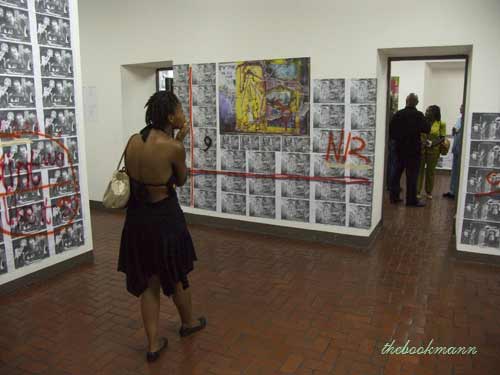
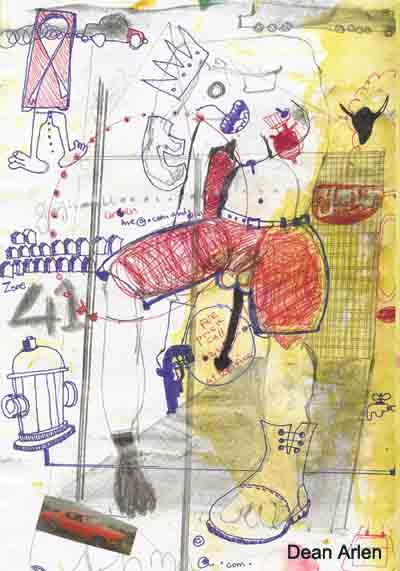
Dean Arlen has managed to curate a visual exhibition that brings art to the public. His exhibition, Cape Town Chronicles is based on sketchbook drawings
and the lower floor of the museum is transformed as if a graffiti artist had defaced it with an aerosol can. The rooms are filled with photocopies, interspersed with twelve posters, digitally enlarged.

Arlen has personalized his work by deliberately marking the territory with familiar symbols and slogans such as, KFC or the Blimp.
These posters are from his sketch book specifically made for the purpose of his six month South African Artist residency where he drew inspiration from. Cape Town Chronicles - 28 November to 17 December, 2006, Fort San Andres, the Museum of Port of Spain, Trinidad


..........................................................................................................


Is it important for an artist to have a large body of work to understand them? Or is it the quality of the work we see that should be contemplated? Or more so, what of concepts yet to be made, should an artist’s work be considered important based purely on conversations about the work? These are the question that comes to mind first when I think about Dean Arlen the artist. He took Commonwealth Fellowship at the Ontario College of Art in 1994. He showed work at the Trinidad Art Society and he has won a competition in Trinidad in the 1997 for sculpture that was not realized by the creators. He has tried to get other artist involved in community environmental art projects over the years, and has produced one show at CCA7 in 2002.


It is not for want of trying that Dean Arlen has produced so little, he has spent more time focusing on creating a groundwork for the works he intends to make. This is difficult at the best of times, and even more so in Mr. Arlen’s instance because of the fact that projects such as his are practically unheard of and this is the beginning of his decade long vision realized at last. He also intends on creating environmental sculpture with other artists on the campus of the University of the West Indies sometime this year. - Adele 2004

Monday, November 27, 2006

Prophet Muhammad & Christ


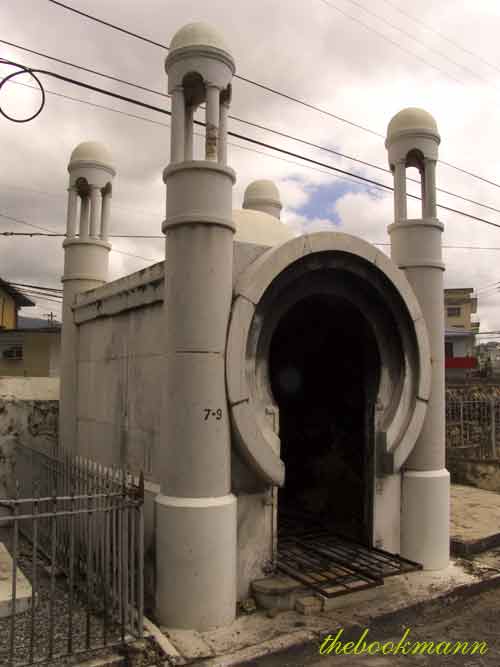
Over darken skies, Port of Spain, a dilapidated Muslim mausoleum with its Arabic circular archway to the burial chamber and the copper covered dome which has been completely desecrated.

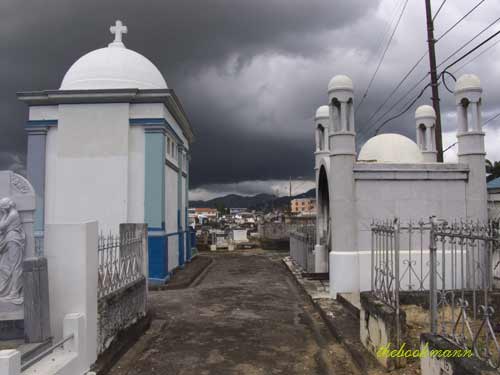
And in death we rest side by side. Two mausoleums of Christian and Muslims families are opposite each other at the Laperose
cemetery in Port of Spain, Trinidad, West Indies, a testament that in the end we all become part in earth.


Over darken skies, Port of Spain, a dilapidated Muslim mausoleum with its Arabic circular archway to the burial chamber and the copper covered dome which has been completely desecrated.

Friday, November 24, 2006

A Benefactor To A Goldsmith - Barbara Jardine


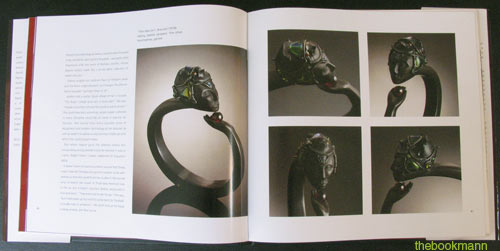
Goldsmith is a book filled with clean, precise colour plates reflecting on a subject that deserves much attention for its details - It is on the art of Jewelery and Barbara Jardine is the recipient of the coffee table book, entitled, Barbara Jardine, Goldsmith, published by Robert and Christopher.

Robert Campbell took a gamble and produced one of the finest coffee table books printed in Trinidad and Tobago. He also had the incentive to photograph one of
Barbara Jardine’s prized pieces, Warrior at the British Victoria and Albert Museum in London. The genesis of the project came soon after the exhibition, Flux and Fire which was held at the National Museum of Trinidad and Tobago in 2005 and was a show on five jewelers

Goldsmith
expands on the Barbara Jardine's repertoire of three decades and offers a privy to her personal life. This is the first in the series of Art books highlighting female artisans in Trinidad and Tobago. The reasoning behind this, Mr. Campbell says, is that they are generally overshadowed by their male counterpart and it is time to recognize the contributions of artists like Jardine, the first of three to come.


The Warrior piece which is the collection from the Victoria and Albert Museum in London, England.

Thursday, November 23, 2006

Flux & Fire - five jewellers and their Art

“An interpersonal chemistry”


Alchemy - Two Goldsmiths

Salivating at the prospects of an early Christmas shopping at Tiffany – Port of Spain, with a price range between $375 to $15,000 TT dollars. So at Christmas parties or other social gatherings, many patrons will adorn themselves with pieces from this show, and provoke a little precious sparkle of envy among themselves. The Alchemy collection by Barbara Jardine and Rachel Ross. The display of adornments, bracelets, rings and necklaces made from precious metals and set with gems at the National Museum, Trinidad and Tobago.

At the Annex of the National Museum of Trinidad and Tobago, the who’s who of the buying public filled the gallery to look, admire and tender for the works of two local jewellers, Barbara Jardine and Rachel Ross. The pieces are from their commercial Alchemy line, and the exhibition runs for two days. See the work from the Flux and Fire exhibition post where the finer details of their craftsmanship is explored. - See also Barbara Jardine’s book, “Goldsmith,” the jeweller’s repertoire of over three decades of the craft. ***

...................................................................................................................


Flux and Fire Exhibition at the National Museum of Trinidad and Tobago

The efforts of five Caribbean jewellers are rewarded with an exhibition entitled, “Flux and Fire, Five jewellers and their Art,” held at the National Museum of Trinidad and Tobago in 2005. The project’s emphasis is to show the importance in the craft of jewellery and to also dispel the notion that jewellery that can only serve as a form of ornamentation from commercial casts, but rather be placed in the arena of Art.

The Artists participating in this show are Barbara Jardine, Jasmine Thomas-Girvin, Rachel Ross, Janice Derrick and Sarah May Marshall. They all are amalgamating a spectrum of skills, proficiencies and ideas of what jewellery means to them. These women are all masters of their trade with several years of expertise, training and qualifications.


Barbara Jardine's Jewelled object

The Annex of the Museum is divided into two rooms where the exhibition is two shows. The Artists have displayed their working tools and conceptual drawings. Steel rulers, dividers, hammers and vices are put on show to stress the fact that not only is the skill of jewellery making technical, but time consuming and costly to produce. The main gallery’s, walls are painted in an imperial red toned with Burgundy. Plinths and customized glass cases are set against the walls, and the Jewellers have tastefully orchestrated an unique approach in highlight their pieces. The subtlety of their personalities are emphasized through the bamboo rods, fine mesh stands, fretwork encasement and cubicle boxes. Rachel Ross’s necklaces are looped together to give the illusion of beads of coral, and there are clusters of bamboo disks interspersed with silver. Her bracelet is a forged disc that is duplicated and interweaved with silver and mother of peal… quite lovely.

Barbara Jardine, has an exquisite retrospective of her work using a series of recessed enclosures. The boxpiece, “Brother Sun,” resonates with the precision of an intricate mount. Mother of peal, turtle shell and ivory are fused and a figure of a face illuminates from a carving underneath the amber. Other works including a perfume bottle capped with an sliver ornate flora facet. The work is equally proficient. An elongated plinth holds the work by Janice Derrick, these are distorted disks etched with lines and perforated with small pin holes that circumvent the discus. ***


Jasmine Thomas-Girvan's Anansi

These women are showing the possibilities of materials, colours, sizes, textures and tones. They do not disappoint with the challenging concepts that they have created separately. To accompany the show there were also a lecture about their processes, how they make livings and their works. This is a rare treat for those who love jewellery, but moreso, it is extremely important for the country, because it is a solitary profession.

Yet these women reflect the highest standards and have shown their works and sold their works all over the world. These Caribbean women want us to know what is possible with a little hard work, determination and drive. This is made clear in particular when one looks at the work across from Janice Derrick’s, the work of Sarah May Marshall. Sarah May attempts to explore Jewellery as ultra modern and 21st century, by looking at the idea of satellites, and motion on the one hand and then, she uses local materials like the ‘Donkey eye’ and Cock’s feathers as a focal point on the other. At the end of the gallery space in fretwork case that harps of the assemblages of Louise Nevelson, sits the works of Jasmine Thomas-Girvan. Her work is a narrative of West Indian folktales and particular the character, “Anansi.” The Pendent made with composites of silver and gold, eclipses with a snail shell as the heart of the figure. She also includes a series of rings; flutes, flames and chariots. . At the end of her story is a show piece of humming birds that meet as a chain. A wonderful suggestion for our National Awards. - Adele
Tuesday, November 21, 2006

The Highlander

Aavour the spirit and live the legend


At Anjanie's liquor mart on the Eastern Main Road, Trinidad,West Indies a Highlander Scotch ad is painted by an artist who has taken the extra special time to clothed a clansman in his national Scottish gab taken straight from the bottle after a nip or two. Evey detail is painted to show the Highlander's coat, pleated skirt, shield and sword. The Legend is authentically illustrated without missing a beat, yet the foundation on his face is a grade too light.

Monday, November 20, 2006

The Knight and I


A knight with a pair of scissors

As images go this one is up there in the shaking ones head with wonder signage. A knight is stabbing with a Barber’s shears at the hair of a woman, lopping off several inches of it. I recall seeing Sesame Street’s version of Rapunzel. That was funny and endearing. This image is also endearing in its own way. Thought had to go into calling your establishment Hair Knights. Exactly why is unclear to me. But I like that the hair knights wear full armour including capes to do their job. I suppose that to cut hair is a swash buckling affair. I can just imagine all of the planning and preparation that went into the typography and the image. The people involved thought about their wanting to attract attention. But what kind? This is a small business on the Eastern Main Road, Trinidad, West Indies so people glance over at this sign without even realizing what it actually is. - Adele


A small hair salon on the Eastern Main Road, Trinidad, West Indies

Friday, November 17, 2006

Where art speaks truly to us -

Where art speaks truly to us - a when a man gave his life to it.....


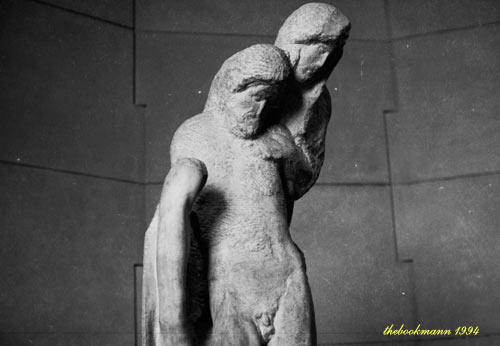
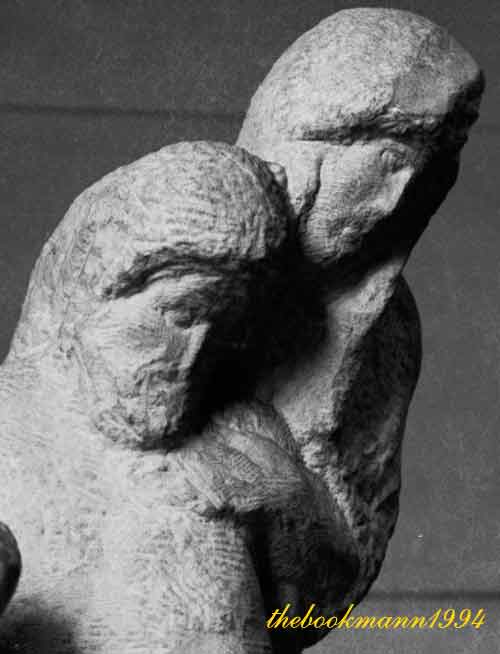
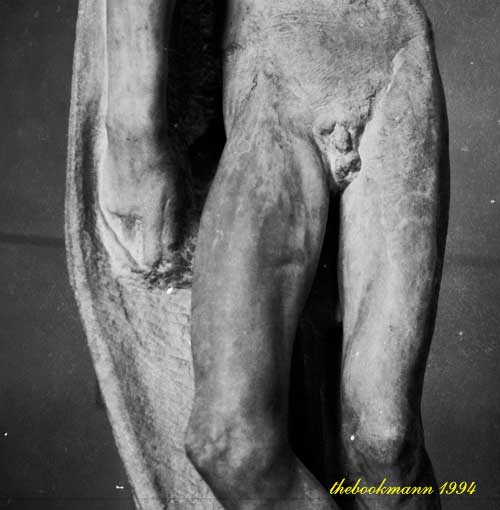
Incomplete, Pietà Rondanini, 1564. Marble. Castello Sforzesco, Milan, Italy.

The bookman came across his archives of photographs which in 1994, he photographed Michelangelo Buonarroti’s last incomplete sculpture, the Pietà Rondanini at the
Castello Sforzesco, Milan, Italy. This shows the desired which Michelangelo believed that one should never stop at what they are beholden to. Unlike the urge of sex which kept Pablo Picasso's desire for art going, but soon withered after his lost his virility.

A mother and child Michelangelo, love for sculpture, not painting.

Michelangelo could
carve his sculpture from a single block of marble and he could alter the form as he visualized it in the process.

Thursday, November 16, 2006

A lawnmower cut

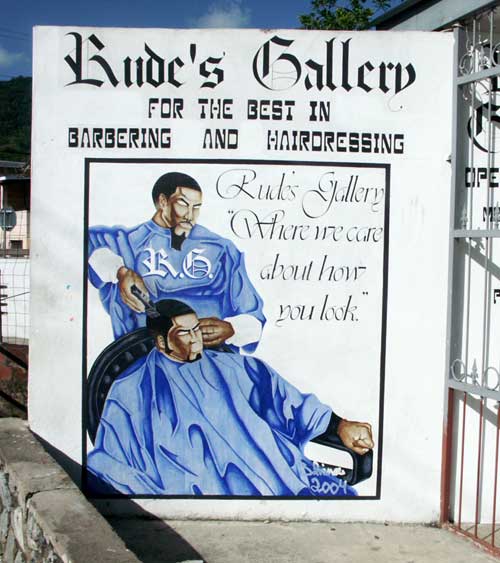
Rude's Gallery.....Where we care about how you look


This one is such a gem that I am sure that I possibly left smoke marks on the page, I was writing so fast. Alright, first of all, this painting is by someone who definitely thinks of himself as an Artist with a capital ‘A’. Secondly, he or she has put their name at the bottom of the painting and they are very pleased with their technical painting skills and belief that they understand human anatomy.

The typography is out of this world! Is the artist assuming that it will be read? Rude’s Gallery for the best in barbering and hairdressing then inside the frame, Rude’s Gallery and in quotes,” Where we care about how you look.” RG is serious! Can’t you see the initials on the front of his apron? It is the only part that is not affected by folds. But did he or she care about how the sign really looks? I cannot get over the person in the barber’s chair brown knuckling his way through a haircut that looks more like a lawnmower cut than something that is being handled skilfully. But not only the client is grimacing, the barber is also biting his lower lip, but then that may concentration, and in that case, I’m sorry dear Artist for poking fun at that. That is likely genuine. - Adele


A wall painting of a Barbering shop, note the detail in the blue apron, Diego Martin, Trinidad, West Indies.

Wednesday, November 15, 2006

Andrew Warhola – Andy Warhol

This summary is not available. Please click here to view the post.

Tuesday, November 14, 2006

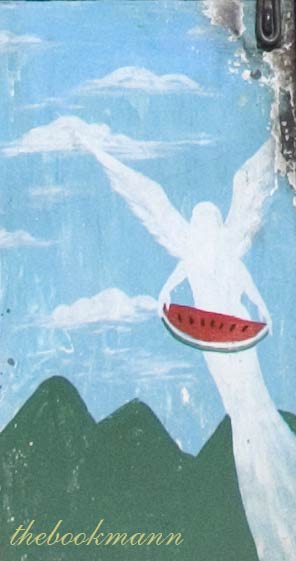
Watermelon from the Gods


Public Art as a shed, St. Joseph, Trinidad

This fruit vendor has commissioned a painting by an artist named T. Millette. Millette has a flair for fruits, flowers, wild life and Jah's blessings which completely surrounds the shed and is part of the canopy. There is poetic side to him as he paints an angel that brings a mouth watering slice of watermelon to thee.


Over the Trinity hills of Trinidad, a slice of watermelon is brought forth by the Gods on an abandoned fruit shed, St. Joseph or a place known by the locals as Small Boats, Trinidad West Indies.

Wednesday, November 08, 2006

Vintage On The Streets

Get the Lion to share your driving fun.....take the saucy, import Anglia full of fire, fancy free and no heating problems ....Go ahead - Challange anything in the Anglia class...quoted from a British 1960 Ford print Ad


.
A two tone British Ford 1960 Anglia two door sedan on the streets of Port of Spain

This is an untarnished blue and white tone British Ford 1960 Anglia two door sedan with an unusual contour that looks like a boat with a cabin incorporating fins as taillights. It shows the pride the owner has taken to restore it and in classical terms it would out do any new Mersedes-Benz on the road.

Tuesday, November 07, 2006

Friday, November 03, 2006

In Search Of ........Galvanize

Finding truth no matter the lie.....


A painting by a street artist on a coconut vendor's cooler around the Queen's Park Savannah, Trinidad, West Indies, 2006

Words rightly put by a street artist, where did we go wrong and why was the art project Galvanize visibly absent, and why did it faltered to ignite any public interest but to soured many of the Artists who took part.

Here are a few clues:

1. If you were told there was more to see but the space was inaccessible to the public. What would you say?

2. If you are told that a video installation is up in a restaurant in Port of Spain and you took the time to go here and nothing is up, and no one in the place knew anything about it. What would you think?


A stencil by Sabrina Charran on a subject too common


3. If you were told that site specific art would be placed in abandoned areas. Where should you look?

4. If you walked across a busy roadway and the gates to a proposed exhibition were closed with no posted apologies. How would you feel?

5. If you had the support of the Art community, an Art organization, television and print media, but still was incapacitated to arouse any public interest. What do you think the agenda of the project was in the first place?


A copy of Nicolai Noel's work stenciled against a wall fifty feet from the street in a abandon lot in Port of Spain filled with garbage. - Was the public expected to walk through the fith to see the small insignificant stencil ?

The project was a big undertaking by the parties involved, and I am unsure whether the objectives were met. Nontheless, the concept in theory was worth attempting. I must state that thebookmann and Adele approached Mr. Lewis regarding the plans for Galvanize as we found that what they intended was extremely close to what thebookmann has been doing for over a year without funding. We suggested video projections of elements from the blog, to be transmitted throughout Port-of-Spain and environs. Unfortunately our suggestion came a little too late, and we were not included. It is essential to make this clear as I continue because contrary to how this maybe perceived, a project like Galvanize is looked upon with optimism, hope and excitement. Such activities are sadly lacking generally in the art landscape of Trinidad and Tobago. In fact Galvanize did not reach (outside of Port-of-Spain or even to Tobago. (Something to seriously look at.)


Tessa Alexander's billboard was locked up in a studio where it should have been opened to the public. Why was this allowed to happen?

My concern was the difficulty I had in getting to see some of the work. for example, Tessa Alexander, Nicolai Noel and Marlon Griffith. These things can happen when an idea has not been completely ironed out. on the other hand, Jaime leeloy produced a thorough project that managed well despite some minor concerns. she was able to use an air conditioned space that she cordened off with a black cloth. She also wisely included a very thorough blog of her working process as a follow up to her work. Leaving nothing to chance. So what was the objective of Galvanize? And was it met? i believe the project helped to prove once and for all the obvious divide between Art and the public at large. it is a very real concern, and needs to be more fully addressed.


Galvanize: A six week programme held as a ‘reaction’ to
CARIFESTA promises a body of work from a group of artists that can be seen all over Port-of-Spain and environs. Oddly, the people who know about Galvanize have the same complaints about Carifesta. They don’t know where everything is located, and they don’t feel inclined to go looking either. - Adele see where it began and the Galvanize launch post. Left: Jaime leeloy's video about the role in which young women are portrayed in her society.
Wednesday, November 01, 2006

"The Inherent Nobility of Man" - A National Feat

Correcting an overdue wrong....


It was a national feat, and a well deserving heartfelt applause erupted after a replica of the mural, 'The Inherent Nobility of Man was revealed to a packed gallery where people had to stand on the periphery of the upper gallery at the National Museum in Port of Spain, Trinidad.


Breathing room - as art patrons began to venture off to see other parts of the Glenn Roopchand exhibition

Glenn Roopchand's The inherent Nobility of Man is constructed by eight large acrylic panels. The work was completed in six months. As a teenager, he was an apprentice to Carlisle Chang, and actually worked onthe original mural. 'The inherent Nobility of Man was one of the most important works since the Country's independence in 1962 and was part of arrival section of the airport.


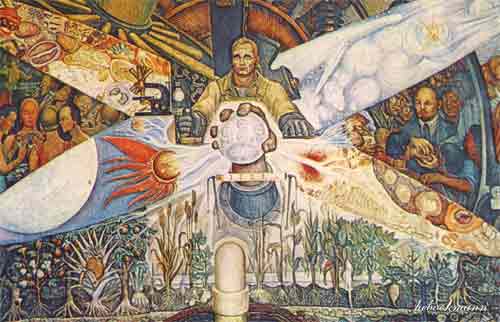
Where Mr. Chang's Influences may have be quoted - Man At The Crossroads, Diego Rivera's painted fresco commissioned for the Rockefeller Center in New York in 1934. This mural was destroyed through political circumstances.


A winged Amerindian symboling a new independence

I have written about the monumental work of theartist Carlisle Chang in the past, and in 2006 theartist and mentor of Mr. Changs’, Mr. Glenn Roopchandtook on the challenging task of recreating or more so, reinterpreting this extremely important work titled, The Inherent Nobility of Man that had been controversially destroyed in the 1970’s. What was striking about the original work to me, wasthe way that Mr. Chang used colour and form. There is an acute awareness in his work of the mural painting of artists like Diego Riviera. Mr. Chang was attempting to tell a personal story to the peoples of Trinidad and Tobago, and his image of the man ofcolour souring into the air, Icarus, struck me asquite powerful. He also explored the symbolic use of several fallen figures with a sense of despair that was quite palpable.

Although I was a child when The Inherent Nobility ofMan was destroyed, I do remember it. In fact it was one of the first local pieces of art that I remember,so it also has deeper meaning for me regarding what is considered Art of Trinidad and Tobago. I also had the pleasure of knowing Mr. Chang in his later years, and everyone knows that he had an amazing memory as well as great culinary skill. He is one of our most important artists for all that he has contributed to the vocabulary of art in this region. Fortunately many other works of Mr. Chang’s can be seen in Trinidad. In another post the bookman and I shall cover the sculpture of the island in greater depth. As I came upon the reinterpretation of The Inherent Nobility of Man by Mr. Roopchand, I was disturbed to find that the figures did not sit in space with the same cohesion as Mr. Chang’s. Although it is clear that this is the work of the pupil who has taken great pains to reproduce the original, I had some concerns .If indeed this is a copy, then it needed to be reproduced precisely.

I do not believe any such endeavour has been attempted before, and Mr. Roopchand did take on a huge task by doing the work in the first place. It is just that, asI looked away from the work, and looked at an actual Roopchand painting some feet away, I saw a much more expressive, lively and proficient work than what looked upon me.What this said to me was that, one can attempt to copy a work, but one cannot copy the energy, drive and soulof a piece. Mr. Roopchand’s efforts to right the wrong done to his teacher is definitely noteworthy, and it is important however for that aspect, and this makes it very valuable to us today and tomorrow - Adele

Disclaimer:

Views expressed on thebookmann are not affiliated with any Art Organizations and an “Art Review” may be open to interpretation as it is an observation at face value.

Amendments to such articles if misleading or with grammatical errors shall be corrected accordingly.

All photographs, Feinin studies, accompanying quotes, articles and visual headers appearing on site are the exclusive property of Richard Bolai © 2004 - 2010 All Rights Reserved.

Any fare use is restricted without written permission